Earth and climate
Farming has always been a partnership with nature, but recent shifts in meteorological patterns have changed the terms of the contract. With the jet stream becoming increasingly erratic—causing weather systems to get « stuck » over the UK for weeks at a time—the predictable seasons of the past are no longer a reliable guide. Today, successful land management requires more than just following the calendar; it demands a deep understanding of the earth systems that underpin productivity.
This resource explores the intersection of soil biology, hydrology, and atmospheric science. By shifting focus from chemistry to biology, and from fighting nature to mimicking its cycles, farmers can not only reduce input costs but also unlock new revenue streams through carbon finance and government schemes like ELMS. Here is how to build a farm that is resilient, profitable, and ready for the future.
Mastering Biogeochemical Cycles to Cut Input Costs
For decades, the solution to fertility was simple: buy it in a bag. However, with volatile fertiliser prices and tightening regulations, the focus is shifting back to the farm’s internal engines: biogeochemical cycles. Understanding how nitrogen, carbon, and water flow through your landscape is the first step toward reducing reliance on external inputs.
Optimising the Nitrogen Cycle
Nitrogen efficiency is the low-hanging fruit of farm profitability. Disruptions in this cycle—often caused by tillage or excessive synthetic application—can cost farmers significantly per hectare. The key lies in leveraging biological fixation:
- Legume Integration: Utilizing crops like white clover in permanent pasture or vetch in arable rotations can fix substantial atmospheric nitrogen. However, this process relies on specific bacteria (Rhizobia) which require micronutrients like Molybdenum to function efficiently.
- The Nitrate Mistake: Adding synthetic fertiliser to a legume crop often shuts down natural fixation. Understanding when to apply organic matter and how to quantify the N-credit for the following wheat crop is essential to avoid wasting money.
- Mineralization: Unlocking the nutrient bank already in your soil requires active biology. Unlike synthetic NPK, natural mineralization provides a slow-release feed that matches crop demand, provided the soil structure allows for adequate aeration.
Carbon Sequestration: Navigating ELMS and Credits
Carbon is no longer just a component of organic matter; it is a commodity. With the introduction of the Sustainable Farming Incentive (SFI) and other ELMS standards, sequestering carbon has become a viable income stream. However, the market is complex, and mistakes can be costly.
Building a Valid Baseline
You cannot manage—or sell—what you cannot measure. A common error is claiming credits without a scientifically valid baseline test. Whether you are aiming for private carbon markets or government funding, data integrity is paramount. Be wary of « double-counting » errors, where the same carbon unit is sold to a private buyer and claimed under a government scheme, which can disqualify you from future payments.
Practical Sequestration Strategies
Increasing Soil Organic Matter (SOM) by even a fraction of a percent is a slow process, but certain methods accelerate the gain:
- Hedgerows vs. Pasture: While permanent pasture is a stable sink, properly managed hedgerows can sequester significantly more carbon per hectare above and below ground.
- Incorporating Leys: Designing rotations that include deep-rooting herbal leys helps pump liquid carbon into the soil profile via photosynthesis, a process often more effective than simply applying compost.
- In-setting vs. Off-setting: Many experts currently recommend « in-setting »—keeping your carbon credits to offset your own farm’s emissions (like diesel and fertiliser hotspots)—rather than selling them off, ensuring you remain net-zero compliant for future supply chain requirements.
Hydrology Management: Flood Prevention and Drought Resilience
Water management in the UK is increasingly about managing extremes: flash floods in winter and drought conditions in spring. A healthy soil acts as a sponge, and managing the hydrological cycle is the best insurance policy against these variances.
Drought-Proofing Light Soils
On sandy loams and light lands, water holding capacity is the limiting factor for yield. Research suggests that a 1% increase in organic matter can hold roughly 20,000 gallons of additional water per acre. Techniques to enhance this « sponge effect » include:
- Biochar Application: acting as a coral reef for soil microbes and a physical reservoir for moisture.
- Min-Till Strategies: Ploughing in April can lead to the loss of vital soil moisture—sometimes up to 5mm per day. shifting to min-till or direct drilling preserves the capillary structure that brings water to the roots.
- Variety Selection: Choosing drought-tolerant wheat varieties specifically bred to yield on light land is becoming as important as selecting for disease resistance.
Slowing the Flow
To prevent downstream flooding liability and improve catchment health, the goal is to slow water down. « Re-wiggling » straightened rivers and installing leaky dams (often more cost-effective than concrete weirs) restores natural hydrology. Well-designed scrapes and ponds not only support biodiversity but act as buffer storage during high rainfall events.
Weatherproofing: Adapting to a Volatile Jet Stream
The « wavy » jet stream phenomenon is causing weather patterns to stick, leading to prolonged wet or dry spells. Relying on 30-year historic weather averages is arguably a historic data mistake. Adaptation requires agility and infrastructure adjustments.
Microclimates and Drilling Dates
Farmers are now having to « spread their bets » by splitting drilling dates to mitigate the risk of a wet autumn or a dry spring. Furthermore, manipulating microclimates can extend the growing season. Stone walls and water butts can act as thermal mass for polytunnels, while strategically positioned hedges can reduce wind chill without casting detrimental shade on crops. On south-facing slopes, maximizing solar gain is crucial for heat-loving crops, turning topography into a competitive advantage.
Ultimately, closing the loop on energy, carbon, and nutrients is not just an environmental aspiration; it is the primary strategy for financial resilience in modern agriculture. By treating the farm as a living ecosystem rather than a factory, you reduce exposure to global price volatility and build a legacy of fertility for the future.
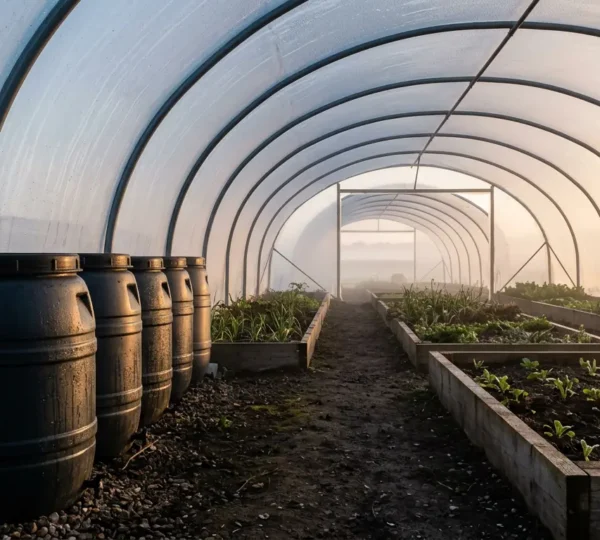
Creating Micro-Climates to Extend the UK Growing Season by 4 Weeks?
The key to extending the UK growing season isn’t fighting the weather with more plastic, but intelligently designing energy-efficient micro-systems on your land. Managing thermal mass and air drainage has a greater impact on overnight temperatures than simple insulation. Strategic…
Lire la suite
Managing the Hydrological Cycle: A Landowner’s Guide to Mitigating Downstream Flood Liability
Proactive water management is no longer an ecological option but a fundamental legal and financial risk mitigation strategy for upstream landowners. Altering natural drainage can create significant legal liability for downstream flood damage under established tort law principles. Nature-based solutions…
Lire la suite
Farm Resilience in a New Climate: A UK Farmer’s Guide to Unpredictable Springs
Relying on traditional forecasts and 30-year climate averages is now a high-risk, failing strategy for UK farming. Atmospheric blocking patterns, driven by a weaker jet stream, are creating prolonged « stuck » weather, rendering historical data unreliable. True resilience comes not from…
Lire la suite
Increasing Water Holding Capacity: How to Drought-Proof Sandy Soils?
The key to drought-proofing sandy soils isn’t just adding temporary inputs, but systematically engineering a resilient, permanent soil-water system. Focus on building stable organic matter with the goal of a 0.5% increase over 5 years. Utilize structural tools like biochar…
Lire la suite
How to Fix Atmospheric Nitrogen to Replace Bag Fertilizer on Arable Farms?
High synthetic fertilizer prices are eroding farm profitability, but relying on legumes without a clear strategy is a gamble. Biological nitrogen fixation is not passive; it’s an active system you can manage by controlling key biochemical levers like micronutrients and…
Lire la suite
Maximizing Carbon Payments: A UK Farmer’s Guide to ELMS and SFI
Successfully monetizing farm carbon is not an ecological hobby; it is a stringent financial exercise demanding rigorous evidence and compliance. Securing payments depends on a validated, unchangeable baseline soil test before any project work begins. Avoiding the « double-counting » of public…
Lire la suite
How Can UK Farmers Leverage Biogeochemical Cycles to Cut Input Costs by 20%?
The key to reducing input costs is to shift from a ‘product application’ mindset to a ‘system optimisation’ mindset, treating your soil’s nutrient cycles as a manageable financial asset. Unlocking the existing phosphorus and potassium ‘locked’ in your soil through…
Lire la suite