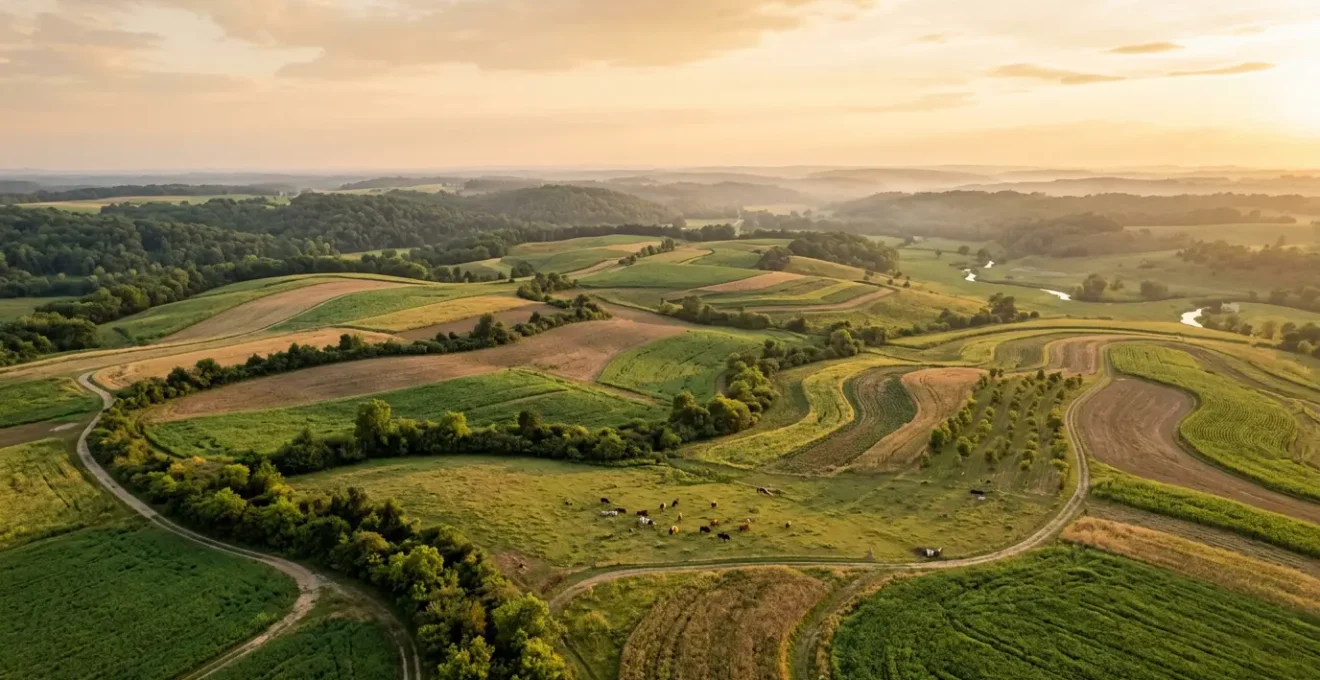
Becoming carbon-negative by 2030 is not about sacrifice; it’s about redesigning your farm into a profitable, closed-loop system.
- The biggest gains come from turning your largest emissions—synthetic fertilizer and fossil fuels—into internal assets through biological processes.
- « In-setting » carbon within your value chain to create premium products builds more long-term financial resilience than selling volatile offset credits.
Recommendation: Focus relentlessly on building soil organic matter. It’s the foundational engine for both deep carbon sequestration and unlocking stacked payments under the UK’s Environmental Land Management schemes (ELMS).
The ambition for UK agriculture to reach Net Zero by 2040 is well-established, but for progressive farmers, the real opportunity lies in moving faster and further. Achieving carbon-negative status by 2030 is not a fanciful dream; it is an achievable engineering challenge. It requires a fundamental shift in thinking: moving away from a linear model of inputs and outputs, and towards designing the farm as a closed-loop biological and economic system. This means seeing carbon not as a liability to be offset, but as the central currency of a new, resilient and highly profitable agricultural model.
Many discussions on this topic remain stuck on isolated tactics like planting trees or basic no-till. While important, these are just single components. The true transformation comes from understanding the system as a whole. It involves diagnosing your biggest carbon ‘leaks’, then re-routing those flows to build natural capital. It’s about leveraging the immense power of photosynthesis to actively pump carbon into the soil, turning a waste product of the atmosphere into the foundation of your farm’s fertility and financial future. This approach views ‘waste’ streams—be it atmospheric CO2, livestock manure, or surplus solar energy—as misplaced resources.
This blueprint moves beyond simply ‘doing less bad’. It focuses on actively ‘engineering more good’ within your own farm gate. We will explore how to tackle the primary emission hotspots, activate your farm’s own carbon-pumping biology, and adopt a smarter economic model that values your environmental assets. Finally, we will ground this strategy in the new reality of UK agricultural policy, showing how to stack payments under ELMS to finance this very transition. This is the roadmap to not just environmental stewardship, but to complete value chain sovereignty.
To navigate this complex but rewarding journey, this article breaks down the core strategies and principles. The following sections will provide a clear, actionable guide, from identifying your primary emissions to monetizing your newfound ecological assets under the UK’s new subsidy frameworks.
Summary: The Carbon-Negative Farm: A Blueprint for Closing the Loop by 2030
- Why Diesel and Fertilizer Are Your Biggest Carbon Hotspots?
- How to Use Photosynthesis to Pump Liquid Carbon into the Soil?
- In-Setting vs Off-Setting: Why Keeping Carbon Credits is Smarter?
- The Tillage Mistake That Releases Years of Sequestration in Minutes
- On-Farm Energy: How to Replace Grid Electricity to Close the Loop?
- How to Raise Soil Organic Matter by 0.5% in 5 Years on Arable Land?
- Why Pollinators and Water Filtration Are Assets on Your Balance Sheet?
- How to Maximize Carbon Sequestration Payments Under the New UK ELMS Schemes?
Why Diesel and Fertilizer Are Your Biggest Carbon Hotspots?
Before building a carbon-negative system, you must first identify the largest leaks in your current carbon cycle. For most modern farms, the two most significant sources of greenhouse gas emissions are not the cattle, but the diesel tank and the fertilizer bag. These inputs represent a massive dependency on fossil fuels, creating both economic and ecological vulnerability. Red-diesel powers the machinery that runs the farm, but it’s the synthetic nitrogen fertilizer that carries a less visible but far more potent climate impact.
The production of ammonia-based fertilizers through the Haber-Bosch process is incredibly energy-intensive. In fact, it is so demanding that global estimates suggest the Haber-Bosch process is responsible for 1% of all human-made CO2 emissions. This is the carbon cost before the fertilizer even reaches the farm gate. Once applied to the field, another, more powerful greenhouse gas is released: nitrous oxide (N2O). Through the process of denitrification in the soil, a portion of the nitrogen applied is converted into N2O.
This is a critical issue because this gas has a staggering impact on global warming. Scientific analysis shows that nitrous oxide has nearly 300 times the warming potential of CO2 over a 100-year period. Therefore, every kilogram of N2O lost from your fields is equivalent to releasing almost 300 kilograms of carbon dioxide. Tackling these two hotspots—diesel for power and nitrogen for fertility—is not just an environmental imperative; it’s the first and most critical step toward building a self-sufficient, closed-loop farm that is insulated from volatile external input costs.
By designing a system that generates its own fertility and power, you are not just cutting emissions; you are plugging the biggest financial drains in your operation.
How to Use Photosynthesis to Pump Liquid Carbon into the Soil?
The most powerful carbon capture technology on the planet is not in a factory; it is already at work in your fields. Photosynthesis is the engine of life, but its role in carbon sequestration is often misunderstood. It’s not just about the carbon stored in the plant’s physical biomass. The real, long-term sequestration happens underground, through a dynamic process we can call the liquid carbon pathway. This is where plants, in partnership with soil biology, actively pump carbon deep into the soil profile.
Here’s how it works: through photosynthesis, plants convert atmospheric CO2 into liquid carbon in the form of sugars (exudates). They then send up to 40% of these sugars down through their roots and out into the surrounding soil. This is not waste; it is a deliberate transaction. The plant is feeding the vast underground economy of microbes, particularly mycorrhizal fungi. These fungi form a symbiotic relationship with the plant roots, creating a vast network of fine threads (hyphae) that extend far beyond the reach of the roots themselves. In exchange for the liquid carbon, the fungi transport crucial nutrients like phosphorus and water back to the plant.
This process is the single most effective way to build stable, long-lasting soil carbon. The fungi use the carbon to create glomalin, a sticky substance that binds soil particles together, forming stable aggregates. This locks carbon away physically, protecting it from being released back into the atmosphere. The scale of this underground carbon flow is immense; global research estimates mycorrhizal fungi receive 13 Gt of CO2 equivalent annually from plants, representing over a third of all fossil fuel emissions. By managing your farm to enhance this natural pathway—using diverse cover crops, reducing soil disturbance, and minimizing synthetic inputs—you are turning your entire farm into a highly efficient carbon pump.

As the illustration shows, this intricate network is the biological infrastructure of a healthy, carbon-rich soil. Supporting this living ecosystem is the key to sequestering carbon for the long term, far more effectively than simply burying biomass. It is the foundation of a truly regenerative and carbon-negative system.
By fostering this symbiotic relationship, you are not just storing carbon; you are actively building the fertility, structure, and water-holding capacity of your most valuable asset: your soil.
In-Setting vs Off-Setting: Why Keeping Carbon Credits is Smarter?
As farms begin to successfully sequester carbon, a new economic question arises: what to do with this newly created environmental asset? The most common answer is « offsetting »—selling carbon credits on a voluntary market to corporations looking to offset their own emissions. While this can provide an income stream, a far smarter, more strategic long-term approach is « in-setting ». This means keeping the carbon asset within your own value chain, using it to create carbon-negative products that command a premium price.
Offsetting effectively sells your environmental story to another company. You do the hard work of sequestration, but they get to claim the carbon-neutral or negative status. In-setting, by contrast, is about investing in your own operation to reduce emissions and increase sequestration, and then leveraging that achievement to build your own brand’s value. It transforms carbon from a simple commodity to be sold off, into a core feature of your product’s identity and quality. As the International Platform for Insetting, quoted by the World Economic Forum, states:
Insetting focuses on doing more good rather than doing less bad within one’s value chain.
– International Platform for Insetting, World Economic Forum – Carbon insetting vs offsetting explainer
This model creates value chain sovereignty. You own the narrative, you control the asset, and you build direct relationships with consumers willing to pay more for verifiably sustainable products. This creates a more stable and predictable income stream, insulated from the volatility of carbon markets, and directly rewards continuous improvement on the farm.
Case Study: FrieslandCampina’s In-Setting Model
A powerful example of this strategy is the Dutch dairy cooperative FrieslandCampina. Rather than encouraging farmers to sell credits externally, they invested €245 million in a performance-based insetting model. Farmers are paid a fixed bonus per litre of milk for meeting specific sustainability criteria, such as reduced methane emissions and improved manure management. This approach directly integrates the cost and value of sustainability into the price of milk itself. It rewards farmers for their actions, creates a predictable income, and allows the cooperative to build immense brand equity around its portfolio of carbon-negative dairy products.
By choosing in-setting, you are betting on your own brand and the growing consumer demand for authentic, climate-positive food. It’s a transition from being a raw material supplier to a producer of high-value, branded environmental goods.
The Tillage Mistake That Releases Years of Sequestration in Minutes
Building soil carbon is a slow, patient process. It can take years of careful management—cover cropping, reduced inputs, and fostering microbial life—to accumulate significant organic matter. Unfortunately, all that hard work can be undone in a matter of minutes by one single action: conventional tillage. Ploughing, discing, and harrowing are the agricultural equivalent of an earthquake, a forest fire, and a hurricane combined for the soil ecosystem.
Healthy, carbon-rich soil is not just dirt; it’s a structured environment built on aggregates. These are small clumps of soil particles held together by biological glues, primarily from fungal hyphae and bacterial secretions. Within these aggregates, particles of organic matter (carbon) are physically protected from decomposition and release. This stable structure is the vault where your carbon is safely stored. Tillage, however, shatters these aggregates, instantly exposing the protected carbon to oxygen and microbial attack. This triggers a massive burst of CO2 release, like opening the doors of the vault and letting the contents blow away in the wind.
The visual impact is stark. A single pass with a plough can release carbon that took a decade to sequester. This is why transitioning to zero-tillage or minimum-tillage systems is non-negotiable for any serious carbon farming enterprise. It is the practice that protects your primary investment. While the transition can present challenges, such as requiring specialised drilling equipment and a different approach to weed management, the long-term benefits are overwhelming. It not only preserves your carbon stores but also dramatically improves soil structure, water infiltration, and resilience to drought, ultimately reducing costs and building a more stable production system.

The image above perfectly captures the destructive power of tillage. On one side, you see the intact, dark, aggregated soil of a no-till system, full of life and locked-in carbon. On the other, the pulverized, light-coloured, and exposed soil post-tillage, ready to release its carbon legacy into the atmosphere.
Protecting the soil from physical disturbance is the foundational principle upon which all other carbon-building strategies must be built. It is the act of conservation that makes accumulation possible.
On-Farm Energy: How to Replace Grid Electricity to Close the Loop?
The second major carbon hotspot after synthetic fertilizer is the farm’s reliance on external energy, from diesel in the tractors to electricity from the grid. Closing the carbon cycle requires also closing the energy loop. The goal is to transform the farm from a net consumer of energy into a self-sufficient energy producer, using its own biological outputs as feedstock. This creates what can be called an energy-nutrient nexus, where waste streams are converted into power, and the byproducts of power generation are returned to the soil as valuable nutrients.
The two most powerful technologies for achieving this on a farm are anaerobic digestion (biodigesters) and agrivoltaics. A biodigester takes organic ‘waste’ like livestock manure, slurry, and crop residues and, in an oxygen-free environment, uses microbes to break it down. This process produces biogas (primarily methane), which can be used to power a generator for on-site electricity or even be upgraded to biomethane to fuel farm vehicles. The critical co-product is the digestate, a nutrient-rich, stable, and biologically active liquid fertilizer that can be applied to fields, replacing the need for synthetic inputs. This single process turns a waste management problem (manure) into a solution for both energy and fertility.
Agrivoltaics, or the co-location of solar panels and agricultural activities, provides a complementary energy source. Modern designs allow for solar arrays to be raised high enough for machinery to pass underneath or spaced to allow for grazing. This dual-use approach not only generates clean electricity but can also create beneficial microclimates, providing shade that reduces heat stress in livestock and lowers soil moisture evaporation. By combining these technologies, a farm can progressively electrify its operations, powering them with its own renewable energy and fertilizing its crops with its own recycled nutrients. A prime example of this can be seen in Juhnde, Germany, where a village-level biogas plant converts farm waste into energy for both agricultural operations and local homes, demonstrating a scalable closed-loop model.
This strategy doesn’t just cut carbon emissions; it provides ultimate energy independence, insulating the farm from rising fuel prices and creating a profoundly resilient and self-sustaining operation.
How to Raise Soil Organic Matter by 0.5% in 5 Years on Arable Land?
The strategic goal of increasing soil organic matter (SOM) is the engine of a carbon-negative farm. A target of raising SOM by 0.5% over five years on arable land is ambitious but achievable with a dedicated, multi-faceted approach. This isn’t about a single practice, but a rotational strategy that combines continuous living cover, strategic animal impact, and microbial support systems. This directly drives the liquid carbon pathway, building deep, stable carbon reserves while enhancing fertility and resilience.
The foundation of this strategy is to eliminate fallow periods. Bare soil is a liability; it is bleeding carbon, water, and nutrients. The first step is implementing diverse, multi-species cover crops immediately after the cash crop harvest. A mix of legumes (for nitrogen fixation), brassicas (for breaking up compaction), and grasses (for fibrous root mass) creates a diverse diet for the soil microbiome, accelerating the carbon-pumping process. Practices like no-till farming are crucial here, as they can sequester up to 0.5 metric tons of carbon per hectare annually by protecting the soil structure built by these roots.
Integrating livestock through managed or ‘mob’ grazing on these cover crops introduces another powerful accelerator. The animals’ manure and urine provide a rich source of nutrients, their trampling action incorporates the plant matter into the soil surface, and their saliva can even stimulate plant regrowth. For long-term gains, rotating sections of arable land into multi-year perennial leys (e.g., deep-rooting alfalfa or clover mixes) allows for an undisturbed period of massive root development and carbon accumulation. Finally, targeted amendments like biochar, a stable form of carbon, can act as a permanent scaffold for microbial life, further locking carbon in place for centuries.
Your 5-Year Action Plan: Building Soil Organic Matter
- Year 1: Baseline & Diversity. Conduct thorough soil organic carbon testing to establish a firm baseline. After the main harvest, plant a diverse cover crop mix of at least 12 species, including legumes, brassicas, and grasses, to feed soil biology.
- Year 2: Animal Impact. Implement high-density, short-duration mob grazing with livestock on the cover crops. This adds a powerful pulse of manure and trampling action, which rapidly accelerates the decomposition and integration of organic matter.
- Year 3: Go Perennial. On rotational sections of your land, transition to a multi-year perennial ley, such as a deep-rooting alfalfa and clover mix. This allows undisturbed root systems to build stable carbon deep in the soil profile.
- Year 4: Add Scaffolding. Apply a soil amendment of biochar (5-10 tons/hectare) combined with compost. The biochar acts as a permanent, porous ‘reef’ for microbial life, creating a long-lasting structure for carbon storage.
- Year 5: Lock It In. Return to cash cropping using strict zero-tillage practices. Maintain continuous soil cover through strategies like undersowing the cash crop to preserve the organic matter you have painstakingly accumulated.
By following this rotational plan, you are not just increasing a number on a soil test; you are fundamentally re-engineering the fertility, water-holding capacity, and profitability of your land from the ground up.
Why Pollinators and Water Filtration Are Assets on Your Balance Sheet?
A truly carbon-negative farm understands that carbon is just one part of a much larger portfolio of valuable ecological assets. The same practices that build soil carbon—such as planting diverse cover crops, restoring hedgerows, and reducing chemical inputs—also generate a suite of valuable ecosystem services. Historically, these benefits like pollination, natural pest control, and clean water have been seen as positive side effects. The modern, closed-loop farm, however, must view them as tangible, monetizable assets that belong on the farm’s balance sheet.
Think of it this way: a wildflower margin isn’t just a pretty border; it’s a factory producing wild pollinators that directly increase the yield of nearby crops. A restored hedgerow is not just a fence; it’s a habitat for predatory insects that reduce the need for expensive pesticides. And high-organic-matter soil is not just fertile ground; it’s a giant sponge that stores water, reduces flooding risk downstream, and filters nutrients, preventing costly runoff. Each of these functions has a real, quantifiable economic value, either through direct yield increases, cost savings, or, increasingly, direct payments through environmental schemes.
Quantifying this value is the first step to managing it. By measuring the impact of these services, you can make a powerful business case for regenerative practices. This shifts the conversation from « How much does it cost to plant a hedgerow? » to « What is the return on investment from our natural pest control asset? » The table below, drawing on data synthesized from various ecological studies, breaks down the potential economic value of these services, demonstrating how natural capital translates directly into financial capital.
The following table outlines the significant financial contributions that well-managed ecosystems can provide on a per-hectare basis, as demonstrated by a synthesis of data from ecological-economic studies.
| Ecosystem Service | Mechanism | Economic Value (per hectare/year) | Measurement Method |
|---|---|---|---|
| Pollination | Wild pollinators increase crop yields by 20-30% for pollinator-dependent crops | $200-$500 | Yield comparison with/without pollinator habitat |
| Natural Pest Control | Predator populations reduce pesticide need by 15-25% | $150-$300 | Cost savings from reduced chemical inputs |
| Water Storage & Filtration | Soil organic matter acts as sponge, storing water and filtering nutrients | $100-$400 | Flood mitigation value + water quality improvement |
| Carbon Sequestration | Soil carbon storage in high-SOM systems | $50-$200 (at $30/ton CO2) | Soil carbon testing + carbon market pricing |
| Erosion Prevention | Ground cover and root systems prevent topsoil loss | $80-$250 | Replacement cost of lost topsoil nutrients |
When you begin to manage your farm not just for crop yield but for the health of its entire ecosystem, you unlock multiple, stacked revenue streams and build a business that is resilient in every sense of the word.
Key Takeaways
- Becoming carbon-negative is an economic strategy, not just an environmental one, focused on creating closed-loop systems for nutrients and energy.
- In-setting (using your carbon status to create premium products) offers greater long-term value and sovereignty than selling offset credits.
- The UK’s ELMS offers a direct financial pathway to fund this transition by « stacking » payments for multiple ecological outcomes on the same parcel of land.
How to Maximize Carbon Sequestration Payments Under the New UK ELMS Schemes?
The transition to a carbon-negative farming system requires investment. Fortunately, the UK’s post-Brexit agricultural policy, the Environmental Land Management schemes (ELMS), is specifically designed to reward farmers for delivering the very public goods we have discussed: clean air, clean water, thriving wildlife, and, critically, climate change mitigation. The key to maximizing revenue from ELMS is to move beyond applying for single actions and instead adopt a « stacking » strategy, where multiple schemes and payments are layered onto the same piece of land.
This strategy aligns perfectly with the closed-loop model. The same practices that build soil carbon also improve water quality and create habitats. Under ELMS, you can get paid for all of these outcomes simultaneously. For example, on a single arable field, you could claim a Sustainable Farming Incentive (SFI) payment for implementing a no-till system and planting a multi-species cover crop. Along the edge of that same field, you could enter a Countryside Stewardship agreement to receive a grant for planting a new, diverse hedgerow, which sequesters carbon, provides a wildlife corridor, and hosts beneficial insects.
On less productive areas of the farm, you could go a step further and create or restore habitats like woodlands or wetlands to generate Biodiversity Net Gain (BNG) credits, which can be sold to developers. As a guide from the AHDB highlights, the foundation for all of this is robust data. To successfully stack these schemes and prove « additionality » (that your actions are delivering new benefits), you must start with a comprehensive baseline audit of your soil carbon, biodiversity, and water quality. Meticulous record-keeping is non-negotiable. This data not only unlocks ELMS payments but also positions you to access potentially more lucrative private markets for carbon and biodiversity as they mature.
To begin this transformation, the next logical step is to establish your baseline: a comprehensive audit of your carbon hotspots and soil organic matter. This data is the foundation of your new balance sheet and your passport to the future of agricultural payments.