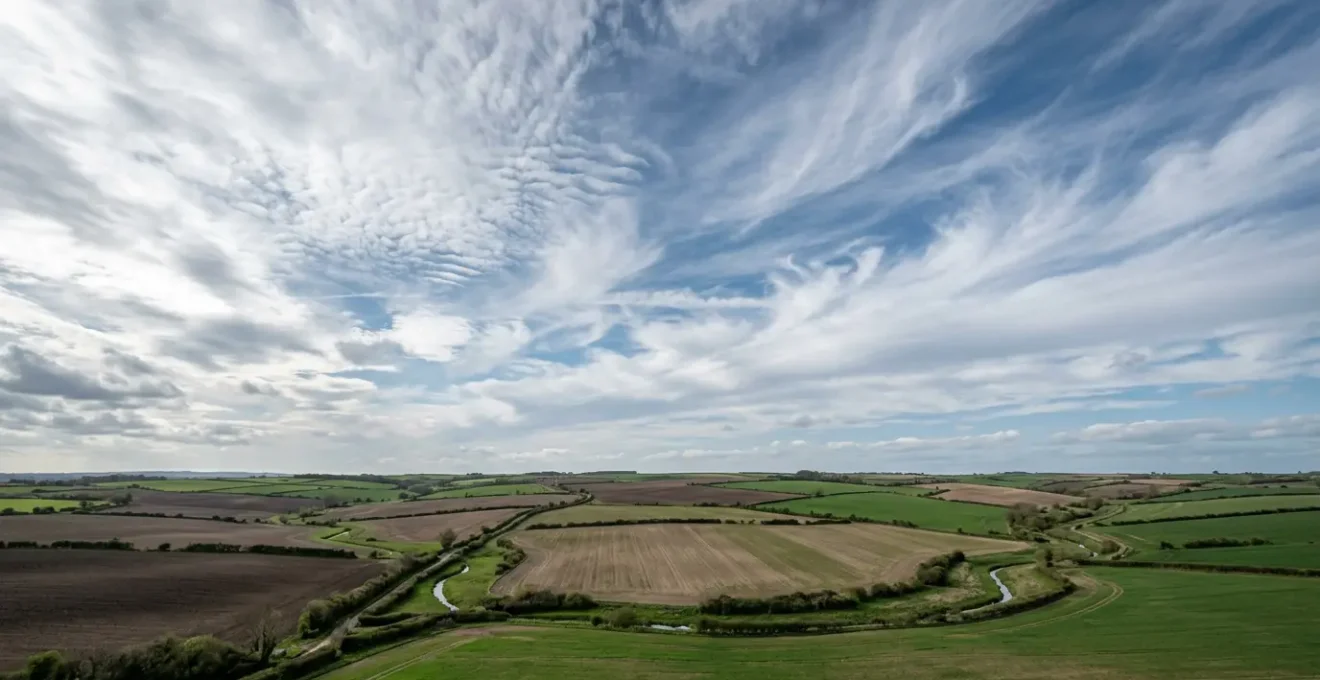
Relying on traditional forecasts and 30-year climate averages is now a high-risk, failing strategy for UK farming.
- Atmospheric blocking patterns, driven by a weaker jet stream, are creating prolonged « stuck » weather, rendering historical data unreliable.
- True resilience comes not from guessing the weather, but from engineering your farm’s physical systems to absorb volatility—from soil hydrology to machinery load.
Recommendation: Shift from reactive planning based on forecasts to proactive system design that builds in buffers against both extreme wet and dry conditions.
For UK farmers, the rhythm of the seasons feels broken. The familiar cadence of a wet winter giving way to a workable spring has been replaced by a jarring sequence of extremes: waterlogged fields that persist into April, followed abruptly by dry, hard-baked soils in May. This meteorological whiplash makes planning planting windows a high-stakes gamble. The common advice—to follow long-range forecasts, choose resilient varieties, or simply ‘improve soil health’—feels increasingly inadequate. These platitudes fail to address the fundamental shift occurring in our climate system.
The problem isn’t just that the weather is changing; it’s that its very behaviour has become more volatile and persistent. This isn’t about simply getting more rain or more sun; it’s about getting stuck in patterns of relentless wet or prolonged drought. But what if the key to navigating this new reality wasn’t about becoming a better weather forecaster? What if true resilience lies in becoming a better farm systems engineer? This guide moves beyond guesswork and into the physics of agricultural adaptation. We will deconstruct the atmospheric forces causing this volatility and provide pragmatic, risk-averse strategies to re-engineer your operations.
This article provides a blueprint for building systemic resilience. We will explore the atmospheric science behind stuck weather patterns, analyse the tactical advantages of split drilling, compare the ground-level impact of tracks versus tyres, and reveal why historical data is now a dangerous trap. By understanding the interconnected mechanics of your farm—from the sky to the soil—you can build a more robust and predictable business in an unpredictable world.
Summary: Farm Resilience in a New Climate: A UK Farmer’s Guide to Unpredictable Springs
- Why a Wavy Jet Stream Causes Stuck Weather Patterns Over the UK?
- How to Split Drilling Dates to Spread Weather Risk?
- Tracks vs Tyres: Which Buy You More Days in the Field?
- The Historic Data Mistake: Why 30-Year Averages Are No Longer Reliable
- Drainage Maintenance: How to Prepare Ditches for Flash Floods?
- Why Soil Biology Goes Dormant Below 6°C and What It Means for Crops?
- The Field Drain Mistake That Accelerates Flooding Downstream
- Designing Climate-Smart Systems to Buffer Extreme Rainfall Events in the North?
Why a Wavy Jet Stream Causes Stuck Weather Patterns Over the UK?
The root cause of the UK’s increasingly erratic weather isn’t random chance; it’s a change in large-scale atmospheric physics. The jet stream, a high-altitude river of air, is the primary driver of our weather systems. Historically, it has flowed in a relatively straight, zonal path, pushing weather systems across the UK at a steady pace. However, as the Arctic warms faster than the equator, this temperature differential weakens, causing the jet stream to become slower and more meandering, or « wavy. » This is where the problem of « stuck » weather originates.
When the jet stream’s waves become large and amplified, they can effectively lock a weather pattern in place over a region for days or even weeks. This phenomenon is known as an atmospheric ‘blocking pattern’. Instead of a mix of sunshine and showers, the UK now experiences prolonged, monotonous conditions. According to research on jet stream dynamics, these blocking patterns cause prolonged dry spells, extended periods of rain, or lengthy heatwaves. This is why we see waterlogged fields for weeks on end, followed by a sudden switch to a mini-drought.
This increased waviness makes forecasting far more difficult. As experts at WeatherEngland note, « When the jet stream becomes weak or highly wavy, uncertainty increases because small atmospheric changes can alter system movement. » For a farm manager, this means that relying on a five-day forecast is no longer enough. The strategic imperative shifts from predicting the weather to building a farm system that is resilient to these prolonged, single-state weather events. Understanding this macro-climatic driver is the first step in developing effective, on-the-ground mitigation strategies.
How to Split Drilling Dates to Spread Weather Risk?
Faced with unpredictable planting windows, the single biggest tactical shift a farmer can make is to abandon the « all-or-nothing » approach to drilling. Instead of aiming for one « perfect » drilling date, a strategy of temporal arbitrage—splitting the drilling process into two or three distinct windows—is a powerful risk management tool. This deliberately diversifies your crop’s establishment phase against the risk of a sudden weather shift, ensuring that not all your assets are exposed to the same environmental stress at the same critical time.
This isn’t just theory; it’s a calculated trade-off. While conventional wisdom suggests drilling early for maximum yield potential, recent weather volatility has flipped this logic on its head. Delaying drilling does come with a measurable yield penalty under « normal » conditions. For example, an analysis of 82 Recommended List varieties from 2010-14 revealed a 0.27% yield loss per day after September 1st. However, this calculated loss is often far smaller than the catastrophic losses incurred from a muddled-in early crop that succumbs to waterlogging, compaction, or high pest and disease pressure.
The interaction between drilling date, variety, and growing conditions is a complex one, where spending more on inputs cannot always rescue a poor start. This concept is visualized below, showing how risk can be distributed over time.

As the image suggests, by creating multiple establishment points, you are building a portfolio of risk. If one window fails, the others may thrive. This approach requires more logistical planning but provides a critical buffer against the kind of total crop establishment failure that is becoming more common.
Case Study: The NIAB Drilling Date and Variety Trial
NIAB trials exploring the interaction between drilling date and variety found up to a 5t/ha yield difference. When comparing winter wheat varieties across multiple drilling dates, the results were stark: even with the highest level of fungicide protection, early-drilled crops often struggled to match the yields of later-drilled plots due to intense pest and disease pressure. The trial conclusively demonstrated that the timing of drilling and a variety’s genetic resistance are now more decisive for final yield than chemical expenditure alone.
Tracks vs Tyres: Which Buy You More Days in the Field?
The decision between tracks and tyres is no longer just about traction; it’s a strategic investment in operational days. In a climate where workable field days are scarce and precious, the ability to travel on wet ground without causing long-term damage is paramount. This is a question of managing hydro-mechanical stress—the combined impact of water saturation and machine weight on soil structure. While tracks are often seen as the ultimate solution for flotation, the reality is more nuanced and depends heavily on machine configuration and soil conditions.
The primary advantage of tracks is their large footprint, which reduces surface pressure and provides superior traction in wet, slippery conditions. However, this comes with a significant trade-off: deep compaction. Tracked machines are inherently heavier, and this extra weight can create compaction layers 60-80cm deep, far below the reach of conventional tillage. Conversely, modern Very High Flexion (VF) and Increased Flexion (IF) tyres, when run at the correct low pressures, can offer comparable or even better surface pressure distribution. As a comparative analysis shows, the choice is not simple.
The following table, based on data from agricultural engineering studies, breaks down the key performance differences. As confirmed by a comprehensive comparison of tracks and VF tyres, the optimal choice depends on balancing upfront cost, fuel efficiency, and the specific type of compaction risk you face.
| Factor | Rubber Tracks | VF/IF Tyres (Properly Inflated) |
|---|---|---|
| Surface Compaction | Reduced surface pressure (large footprint) | Comparable at 0.8-1.2 bar; even distribution across contact area |
| Deep Compaction (60-80cm) | Higher risk due to 20-30% additional vehicle weight | Lower risk with lighter overall machine weight |
| Slip Ratio | 5% (excellent traction in wet conditions) | 10-20% depending on soil moisture |
| Fuel Efficiency | 15% higher fuel consumption due to track flexing | Lower fuel consumption on hard surfaces |
| Initial Investment | Significantly higher upfront cost | Lower cost; wider range of options |
| Maintenance | Complex; replacement expensive | Easier; pressure management critical |
| Operational Days Gained | Better flotation in extreme wet conditions | Comparable with CTIS; excellent in dry/moderate conditions |
Ultimately, a Central Tyre Inflation System (CTIS) on a machine with VF tyres may offer the most versatile solution, providing low pressure in the field and high pressure on the road, minimising both surface and deep compaction. The key takeaway is that tyre pressure management is now as critical as the choice of tyre itself. An overinflated high-tech tyre behaves no better than a basic cross-ply, negating the entire investment.
The Historic Data Mistake: Why 30-Year Averages Are No Longer Reliable
For generations, farm planning has been anchored in the concept of 30-year climate averages. These historical benchmarks for rainfall, temperature, and growing degree days formed the basis for everything from crop selection to insurance calculations. Today, clinging to this data is not just outdated; it’s actively dangerous. The rate of climate change has accelerated to the point where the « average » of the last 30 years bears little resemblance to the reality of the last five. This creates a critical data-fidelity failure at the heart of farm strategy.
The recent past provides stark evidence of this departure from the historical norm. According to climate records, 1,696mm of rain fell across England between October 2022 and March 2024, making it the wettest 18-month period since records began in 1836. This is not a statistical blip; it’s a new paradigm. Basing drainage capacity, drilling schedules, or variety choices on data from the 1990s or early 2000s means you are engineering your farm for a climate that no longer exists.
The trend is equally clear with temperature. The Met Office’s own data highlights this rapid acceleration. This shift invalidates long-term planning that assumes a stable, predictable climate cycle. It demands a move towards more flexible, adaptive strategies that are responsive to short-term volatility rather than long-term averages.
The last 10 years have seen 2% more growing degree days per year on average compared with the most recent 30-year average (1991 to 2020), and 17% more when compared with the previous 30-year average (1961 to 1990).
– Met Office, State of the Climate UK Report via ONS Climate Change Insights
The pragmatic approach is to treat historical data with extreme caution. Instead, focus on building systemic resilience that can buffer a wider range of outcomes. This means investing in soil structure that can handle both inundation and drought, and machinery that can operate in marginal conditions, rather than betting the farm on the hope that next year will be « average. »
Drainage Maintenance: How to Prepare Ditches for Flash Floods?
With prolonged rainfall events becoming more common, farm drainage systems are being pushed beyond their original design capacity. The focus of maintenance must shift from simply getting water off the land to managing its flow during peak events. A blocked ditch or a collapsed outfall during a flash flood can turn a manageable rainfall event into a catastrophic field inundation. Proactive, year-round maintenance is no longer a « nice-to-have »; it’s a critical component of risk management, ensuring the system functions at 100% capacity when it is most needed.
Effective preparation starts with a systematic audit of the entire drainage network, from field drains to main river outfalls. This involves more than a quick glance from the tractor cab. It means walking the ditch lines, identifying blockages from silt or vegetation, checking for signs of bank erosion, and ensuring culverts are clear of debris. In the face of intense rainfall, every bottleneck in the system reduces its overall capacity, increasing the risk of water backing up and flooding valuable cropping land. The goal is to create a clear, unobstructed pathway for water to exit the farm as efficiently as possible.
However, simply moving water off your land quickly is only half the battle. Modern drainage strategy also involves improving the soil’s ability to absorb and hold water in the first place, reducing the volume that needs to be drained. This requires a holistic approach that integrates drainage maintenance with soil structure management. Reducing compaction is the single most effective way to increase infiltration and reduce surface runoff, taking pressure off the ditch and pipe system during a storm.
Action Plan: Preparing Your Land for Extreme Weather
- Assess Compaction Risk: Avoid working soils with heavy equipment when they are wet. Use a penetrometer to confirm the location and depth of any existing compaction before taking action.
- Reduce Field Passes: Combine operations where possible to reduce the number of times machinery travels across fields, concentrating traffic to fewer lanes.
- Optimise Machinery Setup: Consider fitting rubber tracks or correctly inflated VF/IF tyres to tractors and combines to reduce ground pressure. Explore Controlled Traffic Farming (CTF) to confine compaction to permanent tramlines.
- Enhance Soil Resilience: Implement rotational management techniques, including the use of cover crops with deep rooting systems, to improve soil structure and organic matter.
- Subsoil Strategically: Only subsoil when conditions are right (i.e., when the soil is dry enough to fracture) to avoid smearing and making compaction worse. Never run heavy equipment on freshly loosened soil.
Why Soil Biology Goes Dormant Below 6°C and What It Means for Crops?
The challenges of a wet, cold spring extend far beneath the surface. While we focus on waterlogging and field access, a critical process is shutting down in the soil itself: biological activity. The vast ecosystem of microbes, fungi, and other organisms responsible for nutrient cycling and soil structure effectively enters a state of dormancy when soil temperatures drop below approximately 6°C. This has profound implications for crop establishment and early-season vigour.
When soil biology is dormant, key processes halt. The mineralisation of nitrogen from organic matter stops, meaning the soil’s natural supply of this crucial nutrient is locked away. This makes young plants entirely dependent on applied fertilisers, which themselves can be less effective in cold, saturated soils. Furthermore, the beneficial relationship between plant roots and mycorrhizal fungi, which help with the uptake of phosphorus and other micronutrients, is severely inhibited. The result is a hungry, struggling crop, even in a field with theoretically adequate fertility.
The macro view of soil below reveals the complex world that becomes inactive in the cold. It’s a reminder that soil is not an inert medium but a living system.

As the image illustrates, the intricate network of pores and aggregates that support life is still there, but the engine has stalled. This biological shutdown is why crops planted into cold, wet seedbeds often appear yellow and stunted. They are not just suffering from a lack of oxygen at the root zone; they are also starved of the bio-available nutrients that a healthy, active soil microbiome would provide. This underscores the importance of waiting for soil temperatures to rise, not just for surface conditions to dry. Forcing a crop into a biologically inert seedbed is a recipe for a poor start that can cap yield potential for the rest of the season.
The Field Drain Mistake That Accelerates Flooding Downstream
For decades, the goal of field drainage was simple: get water off the land as fast as possible. This approach, however, is a major contributor to a wider, systemic problem. By designing systems that « firehose » water from fields into ditches and then into rivers, we solve a local problem (a waterlogged field) by creating a much larger one downstream (flash flooding). The common mistake is focusing on exit velocity rather than on flow velocity control. The most damaging element in this system is often the most overlooked: the compacted farm tramline.
On sloping arable land, compacted wheelings act as artificial channels. They prevent water from infiltrating the soil profile and instead concentrate it, accelerating its journey towards the nearest drain or ditch. In fact, research has demonstrated that up to 80% of runoff in arable fields on sloping land comes directly from these compacted tramlines. This rapid runoff carries with it valuable topsoil and expensive inputs, while also overwhelming local watercourses and contributing to flood risk for communities downstream. It is a costly mistake for both the farmer and the wider environment.
The financial impact of compaction goes far beyond increased flood risk. It is a direct drain on farm profitability, reducing yields and increasing costs. Mitigating it is not an environmental charity; it is a sound economic decision.
Economic Impact of UK Soil Compaction
The true annual cost of soil compaction to UK agriculture is estimated at a staggering £350 to £500 million. Extensive research has proven that compaction directly reduces crop yields, increases tillage-related costs (energy, time, and wear), diminishes the soil’s ability to absorb water, and significantly amplifies problems associated with runoff and flooding. In a three-year UK trial, a direct comparison showed an average 4.2% yield increase when using track systems versus conventional tyres, proving that machinery choices have measurable and significant economic consequences.
The solution lies in a two-pronged approach. Firstly, implementing strategies to reduce compaction, such as Controlled Traffic Farming (CTF) and using low-pressure tyres. Secondly, where possible, incorporating features within the drainage system—such as small in-ditch weirs or offline storage ponds—that slow the flow of water before it leaves the farm. This turns the farm from being part of the flooding problem into a key part of the solution, a strategy that is increasingly being recognised and supported by environmental stewardship schemes.
Key Takeaways
- The UK’s weather is now dominated by « blocking patterns » that create prolonged wet or dry spells, making historical 30-year averages obsolete for planning.
- True farm resilience is achieved by engineering the farm’s physical systems (soil, drainage, machinery) to buffer volatility, not by trying to predict the weather.
- Managing hydro-mechanical stress by optimising machinery (tracks vs. correctly inflated tyres) and reducing compaction is a direct investment in workable field days and yield potential.
Designing Climate-Smart Systems to Buffer Extreme Rainfall Events in the North?
The collection of strategies discussed—from understanding atmospheric physics to managing soil biology—are not isolated tactics. They are interconnected components of a single, overarching goal: to design a climate-smart farm system. This is a system engineered for resilience, one that can absorb the shocks of extreme weather events rather than simply reacting to them. It moves beyond a focus on maximising yield in a « good » year to ensuring survival and profitability in a « bad » year, which are becoming increasingly frequent.
Designing such a system requires a holistic viewpoint. It means seeing the farm not as a series of individual fields, but as an integrated hydrological and mechanical unit. A decision about tyre pressure in one field directly impacts runoff and flood risk in another. The timing of drilling affects the soil’s biological activity, which in turn influences nutrient requirements and crop health. As highlighted by parliamentary briefings on climate change, the future holds more extremes, not fewer.
Climate change is projected to result in warmer, wetter winters and hotter, drier summers. Globally, climate change is projected to increase temperatures and change rainfall patterns; increasing the frequency of extreme events, such as droughts and floods.
– POST Parliament, Climate Change and Agriculture POSTnote
A climate-smart system, therefore, has built-in buffers. It has soil with high organic matter that can act like a sponge, holding water during a drought and allowing it to infiltrate during a deluge. It has a drainage network that can manage flow velocity, protecting both the farm and its neighbours. It utilises machinery that minimises long-term damage to the soil structure. It embraces temporal arbitrage by spreading risk across different planting and harvesting windows. This is not about finding a single silver bullet, but about building a multi-layered defence against volatility.
The transition to a climate-smart system begins with a comprehensive audit of your current operations through the lens of risk and resilience. Evaluate your farm’s vulnerabilities to both prolonged wet and dry periods, and start implementing these pragmatic, systems-based strategies to build a more robust and future-proof enterprise.