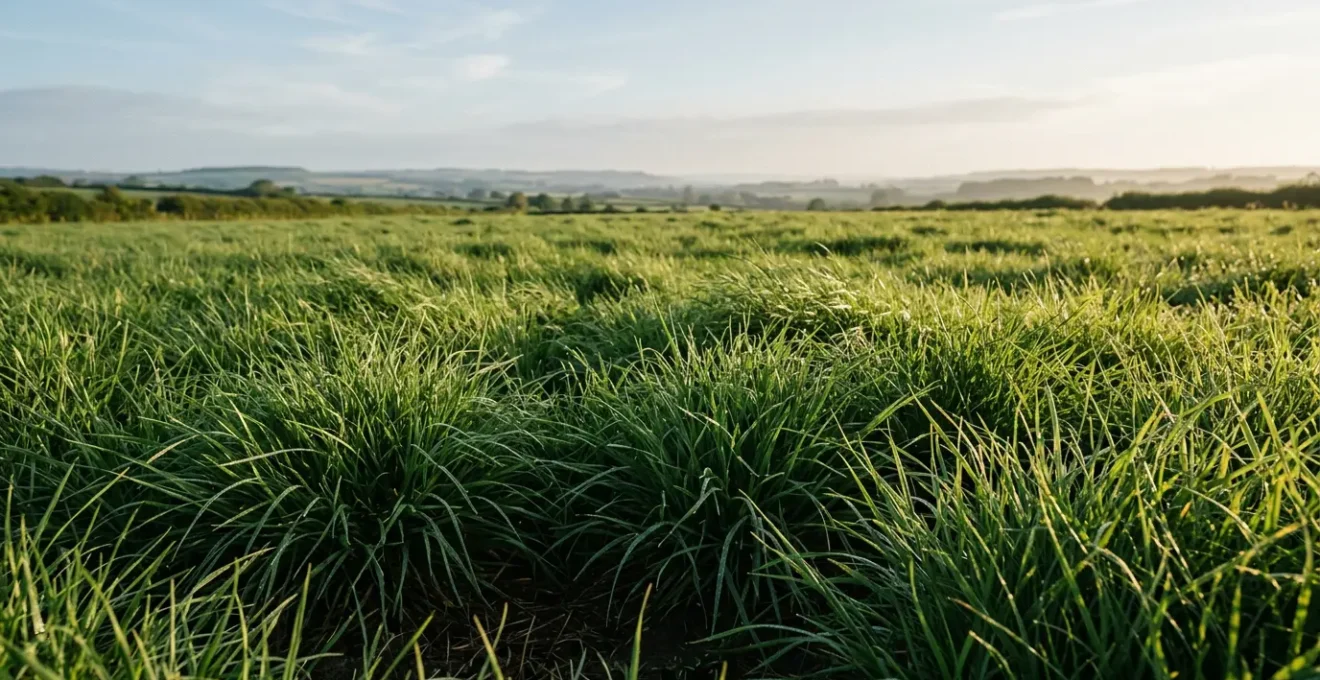
Seeing your pastures turn brown by August isn’t inevitable; it’s a sign that the field’s water cycle is broken and losing too much moisture to evapotranspiration.
- Leaving taller grass acts as « soil armour, » cooling the ground, trapping humidity, and drastically reducing moisture loss from the soil surface.
- Strategic hedges and trees do more than provide shade—they create powerful microclimates that can slash evaporative water loss from wind by up to 30%.
Recommendation: Start by digging a hole. Understanding your soil’s structure and organic matter content is the first step, as every 1% increase in organic matter can help it hold thousands of extra gallons of plant-available water per acre.
For any grazing manager, the sight of pastures turning brown and dormant in the peak of summer is a familiar frustration. When the grass stops growing in July or August, it signals a costly reliance on stored forage and a halt in animal weight gain. The conventional wisdom often involves either expensive irrigation, which is not always practical or sustainable, or simply accepting this « summer slump » as an unavoidable part of the season. Many managers try rotating faster or slower, but without addressing the root cause, these are just temporary fixes.
The problem isn’t just a lack of rain; it’s an excess of water loss. Every day, your pasture is « breathing out » a significant amount of water into the atmosphere through a process called evapotranspiration (ET). This is the combined loss of water from plant transpiration and soil evaporation. But what if the key to resilient, green pastures wasn’t just about getting more water in, but about smartly managing how much water leaves? What if you could turn your grass, soil, and field boundaries into an active water-conservation system?
This article moves beyond the platitudes and dives into the plant physiology and soil science that govern your pasture’s water cycle. We will treat evapotranspiration not as a given, but as a process you can influence. By understanding and managing the hidden factors—from the cooling effect of taller grass swards to the wind-breaking power of a well-designed hedge and the water-holding magic of soil organic matter—you can build a more drought-resilient system from the ground up. We will explore how to quantify water loss, select more water-efficient forage species, and diagnose underlying soil issues that might be holding your pastures back.
This guide provides a framework for understanding the core principles of water conservation in your grazing system. The following sections break down the key strategies you can implement to keep your pastures productive, even when the heat is on.
Summary: A Pasture Ecologist’s Guide to Mastering Field Moisture
- Why Leaving More Grass Behind Keeps the Soil Cooler and Moister?
- How to Estimate Daily Water Loss Using Weather Data?
- Cocksfoot vs Ryegrass: Which Transpires Less in Hot Weather?
- The Hedge Removal Mistake That Increases Field Drying Rates
- Silvopasture Shade: How Trees Reduce Heat Stress on Grass and Stock?
- Why Shallow Roots in July Indicate a Pan at 15cm Depth?
- Why 1% More Organic Matter Holds 20,000 Gallons of Water?
- Increasing Water Holding Capacity: How to Drought-Proof Sandy Soils?
Why Leaving More Grass Behind Keeps the Soil Cooler and Moister?
One of the most powerful tools for managing soil moisture is your grazing plan itself. The common impulse during dry weather can be to graze tighter to « use every last blade. » However, this is physiologically counterproductive. Leaving a higher grass residual (e.g., 4-6 inches) creates what can be called « soil armour. » This layer of vegetation fundamentally alters the microclimate at the soil surface. It acts as a physical barrier, shading the soil from direct solar radiation. This simple act of shading can dramatically lower soil temperatures, reducing the rate of evaporation and preventing the top layer of soil from baking into a hard, water-repellent crust.
Furthermore, the taller grass traps a thin layer of air at its base. This « boundary layer » is less affected by wind and becomes more humid as the plants transpire. By slowing airflow across the soil surface, this humid micro-environment significantly lowers the evaporative demand, keeping precious moisture in the soil profile where plant roots can access it. In essence, the grass creates its own protected ecosystem. This strategy also encourages deeper root systems, which are more capable of accessing water from lower in the soil profile.
Case Study: The Long-Term Benefit of Permanent Grass Cover
The positive impact of maintaining grass cover on soil health is not just a theory. A 14-year study in Slovakia on soil management provided clear evidence. It showed that plots with a permanent, no-till grass sward continuously increased total soil organic carbon in the topsoil. In contrast, conventionally plowed plots saw no improvement over the same period. The permanent grass cover also boosted the availability of potentially mineralizable nitrogen, demonstrating that a consistent sward protects and enhances the soil’s biological engine, which is essential for both nutrient cycling and long-term moisture retention.
This approach moves grazing management from a simple act of harvesting forage to a strategic tool for stewarding soil moisture. By leaving more behind, you are investing in the health and resilience of the entire pasture ecosystem. This residual grass is not waste; it is the key infrastructure for drought-proofing your operation from the ground up, protecting the soil’s biological activity and water reserves for the next growth cycle.
How to Estimate Daily Water Loss Using Weather Data?
Managing what you don’t measure is difficult. While you can see the effects of drought, quantifying the daily water loss from your pastures can feel like guesswork. However, you can make a very good estimate of evapotranspiration (ET) using publicly available weather data. This transforms the abstract concept of water loss into a concrete number you can use for making irrigation, rotation, and feed-planning decisions. The process relies on combining reference evapotranspiration (ETr), a standardized measure of atmospheric water demand, with a crop-specific coefficient (Kc) for your pasture.

Reference ET is calculated from four key weather parameters: solar radiation, temperature, humidity, and wind speed. Fortunately, you don’t need to calculate this yourself. Many agricultural universities and government agencies maintain weather station networks (like MSU’s Enviroweather in Michigan or California’s CIMIS) that provide daily ETr values. By multiplying this reference value by the appropriate crop coefficient for your forage type and its stage of growth, you get your pasture’s specific crop evapotranspiration (ETc), a reliable estimate of its daily water use in inches or millimeters.
Your Field Guide to Estimating Water Loss
- Access local weather data: Use agricultural weather station networks to obtain daily reference evapotranspiration (ETr) estimates based on temperature, humidity, wind speed, and solar radiation.
- Identify your crop coefficient (Kc): For pastures, the Kc value changes throughout the season; use published tables or local extension resources to find the appropriate Kc for your grass type and growth stage.
- Calculate crop water use (ETc): Multiply the reference evapotranspiration (ETr) by your crop coefficient: ETc = ETr × Kc. This gives you the estimated daily water loss from your pasture.
- Apply to grazing decisions: Use the calculated ETc value to determine irrigation needs, adjust rotational grazing speed, or calculate your ‘drought runway’ before supplemental feed becomes necessary.
Armed with this daily water loss figure, you can manage your pasture’s « water budget » with much greater precision. For instance, if you know your soil can hold 2 inches of plant-available water and your pasture is losing 0.25 inches per day, you know you have roughly 8 days before plants begin to experience significant stress. This quantitative approach allows for proactive rather than reactive management, turning weather data into a powerful decision-making tool.
Cocksfoot vs Ryegrass: Which Transpires Less in Hot Weather?
Not all grasses are created equal when it comes to heat and drought. While perennial ryegrass is a high-quality, productive forage in cool, moist conditions, its shallow root system and high transpiration rate make it particularly vulnerable during summer heatwaves. In contrast, deep-rooted perennial forages like cocksfoot (also known as orchardgrass) have evolved physiological mechanisms to not just tolerate, but survive, extended dry periods. Understanding these differences is key to building a more resilient pasture sward.
Cocksfoot’s primary survival strategy is summer dormancy. As soil moisture depletes and temperatures rise, the plant effectively shuts down its above-ground growth. It stops trying to produce new leaves and dramatically reduces its transpiration rate. This physiological pause conserves vital energy and water, allowing the plant to survive until autumn rains arrive. This is a stark contrast to ryegrass, which will often continue to try to grow, rapidly depleting its internal reserves and soil moisture, leading to plant death in a severe drought. The resilience of this strategy is remarkable; field trials in Morocco demonstrated that some cocksfoot varieties had a 79% survival rate after severe summer drought.
This ability to enter a state of suspended animation is a critical evolutionary trait for surviving in regions with dry summers. As a group of researchers studying Mediterranean forages noted:
A complete vegetative arrest under stress is a prerequisite for summer survival in Mediterranean environments.
– Piano E., Pecetti L., Annicchiarico P., et al., Combining drought tolerance and responsiveness to summer moisture availability in cocksfoot germplasm grown in Mediterranean environments
While a dormant plant may not be actively producing feed, its survival ensures a rapid green-up and recovery when conditions improve. Incorporating drought-dormant species like cocksfoot into a pasture mix acts as a form of biological insurance. It creates a sward that may be less uniformly productive during ideal spring conditions but is far more likely to persist and recover after the stress of a mid-summer heatwave, reducing the long-term costs of pasture renovation.
The Hedge Removal Mistake That Increases Field Drying Rates
Hedges and shelterbelts are often seen as inconvenient obstacles to modern farming, taking up valuable space and complicating machinery operations. However, from a water-cycle perspective, removing them is a significant mistake that can accelerate field drying rates. These living windbreaks are powerful tools for reducing evapotranspiration by modifying the microclimate across a surprisingly large area. Their primary function is to reduce wind speed, which is a major driver of evaporative water loss from both soil and plant surfaces.
When wind flows over a pasture, it strips away the thin layer of humid air that naturally forms around plant leaves and at the soil surface. This constant removal of moisture-laden air accelerates transpiration and evaporation. A properly designed shelterbelt disrupts this process. By forcing the wind up and over the hedge, and filtering it through the leaves, it creates a large zone of calmer air on its leeward side. The effect is significant; studies have consistently shown a 10% to 30% reduction in evapotranspiration in areas protected by shelterbelts. This translates directly to more water being available for grass growth for a longer period into a dry spell.
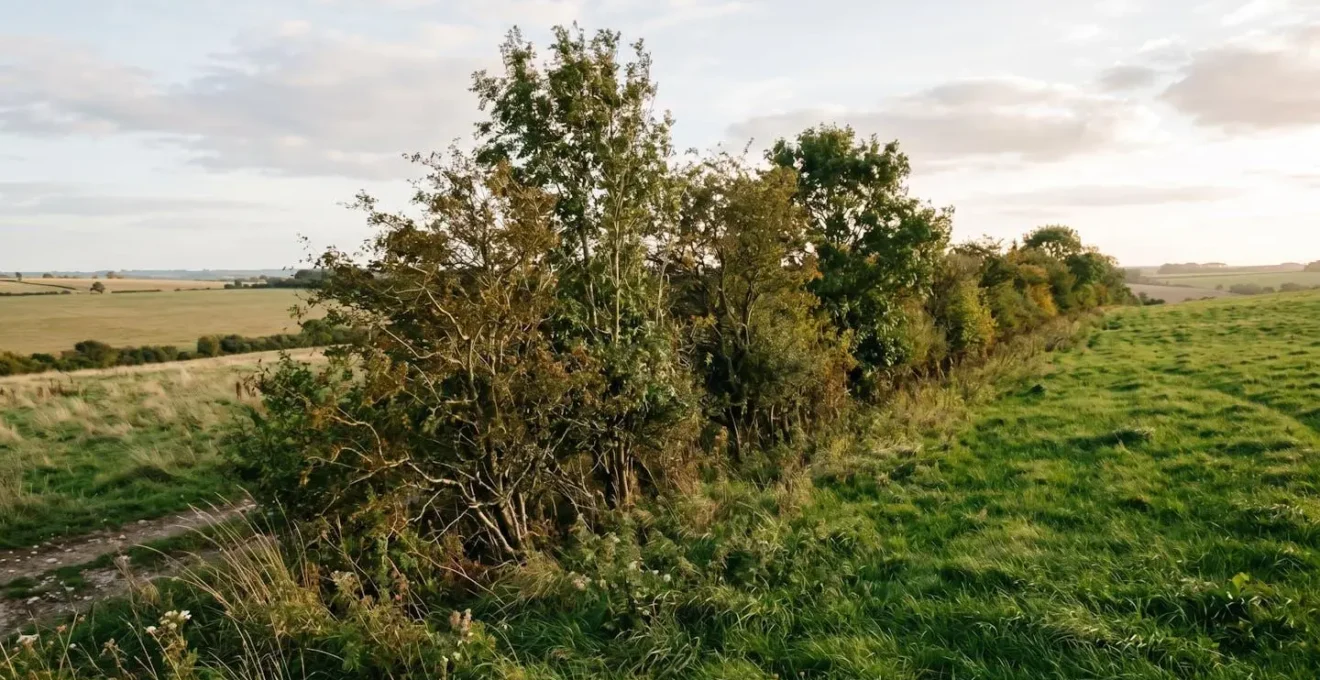
The effectiveness of a windbreak, however, is not about creating a solid wall. The key is optimal porosity. A dense, wall-like hedge can create intense turbulence on its downwind side as the air tumbles over the top, which can negate the benefits. The ideal shelterbelt has a porosity of about 40-60%, allowing some air to filter through gently. This creates a much larger and more effective zone of protection.
This table, based on data from the FAO, illustrates how density impacts the effectiveness of a windbreak. An optimal density provides the best balance of wind reduction and protected area with minimal turbulence.
| Shelterbelt Density/Porosity | Wind Speed Reduction | Protected Area (Leeward) | Turbulence Effect |
|---|---|---|---|
| Dense/Solid (0-20% porosity) | Up to 90% | Limited zone (comparatively small) | High turbulence on leeward side due to lower pressure |
| Optimal (40-60% porosity) | Moderate reduction | Up to 20-30× height | Minimal turbulence; gradual wind reduction |
| Very Porous (>70% porosity) | Minimal reduction | Reduced effectiveness | Wind passes through with little modification |
Re-evaluating field boundaries as critical components of your farm’s water management system is a paradigm shift. A mature hedge is not just a fence line; it is an active piece of ecological infrastructure, conserving moisture, providing habitat, and building resilience against the drying winds of summer.
Silvopasture Shade: How Trees Reduce Heat Stress on Grass and Stock?
Integrating trees into pastures, a practice known as silvopasture, offers one of the most effective strategies for mitigating heat stress and reducing water loss. While hedges manage wind, scattered or row-planted trees manage the other major driver of evapotranspiration: solar radiation. The shade cast by trees provides a direct and significant reduction in the heat load on both the forage sward and the grazing animals themselves, creating islands of coolness that have a profound impact on the entire system’s water balance.
For the grass, shade during the hottest part of the day lowers both soil and leaf temperatures. This reduces the plant’s transpiration rate, conserving internal moisture. The cooler soil surface also means less direct evaporation. While dense, continuous shade can reduce forage production, the intermittent shade from well-spaced trees can actually enhance the growth of cool-season grasses during hot summers by protecting them from the most intense heat and light stress. The trees’ deep roots can also bring up water from lower soil layers and release some of it in the topsoil (a process called hydraulic lift), benefiting nearby grasses.
For livestock, the benefits are even more apparent. Animals actively seek shade to regulate their body temperature, reducing heat stress, which can otherwise suppress appetite and lower productivity. Reduced heat stress means animals can continue to graze comfortably for longer periods, maintaining intake and performance during heatwaves.
Case Study: Quantifying Heat Stress Reduction in North Carolina
A silvopasture study in North Carolina with pine and oak trees provided clear metrics on this cooling effect. During the summer, the shade under the tree rows was 80% or greater. This had a measurable impact on the environment: the Temperature-Humidity Index (THI), a key measure of heat stress, was up to 1.5 points lower under the trees compared to open pasture. This translated directly to animal welfare, with livestock in the silvopasture system showing lower core body temperatures and fewer signs of heat stress, allowing them to graze more effectively during the day.
Silvopasture is a long-term investment, but it represents a powerful, multi-layered approach to building pasture resilience. By strategically adding the vertical element of trees, you are creating a more complex, stable, and productive ecosystem that is far better equipped to handle the stresses of a changing climate and summer heatwaves.
Why Shallow Roots in July Indicate a Pan at 15cm Depth?
If you find your pastures crashing at the first sign of dry weather, and digging a small hole reveals a dense mat of roots confined to the top few inches, the problem may be more physical than biological. The presence of shallow roots in mid-summer is a classic symptom of a compaction layer, or « pan, » often located around 6 inches (15 cm) below the surface. This hardened layer of soil acts as a physical barrier, profoundly disrupting your pasture’s ability to handle both wet and dry conditions.
This pan is often created by repeated trafficking with heavy equipment or by continuous grazing in wet conditions, which squeezes soil particles together and destroys its structure. When it rains, water cannot infiltrate past this dense layer, leading to waterlogging in the root zone. This saturated, low-oxygen environment is hostile to root growth and can kill off beneficial soil organisms. Plant roots, unable to penetrate the pan, are forced to spread out horizontally in the shallow topsoil.
While this situation is problematic in the wet, it becomes catastrophic in the dry. The shallow layer of soil that the roots can access has a very limited water-holding capacity. During a heatwave, this small reservoir of moisture is depleted in a matter of days. The roots are physically blocked from reaching the deeper, cooler, and moister soil layers below the pan. The pasture, which may have looked lush just a week before, suddenly and rapidly desiccates. It is effectively a shallow-rooted system sitting on top of a « perched » water table in the winter and a sun-baked brick in the summer.
Diagnosing a compaction pan is straightforward: the best tool is a spade. Dig a test pit and examine the soil profile. You will often see a clear change in structure, density, and color at the pan layer. Roots will be seen growing horizontally along the top of this layer, unable to push through. Breaking this pan, whether through mechanical means like subsoiling (done under appropriate dry conditions) or biological means like planting deep-rooted cover crops (e.g., tillage radish, chicory), is essential to restoring the soil’s vertical water-handling capacity and unlocking its true drought resilience.
Why 1% More Organic Matter Holds 20,000 Gallons of Water?
The figure is so often quoted that it risks becoming a platitude: adding 1% soil organic matter (SOM) allows an acre of soil to hold an additional 20,000 gallons of water. While the exact number can vary with soil type, the principle is profoundly important for drought resilience. This isn’t just about making the soil more « spongy »; it’s about fundamentally re-engineering the soil’s architecture to capture, store, and, most importantly, release water to plant roots.
Soil organic matter, which is the complex, carbon-rich material derived from decomposed plants and microbes, has an incredible capacity to attract and hold water molecules. Humus, the stable, long-lasting component of SOM, can hold up to 90% of its weight in water. But its true power lies in its ability to act as a « glue, » binding small soil particles (sand, silt, and clay) into larger, more stable structures called aggregates. It is the space between these aggregates—the pore structure—that creates the reservoir for plant-available water.
This is the key distinction. A very fine, compacted clay soil might hold a lot of water, but it holds it so tightly (with high tension) that plant roots cannot extract it. Conversely, a coarse sandy soil has plenty of large pores, but water drains through it too quickly. As one soil scientist aptly put it, the real magic of SOM is in creating the right kind of storage.
Organic matter’s true genius is not just being a sponge, but creating the pore structure that holds water at tensions plants can actually access.
– Soil water dynamics research synthesis, Water holding capacity analysis in agricultural soils
This plant-available water is held in the medium-sized « mesopores » that organic matter helps create. This is the water that resists the pull of gravity but can be easily taken up by root hairs. Therefore, when you increase your soil organic matter, you are not just increasing the total amount of water your soil can contain; you are specifically increasing the size of the bucket that your plants can actually drink from during a dry spell. This makes building SOM one of the most fundamental and high-leverage strategies for long-term drought-proofing.
Key Takeaways
- Manage Grazing Residuals: Leaving a taller sward (4-6 inches) acts as « soil armour, » cooling the ground and trapping moisture, which is the most immediate action you can take to reduce water loss.
- Leverage Windbreaks: A hedge with 40-60% porosity is an active tool, not a passive boundary. It can reduce evaporative wind effects by 10-30%, conserving huge volumes of water across a field.
- Build Soil Organic Matter: Every 1% increase in SOM dramatically boosts your soil’s water-holding capacity. This is the single most important long-term strategy for drought resilience.
- Choose the Right Plants: Incorporating drought-dormant species like cocksfoot alongside more productive grasses like ryegrass creates a more resilient pasture mix that can survive and recover from severe summer stress.
Increasing Water Holding Capacity: How to Drought-Proof Sandy Soils?
Sandy soils present a particular challenge for grazing managers. Their large particle size creates large pore spaces, which leads to excellent drainage—a benefit in wet climates, but a liability in a drought. Water and nutrients pass through them quickly, making them inherently « leaky » and prone to drying out. However, this is not an immutable fate. The key to drought-proofing sandy soils lies in aggressively and continuously building soil organic matter (SOM) to improve their structure and water-holding capacity.
For sandy soils, organic matter plays a dual role. Firstly, the organic matter particles themselves act like tiny sponges, holding onto water that would otherwise drain away. Secondly, and more importantly, the sticky substances produced during the decomposition of organic matter act as a glue, binding sand particles together to create soil aggregates. This process builds a network of smaller pores within the larger sand structure, dramatically increasing the soil’s ability to hold onto plant-available water against the pull of gravity.
The most effective way to achieve this on a pasture scale is through the establishment of permanent forage cover and maximizing root turnover. Practices like no-till or minimal tillage are critical, as plowing constantly burns up organic matter by introducing too much oxygen into the soil. Using diverse swards with deep-rooting species like chicory, plantain, and cocksfoot, alongside legumes, creates a continuous « root channel » for carbon deposition deep in the soil profile. Managed grazing, where plants are allowed to recover fully and grow significant root mass between grazings, is also a powerful engine for building SOM.
Case Study: Transforming Sandy Loam with Permanent Grass Cover
A comprehensive 14-year study on sandy loam soil in Slovakia demonstrated this principle in action. It compared various management systems and found that establishing a no-till, permanent grass sward was a highly effective long-term strategy. Over the 14 years, the plots with a permanent four-species grass mixture continuously increased total soil organic carbon in the topsoil. In stark contrast, the conventionally plowed plots showed no net change. This demonstrates that for challenging soils, the consistent biological activity and root deposition from a permanent pasture is a proven method for building the organic matter necessary to improve water-holding capacity and overall soil health.
Drought-proofing sandy soil is a long-term project, not a quick fix. It requires a strategic shift towards practices that continuously feed the soil with carbon and protect its fragile structure. By focusing on building organic matter through perennial cover and managed grazing, you can gradually transform a leaky, drought-prone field into a resilient and productive pasture.
To begin applying these principles, take a spade and dig a test pit in your best and worst-performing areas. Observing your soil’s structure, root depth, and signs of life is the most important first step in building a more resilient and water-wise grazing system.