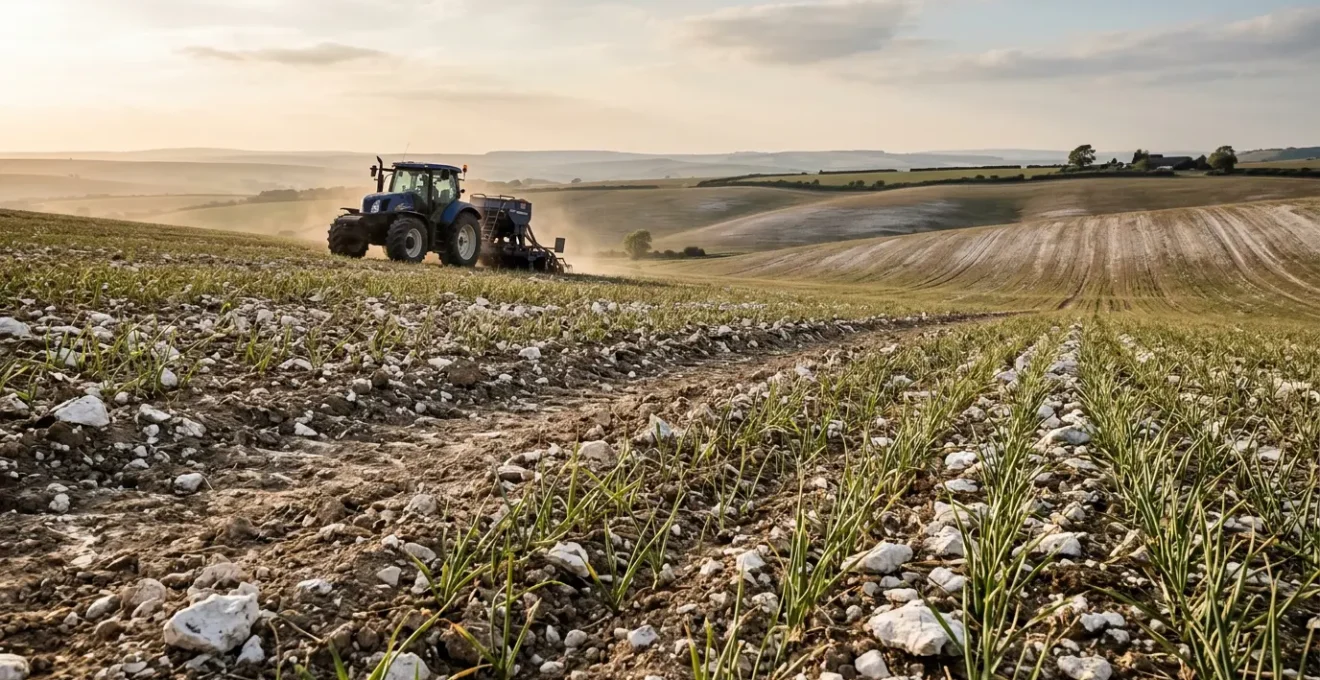
The key to profitable farming on shallow chalk isn’t fighting its alkaline nature, but mastering biological and structural workarounds to build a new, functional topsoil on the surface.
- Nutrient availability is dictated by pH; biological strategies like rhizosphere acidification can unlock ‘locked’ minerals.
- Water holding capacity is dramatically improved by creating a « false topsoil » of organic matter and biochar, bypassing the need for deep soil.
- No-till cultivation is critical to prevent the « flint conveyor belt » effect that damages machinery and degrades soil structure.
Recommendation: Shift focus from deep cultivation to surface management. Prioritise building a rich organic layer and selecting crops with root systems adapted to this specific environment.
For farmers working the rolling landscapes of the South Downs or the Wolds, the reality of the soil is often measured in inches. A thin layer of topsoil over a deep, unforgiving chalk substratum presents a unique set of agronomic challenges that standard farming advice often fails to address. The high pH, the rapid drainage, and the notorious « nutrient lock-up » can feel like a constant battle, limiting yield potential and frustrating efforts to build soil health. The common wisdom to simply « add more organic matter » or « choose different crops » barely scratches the surface of this complex problem.
But what if the goal wasn’t to fundamentally change the chalk, an impossible and costly task, but to work with its nature in a more sophisticated way? This guide moves beyond the platitudes to offer a specialist’s perspective, rooted in the understanding of soil biology and structure. The core principle is innovation over brute force. Instead of fighting the high pH, we’ll explore how to biologically sidestep it. Instead of bemoaning the lack of soil depth, we’ll detail how to construct a highly effective « false topsoil » on the surface. This approach is about leveraging specific plant behaviours, microbial allies, and strategic cultivation to unlock the surprising potential hidden within these challenging soils.
This article will dissect the core challenges of chalkland farming and provide innovative, practical solutions. We will explore the science behind nutrient behaviour, strategies for water management, crop selection, and cultivation techniques specifically tailored for thin soils. Get ready to rethink your relationship with chalk.
Summary: A Practical Guide to Farming on Shallow Chalk Soils
- Why Nutrients Lock Up on High pH Chalk Substrata?
- How to Increase Water Holding Capacity When You Can’t Deepen the Soil?
- Barley vs Wheat: Which Cereal Tolerates Shallow Soils Better?
- The Cultivation Mistake That Brings Flint to the Surface
- Surface Mulching: How to Build a False Topsoil Layer Over Chalk?
- How to Lower Soil pH Biologically to Release Calcium and Magnesium?
- Drought Tolerant Varieties: Choosing Wheat That Yields on Light Land
- Increasing Water Holding Capacity: How to Drought-Proof Sandy Soils?
Why Nutrients Lock Up on High pH Chalk Substrata?
The fundamental challenge of chalk soils begins at a chemical level. The high concentration of calcium carbonate (CaCO3) buffers the soil pH, keeping it persistently alkaline, often at 8.0 or higher. While this provides an abundance of calcium, it creates a chemical environment where other essential nutrients become « locked up, » or precipitated into forms that are insoluble and unavailable for plant uptake. This isn’t a deficiency of nutrients in the soil, but a crisis of accessibility. The primary culprits affected are phosphorus and key micronutrients like manganese, iron, and boron.
At high pH, phosphorus reacts with the abundant calcium to form insoluble calcium phosphates. Essentially, the nutrient becomes locked into a mineral solid that plant roots cannot absorb. Similarly, iron and manganese precipitate as insoluble hydroxides. The visual result can be chlorosis—a yellowing of the leaves—even when soil tests show adequate total levels of these nutrients. As noted in a review of chalk soil properties on ScienceDirect, this alkalinity is a direct cause of micronutrient unavailability. Understanding this mechanism is crucial: simply adding more of a locked-up nutrient is often ineffective and costly, as it too will quickly become unavailable.
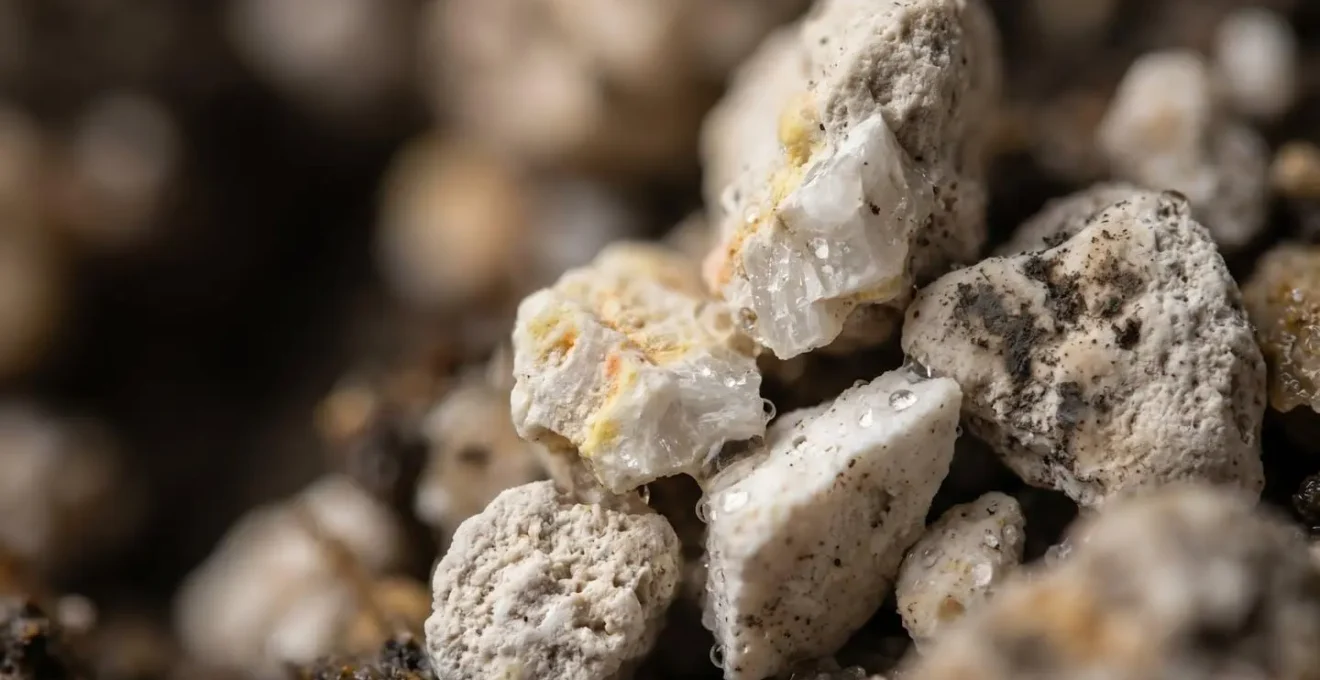
This microscopic view reveals the challenge. The crystalline structure of the chalk acts as a vast surface area for these chemical reactions to occur. The solution, therefore, is not to try and change the pH of the entire soil profile, but to create micro-zones of lower pH directly around the plant roots—a process we’ll explore through biological means. The goal is to create pockets of availability where the plant needs them most, sidestepping the dominant chemistry of the bulk soil.
How to Increase Water Holding Capacity When You Can’t Deepen the Soil?
On shallow soils, rainfall often feels like a missed opportunity. The limited topsoil depth and the porous nature of the chalk substratum mean water drains away rapidly, leaving crops vulnerable to even short periods of drought. Since physically deepening the soil is not a viable option, the strategy must shift to maximizing the water holding capacity (WHC) of the existing topsoil layer. The key to this is aggressively increasing the soil’s organic matter content, which acts like a sponge.
Organic matter, in the form of compost, manure, or cover crop residues, has a profound effect on soil structure. It binds soil particles together into stable aggregates, creating a network of micropores and macropores. These pores are what hold water against the pull of gravity, keeping it in the root zone where it’s needed. One of the most potent tools for this is biochar, a form of charcoal made for soil application. Its incredibly porous structure provides a vast internal surface area that can hold water. In fact, research from 2024 demonstrates that almond shell biochar application can produce a 20-25% increase in water holding capacity in sandy soils, a principle directly applicable to the light texture of many chalk-based topsoils.
Achieving this requires a consistent and long-term commitment. It’s not a one-off fix but a continuous process of feeding the soil. To get the most out of amendments like biochar, it’s important to select the right kind. Key properties to look for include:
- Biochar with a high oxygen content and (O+N)/C ratio to inhibit evaporation.
- Mixed particle sizes and irregular shapes for rapid water storage.
- Hydrophilic (water-attracting) surfaces, not hydrophobic ones.
- Production at lower pyrolysis temperatures (300-500°C) to retain more water-holding chemical groups.
By focusing on building this sponge-like organic layer, you are effectively creating a more resilient and drought-proof topsoil, making the most of every drop of rain.
Barley vs Wheat: Which Cereal Tolerates Shallow Soils Better?
Choosing the right crop is a cornerstone of successful farming on chalk, and when it comes to cereals, the choice between barley and wheat is critical. While both can be grown, barley generally demonstrates a higher tolerance for the specific stresses imposed by shallow, alkaline soils. This isn’t just anecdotal; it’s rooted in the fundamental differences in their physiology and root architecture. Barley’s inherent hardiness often gives it an edge in less-than-ideal conditions.
Barley is known for its superior tolerance to salinity and sodicity, conditions that share characteristics with the osmotic stress found in dry, high-pH soils. This resilience means it can often maintain yield where wheat would struggle. For example, according to North Dakota State University’s 2025 field research, barley and oat crops outyielded all spring wheat varieties as soil salinity and sodicity increased. This indicates barley’s more robust system for handling chemical and drought stress. Wheat, particularly modern high-yield varieties, has often been bred for optimal conditions and can be less forgiving of the nutrient and water limitations of chalk soils.
Research into root systems reveals the « why » behind this difference. Studies, such as those at Montana State University, have shown that barley tends to have a more shallow, fibrous, and scavenging root system. This is an advantage on thin soils, as it allows the plant to efficiently explore the limited topsoil layer for moisture and nutrients. In contrast, many wheat varieties pursue a deeper, taproot-style architecture. While this is beneficial for accessing deep moisture in other soil types, on solid chalk, this energy can be wasted trying to penetrate an impenetrable layer. Barley’s strategy of thoroughly exploiting the top few inches is simply a better match for the environment.
The Cultivation Mistake That Brings Flint to the Surface
The presence of flint is a defining and often destructive feature of many chalk soils. These sharp, abrasive stones take a heavy toll on equipment. As the classic text Lockhart & Wiseman’s Crop Husbandry notes, this is a long-standing issue:
Sharp-edged flints of various sizes, found in soils overlying some of the chalk formations, are very wearing on cultivation implements and tyres, as well as being destructive when picked up by harvesting machinery.
– Lockhart & Wiseman’s Crop Husbandry, ScienceDirect Agricultural Sciences Topics
However, a common mistake dramatically worsens this problem: deep ploughing. The mouldboard plough, designed to invert the soil, acts as a conveyor belt, continuously dredging new flints from the subsoil and depositing them in the precious topsoil layer. This not only accelerates wear and tear on machinery but also dilutes the organic matter-rich topsoil with sterile, problematic stone. It’s a cycle of degradation that actively works against efforts to improve soil health.
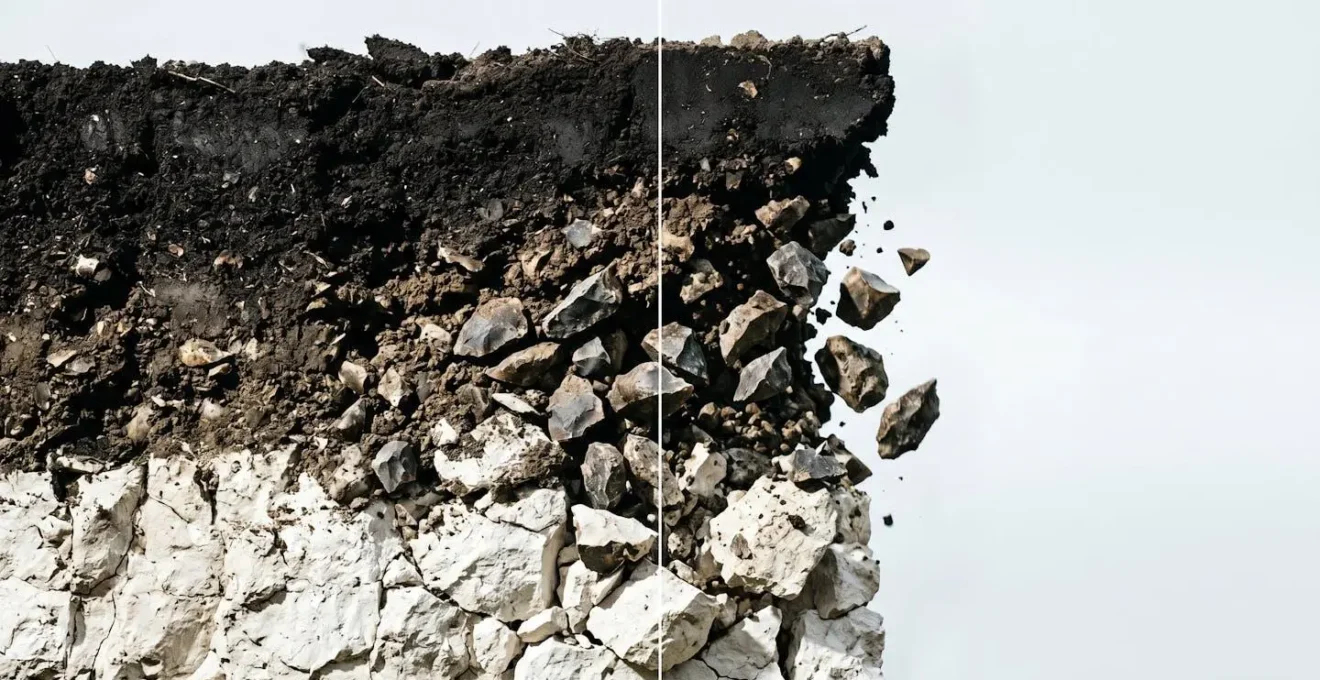
The solution is a radical shift in cultivation philosophy towards minimum-tillage or, ideally, zero-tillage (no-till) systems. By ceasing soil inversion, the « flint conveyor belt » is switched off. Stones that are currently in the topsoil remain, but no new ones are brought to the surface. Over time, as organic matter is built, these stones can become incorporated into a more stable soil matrix.
Case Study: John Cherry’s No-Till Transition on Chalky Boulder Clay
John Cherry, a prominent UK farmer and host of the Groundswell event, provides a compelling example. He transitioned his 2500 acres of chalky boulder clay from ploughing to no-till. He observed that ploughing buried the living topsoil, causing a temporary nitrogen rush from oxidised organic matter but no lasting benefit. Since adopting no-till, he has stopped the upward movement of flints and seen profound economic and ecological gains. His farm has eliminated all phosphate and potash fertiliser applications, as soil nutrient levels have remained stable or improved through natural cycling, and his nitrogen bill has been cut significantly. This demonstrates that stopping the plough is not just about managing flints; it’s a gateway to a more profitable and resilient farming system.
Surface Mulching: How to Build a False Topsoil Layer Over Chalk?
If you can’t deepen the soil, build a new layer on top. This is the core principle of surface mulching on shallow chalk. The goal is to create a « false topsoil »—a rich, deep, organic layer that sits on top of the existing mineral soil. This layer becomes the primary zone of root activity, nutrient cycling, and water retention, effectively bypassing the limitations of the thin soil beneath. This is not just about adding a bit of compost; it’s a deliberate, long-term construction project for your soil.
This false topsoil is built through consistent, heavy applications of organic materials. This can include well-rotted farmyard manure, green waste compost, or chopped straw. The quantities required are significant; soil improvement experts often recommend applying 3 to 4 inches of compost annually to make a real impact on chalky ground. This material serves multiple functions. It physically increases the depth available for root exploration. It dramatically improves water holding capacity, acting as a reservoir. And crucially, it provides a buffer against the high pH of the underlying chalk.
As this organic matter decomposes, it creates an environment that is fundamentally different from the mineral soil. It has a naturally lower pH, which helps to keep micronutrients available. It provides a slow-release source of nutrients as it breaks down. And it fosters a vibrant community of soil organisms—earthworms, bacteria, and fungi—that are the engines of a healthy soil ecosystem. This living layer is what transforms a thin, challenging soil into a productive and resilient one. It’s a strategy that requires patience and a steady supply of organic material, but the long-term payoff is a fundamental improvement in the farm’s most valuable asset.
How to Lower Soil pH Biologically to Release Calcium and Magnesium?
While physically changing the pH of an entire field of chalk soil is impractical, it is possible to create localised zones of lower pH right where the plant needs them: in the rhizosphere, the area immediately surrounding the roots. This biological approach uses natural processes to unlock the nutrients held captive by the soil’s high alkalinity. It’s a strategy of precision and finesse, rather than brute chemical force. This involves leveraging specific plants, microbial inoculants, and organic processes to create acidic micro-environments.
Plants are not passive victims of soil chemistry; many have evolved strategies to manipulate their root environment. Some, like buckwheat and lupins, exude organic acids from their roots. These acids act as natural chelating agents, binding to mineral nutrients like calcium, magnesium, and iron, and making them soluble and available for uptake. Incorporating such plants into a cover crop mix can effectively « mine » nutrients from the soil. Another powerful biological tool is the introduction of beneficial microbes. Sulphur-oxidising bacteria, for example, can be applied with elemental sulphur. The bacteria convert the sulphur into sulphuric acid in tiny, controlled pockets, gently dissolving chalk and releasing nutrients locally without drastically altering the bulk soil pH.
Furthermore, fostering a healthy population of arbuscular mycorrhizal fungi (AMF) is essential. These fungi form a symbiotic relationship with plant roots, extending a vast network of fine hyphae far into the soil. This network is incredibly efficient at exploring the soil volume and mining for locked-up nutrients, especially phosphorus, which it then transports directly into the plant. This biological toolkit offers a sophisticated way to work with, rather than against, the inherent nature of chalk soil, turning a chemical problem into a biological opportunity.
Your Action Plan: Biological Management of High pH Soils
- Assess Deficiencies: Conduct foliar tests to identify specific micronutrient deficiencies (e.g., iron, manganese) caused by pH lock-up.
- Targeted Supplementation: Apply chelated micronutrients (e.g., EDDHA iron) as a foliar spray or soil drench for rapid correction and to bypass soil lock-up.
- Select Acidifying Cover Crops: Integrate crops known for rhizosphere acidification, such as buckwheat or lupins, into your rotation to naturally chelate nutrients.
- Inoculate with Beneficial Microbes: Introduce sulphur-oxidising bacteria with sulphur applications or establish arbuscular mycorrhizal fungi to extend root access to locked-up minerals.
- Commit to Organic Matter: Maintain a programme of adding substantial organic matter (3-4 inches annually) to create a pH-buffering layer and promote the production of mild organic acids.
Drought Tolerant Varieties: Choosing Wheat That Yields on Light Land
In a water-limited environment like shallow chalk soil, crop genetics play a pivotal role in achieving a successful harvest. While building soil organic matter is a long-term strategy, selecting varieties specifically bred for drought tolerance can provide immediate resilience. Plant breeders have made significant strides in identifying the genetic traits that allow cereals like wheat to thrive with less water. For farmers on light land, choosing a variety is no longer just about top-end yield potential; it’s about yield stability in a challenging environment.
Drought tolerance is not a single trait but a combination of several characteristics. Some varieties have deeper or more aggressive root systems that are better able to explore the soil for any available moisture, even penetrating fine fissures in the chalk. Others employ a more conservative strategy, exhibiting physiological traits that help conserve water. One key mechanism that breeders select for is a reduced residual transpiration rate. This is the plant’s ability to minimise water loss through its leaves (stomata) when they are supposed to be closed, particularly at night. A plant that is « leakier » will lose more water, making it more vulnerable to drought stress.
As a review of drought tolerance research notes, the reduction of this residual transpiration rate has been a key selection criterion in modern wheat and barley breeding programmes. When reviewing variety guides from AHDB or seed suppliers, pay close attention to ratings for performance on light land and resilience to drought. Often, a variety with a slightly lower top-end yield but with robust performance in dry years will be a more profitable and reliable choice in the long run on chalk soils. It’s about prioritising resilience over a maximum yield that may only be achievable in a perfect, wet year.
Key Takeaways
- High pH in chalk soils chemically locks up key nutrients like phosphorus and iron, making them unavailable to plants.
- The most effective strategy for shallow soils is to build a « false topsoil » with heavy organic matter and biochar applications to hold water and buffer pH.
- Ceasing deep ploughing and adopting no-till is crucial to stop the « flint conveyor belt » that brings stones to the surface and damages equipment.
Increasing Water Holding Capacity: How to Drought-Proof Sandy Soils?
For chalk-based soils, which often have a light, sandy or silty topsoil, the most powerful tool for drought-proofing is biochar. This highly porous form of charcoal acts as a permanent structural amendment, creating a « water-holding matrix » that fundamentally changes how your soil handles moisture. Unlike compost, which decomposes over time, biochar is extremely stable and provides a lasting improvement to soil structure and water retention. Its impact can be immense, turning a free-draining, drought-prone soil into a resilient reservoir.
The efficacy of biochar lies in its microscopic structure. It is riddled with pores of varying sizes, creating a vast internal surface area. Comprehensive 2023 research testing 21 different biochar samples found a water holding capacity ranging from 78% to 400% by weight. This means some biochars can hold up to four times their own weight in water. When incorporated into the topsoil, this network of pores holds water that would otherwise be lost to drainage, keeping it available to plant roots for longer. This extends the time between wilting points, giving crops a crucial buffer during dry spells.
However, more is not always better. The key is to apply biochar at a rate that maximises *plant-available* water. As shown by a detailed study on application rates, very high concentrations can hold water so tightly in micropores that it becomes unavailable to plants. The following table summarises the impact of different application rates in sandy soils.
| Biochar Application Rate | Water Retention Impact | Readily Available Water (RAW) Effect | Optimal Use Case |
|---|---|---|---|
| 5% (v/v) | Significantly increased field capacity | Highest RAW capacity – water easily accessible to plants | Recommended for most sandy soil applications |
| 10% (v/v) | Increased field capacity with reduced drainage point | High RAW capacity maintained | Suitable for very sandy or drought-prone soils |
| 15% (v/v) | Further water holding increase but diminishing returns | RAW capacity begins to decline | Consider for severely degraded sandy soils only |
| 25-75% (v/v) | High total water retention | RAW significantly reduced – water held in micropores unavailable to plants | Not recommended – water retained but not plant-accessible |
For most applications on chalk topsoils, an application rate of 5% by volume is the sweet spot, delivering the greatest increase in readily available water for your crops.
By shifting from a mindset of « fixing » the chalk to one of « building on top of it, » the entire dynamic changes. The strategies outlined here—from building a false topsoil and leveraging biochar, to adopting no-till and choosing adapted crop genetics—are not isolated tactics. They form an integrated system. This system views the soil not as a dead medium to be chemically altered, but as a living ecosystem to be nurtured. Success on shallow chalk soil comes from becoming a master of soil biology and surface architecture. Start implementing these soil-building strategies today to transform your chalk land from a challenge into a productive and resilient asset.