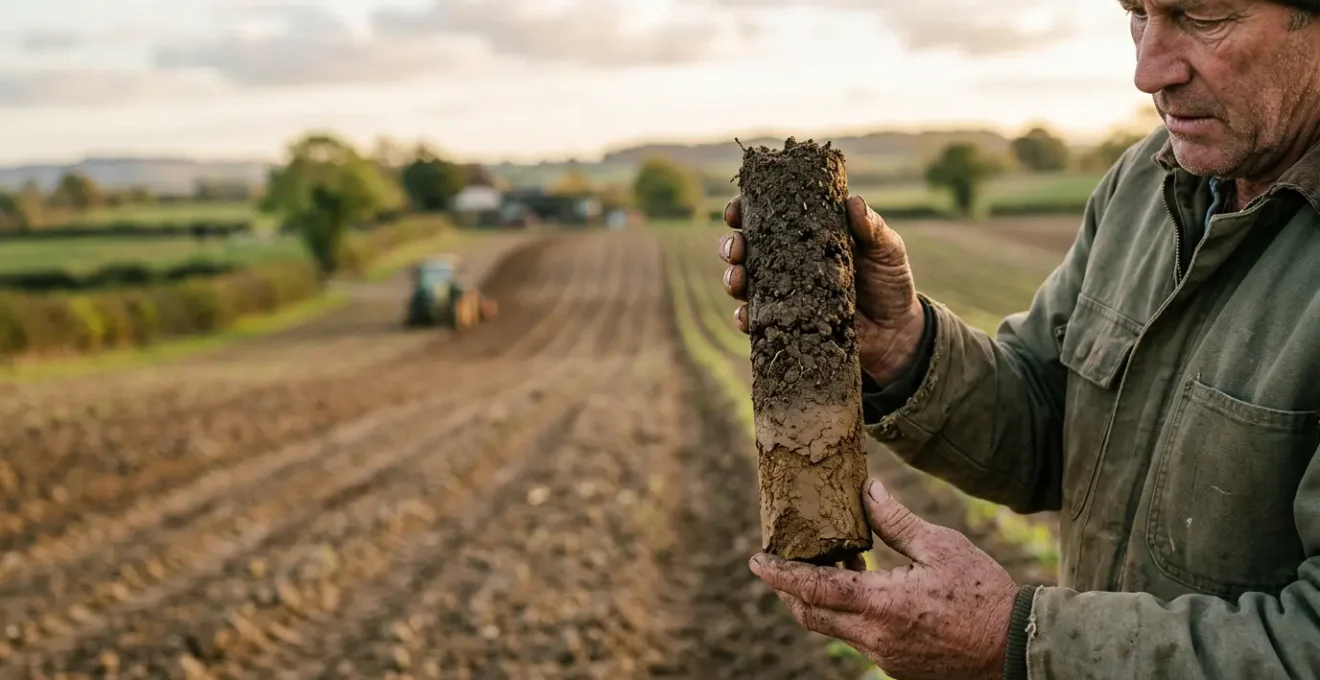
Soil compaction is not a simple problem of restricted root growth; it’s a systemic failure of the soil’s pore network, directly impacting nutrient and water availability and costing significant yield even in fertile fields.
- Quantifying compaction is critical: A simple percolation test can provide objective data on your soil’s hydraulic conductivity, a key indicator of macropore function.
- The primary cause is mechanical: Axle load is the main driver of deep subsoil compaction, while tyre pressure dictates topsoil damage.
Recommendation: Before any remedial action or drilling, perform a structured porosity assessment to diagnose the type and depth of compaction, allowing for a targeted, cost-effective intervention rather than blind tillage.
For arable farmers, particularly after a wet harvest season, the state of the soil is a primary concern. The visible signs of a challenging season—ruts, standing water, and poor crop establishment—often point to an invisible enemy: soil compaction. It is tempting to believe that with sufficient fertiliser and favourable weather, the next crop will overcome this physical barrier. This approach, however, overlooks the fundamental physics of soil health. Compaction is more than just dense earth; it is the systematic destruction of soil porosity, the network of spaces that transport air, water, and nutrients to plant roots.
Conventional wisdom often suggests a quick look with a spade or avoiding traffic on wet ground. While sound advice, this fails to quantify the problem or provide a clear decision-making framework. The true threat of compaction lies in its insidious ability to decouple yield potential from soil fertility. A field with perfect N-P-K values can still underperform dramatically if its pore network has collapsed. This reduces aeration, leading to nutrient loss through processes like denitrification, and restricts the water supply available to roots, creating drought stress even in moist conditions.
But what if we approached compaction not as a vague problem, but as a solvable physics equation? The key is to shift from qualitative observation to quantitative measurement. Understanding concepts like hydraulic conductivity, aggregate stability, and the distinct effects of axle load versus tyre pressure allows for a precise diagnosis. This technical perspective reveals that compaction is a predictable result of specific forces and that its reversal requires equally specific, targeted interventions.
This guide provides a framework for assessing soil porosity and making informed decisions before drilling. We will explore the mechanisms by which compaction limits yield, detail how to conduct a proper percolation test, compare tillage systems, and discuss strategies for both remediation and long-term prevention, particularly in the context of challenging wet weather conditions.
To navigate this technical guide, the following sections provide a structured path from understanding the problem to implementing effective solutions.
Summary: A Technical Guide to Assessing Soil Compaction and Porosity
- Why Low Porosity Reduces Yields Even with Perfect Fertility?
- How to Conduct a Percolation Test to Measure Macropore Function?
- Ploughed vs Direct Drilled: Which Maintains Better Air Exchange?
- The Tyre Pressure Mistake That Destroys Porosity in One Pass
- Root Health: How Porosity Affects the Depth of Wheat Roots?
- Subsoiling vs Keyline Plowing: Which Better Aerates the B-Horizon?
- Why Slaking Happens and How It Seals Your Soil Surface?
- How to Maintain Aggregated Topsoil Structures to Prevent Runoff During Wet UK Winters?
Why Low Porosity Reduces Yields Even with Perfect Fertility?
A common misconception is that yield is primarily a function of chemical fertility. However, soil is a three-phase system: solid (minerals, organic matter), liquid (soil solution), and gas (soil atmosphere). Low porosity, or soil compaction, critically compromises the liquid and gas phases, creating a cascade of negative effects that directly throttle yield potential. When pore spaces, particularly the large macropores responsible for drainage and aeration, are squeezed shut, the soil’s ability to function as a healthy growth medium collapses. This can lead to 10-20% potential long-term productivity losses globally, even before factoring in increased input costs.
The primary impact is on the soil atmosphere. Plant roots and beneficial microbes require oxygen for respiration. In a compacted, waterlogged soil, oxygen is rapidly depleted. This anaerobic environment triggers denitrification, a process where microbes convert valuable nitrate fertiliser into nitrogen gas, which is lost to the atmosphere. Essentially, compaction causes your expensive fertiliser to vanish into thin air. Furthermore, these oxygen-deprived conditions favour the proliferation of pathogenic fungi and bacteria responsible for root diseases like Pythium and Rhizoctonia.
Simultaneously, the restriction of the liquid phase is equally damaging. While a compacted soil might hold water, its hydraulic conductivity is dramatically reduced. This means water cannot move freely. Roots are unable to access water held in micropores just inches away, and surface water cannot infiltrate, leading to runoff and erosion. The plant experiences drought stress despite being in a field with adequate moisture, as its root system is confined to a small, rapidly-drying volume of topsoil. As experts from the University of Minnesota Extension note:
Soil compaction in wet years decreases soil aeration, increasing denitrification. The risk of root diseases can also increase. All of these factors add stress to the crop and, ultimately, lead to yield loss.
– University of Minnesota Extension, Soil compaction management guide
Ultimately, low porosity forces the plant to expend significant energy just to survive. Energy that would have been allocated to grain fill or biomass production is diverted to overcoming physical restrictions and nutrient deficiencies. This constant stress is the fundamental reason why even a perfectly fertilised field will fail to reach its yield potential when its physical structure is compromised.
How to Conduct a Percolation Test to Measure Macropore Function?
Visual assessment can be subjective. To truly understand your soil’s condition, a quantitative measurement of its hydraulic conductivity is necessary. A percolation test is a straightforward, low-cost method to assess the functionality of your soil’s macropore network—the « superhighways » for air and water. This test measures the rate at which water moves vertically through the soil profile, providing a direct indication of compaction levels and the soil’s ability to handle rainfall and support aeration.
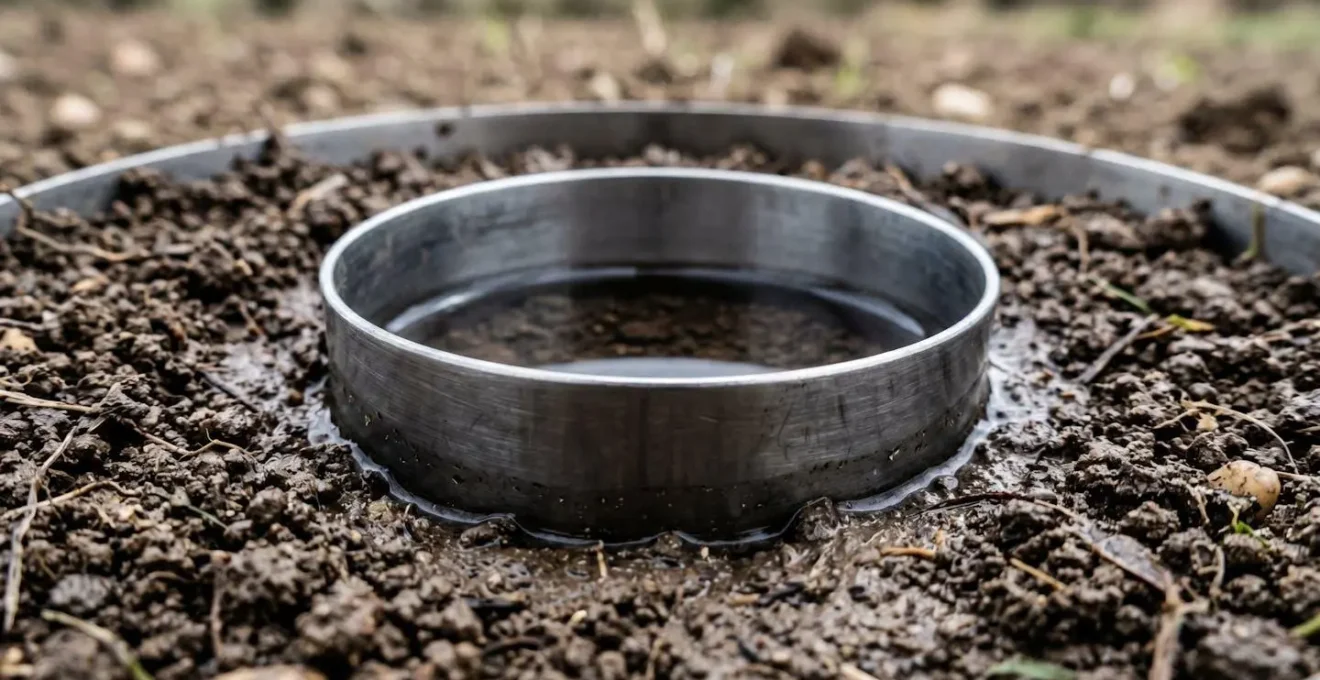
The test involves excavating a hole to a specific depth, saturating the surrounding soil to simulate wet conditions and account for soil swelling, and then measuring the rate at which the water level drops. A rapid drop indicates a well-structured soil with continuous macropores, while a slow drop signals a compacted layer or poor structure that is impeding water flow. For more precise scientific work, a double-ring infiltrometer is often used to isolate vertical water flow from lateral seepage, providing a more accurate measure of infiltration.
The results of this test are not just academic; they provide a clear basis for management decisions. By comparing your infiltration rates across different areas of a field, you can create a compaction map that identifies problem zones requiring targeted intervention. This data-driven approach prevents unnecessary and costly deep tillage across an entire field, focusing resources precisely where they are needed most.
Your Action Plan: Field Percolation Test Procedure
- Excavate a test hole 300mm square by 300mm deep below the proposed depth level. This targets the layer most likely affected by machinery.
- Presoak the soil by filling the hole with water and maintaining it for at least 4 hours (12 hours for heavy clays) to ensure soil swelling is complete.
- After saturation, refill the hole to a depth of 6 inches and begin timing. Record the water level drop at regular 10-30 minute intervals.
- Calculate the percolation rate in minutes per inch by dividing the time interval by the water-level drop during that interval.
- Repeat the test in 2-3 different locations across the field (e.g., headlands, center, known wet spots) to build a comprehensive compaction map.
Interpreting the results is key. A simple classification can help translate the raw numbers into actionable insights, guiding your decision on whether to proceed with drilling, consider shallow cultivation, or schedule urgent deep tillage. The following index provides a general guide.
| Infiltration Time | Soil Health Category | Management Decision |
|---|---|---|
| Water drains in less than 10 minutes | Excellent (Sandy soil) | Proceed with drilling – optimal conditions |
| 10-30 minutes for 6 inches | Good (Loam) | Proceed with drilling – favorable structure |
| 30-60 minutes | Moderate (Clay loam) | Consider shallow cultivation before drilling |
| More than 1 hour | Poor (Compacted/Heavy clay) | Urgent subsoiling or deep tillage required |
Ploughed vs Direct Drilled: Which Maintains Better Air Exchange?
The debate between conventional ploughing and no-till (direct drilling) systems is central to managing soil porosity and air exchange. While ploughing offers short-term benefits by temporarily fluffing the soil and incorporating residues, from a soil physics perspective, it is a highly disruptive event. Tillage aggressively breaks down natural soil aggregates, destroys existing biopore networks created by earthworms and old root channels, and exposes soil organic matter to rapid oxidation. This leads to a loss of the « glues » that hold soil together, making it more susceptible to slaking and re-compaction under rainfall and subsequent wheel traffic.
In contrast, long-term no-till systems aim to build and preserve soil structure. By leaving crop residues on the surface and eliminating mechanical disturbance, no-till encourages the development of a stable, aggregated topsoil. Earthworm populations flourish, creating a continuous network of vertical macropores that dramatically improve water infiltration and aeration. Research from the Kellogg Biological Station’s long-term experiments confirms that greater soil aggregation is achieved within 10 years under no-till compared to tilled systems.
The transition to no-till is not without its challenges and requires a long-term perspective. There is often a transitional period of several years where yields may lag as the soil biology adapts and rebuilds. However, the long-term benefits for soil structure, water-holding capacity, and air exchange are well-documented. A key case study highlights this profound difference.
Case Study: KBS LTER 30-Year No-Till vs. Conventional Tillage
The Kellogg Biological Station Long-Term Ecological Research project provided definitive evidence of no-till’s structural benefits. Between 1995 and 2006, no-till fields consistently showed the highest infiltration rates, comparable to undisturbed forests. This superior structure proved critical during the 2012 drought, where no-till systems exhibited significantly higher soil moisture and water-holding capacity than their conventionally tilled counterparts. The research concluded that after a transitional period of 7 to 9 years, continuous no-till systems produce higher and more stable yields, as this timeframe allows soil biology to restore the nutrient cycles and physical structure destroyed by tillage.
For a farmer concerned about soil health after a wet season, the choice is clear: while ploughing may seem like a quick fix, it perpetuates a cycle of structural degradation. Direct drilling, as part of a holistic system with cover crops and controlled traffic, offers a path towards building a resilient soil structure with superior air and water exchange capabilities for the long term.
The Tyre Pressure Mistake That Destroys Porosity in One Pass
While tillage systems play a long-term role, the most immediate and destructive force affecting soil porosity is machinery traffic. A single pass with improperly configured equipment on wet soil can undo years of structural improvement. The critical mistake many operators make is failing to distinguish between the effects of tyre pressure (contact pressure) and axle load. They are not the same, and they damage different parts of the soil profile.
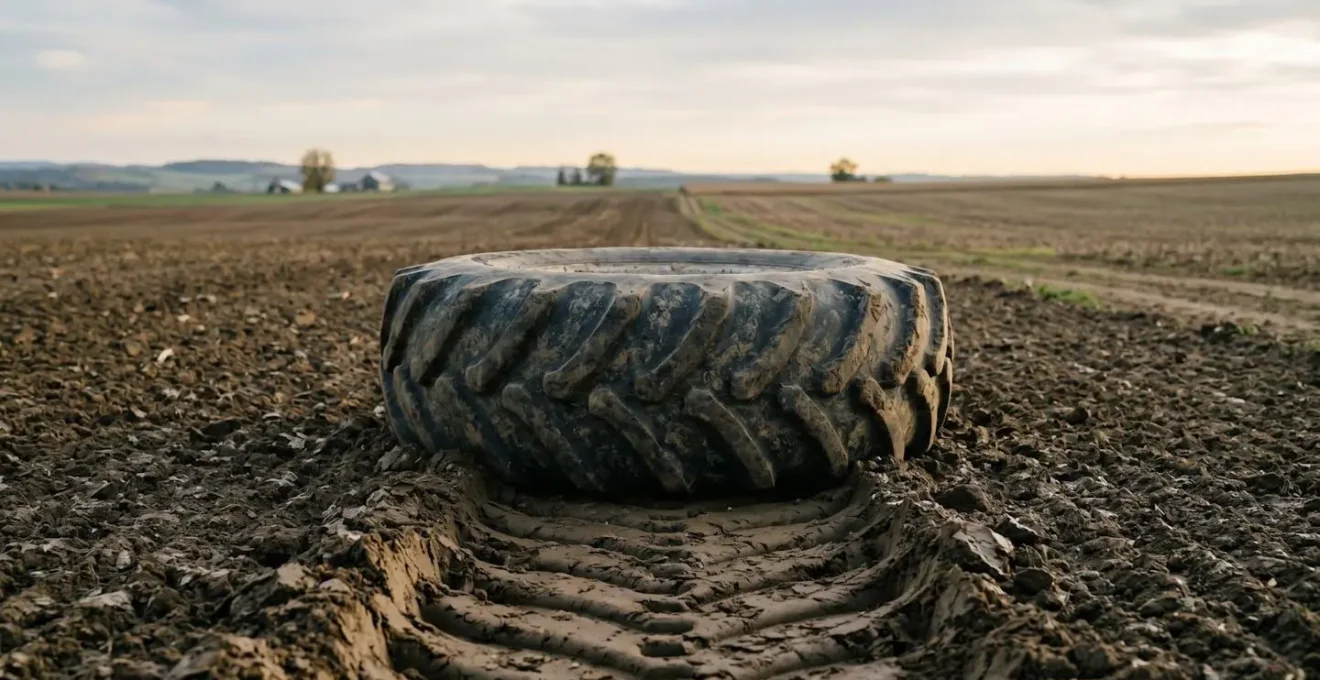
Contact pressure is the force exerted per unit area at the tyre-soil interface. It is primarily responsible for compaction in the topsoil (0-20 cm). High tyre pressures create a small, hard footprint that shears soil aggregates and seals the surface. This is why lowering tyre pressure, using wider tyres, or switching to tracks (which dramatically increases the footprint) is so effective at protecting the topsoil. It spreads the machine’s weight over a larger area, reducing the pressure at any single point.
However, axle load—the total weight on an axle—is the primary driver of deep subsoil compaction (below 30 cm). This type of compaction is far more persistent and damaging. No matter how low your tyre pressure is, the total weight of the machine is still transmitted into the soil. Once the load exceeds the soil’s bearing capacity, deep, yield-robbing hardpans are formed. An international soil compaction project, summarized by Penn State Extension, found that 10-12 ton axle loads reduced yields by approximately 15% in the first year, with residual effects lasting over a decade. This highlights a crucial point from soil physics:
Compaction in the topsoil is related to ground contact pressure only, compaction in the upper part of the subsoil is related to both ground contact pressure and axle load, and compaction in the lower subsoil is related to axle load only.
– International Soil Compaction Research Consortium
This distinction is vital for preventative management. Protecting the topsoil is about managing pressure, but protecting the valuable subsoil—which is almost impossible to fix economically—is about managing total weight. This means that after a wet harvest, the decision to travel with a fully loaded 20-ton grain trailer or slurry tanker is not just a logistical one; it is an economic decision with multi-year consequences for your soil’s porosity and yield potential.
Root Health: How Porosity Affects the Depth of Wheat Roots?
The health and extent of a crop’s root system are directly proportional to the volume of soil it can explore. For a crop like wheat, deep roots are essential for accessing water and nutrients stored in the subsoil, particularly during dry periods in the growing season. Soil compaction acts as a physical barrier, fundamentally limiting this exploration and, consequently, the crop’s resilience and yield potential. When roots encounter a compacted layer (a hardpan), their growth is either halted entirely or diverted horizontally, forcing the entire root system to exist within a shallow, rapidly depleted layer of topsoil.
This physical restriction has profound physiological consequences. A 2024 systematic review of 142 studies confirmed that, on average, wheat yields decreased by 4.1% in compacted soil, a direct result of compromised root function. The energy the plant expends trying to penetrate dense soil is energy not used for vegetative growth or grain production. Roots that do manage to find cracks or fissures are often deformed and inefficient at nutrient and water uptake.
The most dangerous aspect of compaction on root health is the creation of a « perched water table » above the hardpan. While the surface may appear dry, the soil immediately below can be saturated and anaerobic, suffocating roots. Conversely, the soil just below the hardpan can be rich in moisture, but completely inaccessible to the plant. This creates a paradoxical situation where the crop shows signs of drought stress even when there is ample water just centimeters out of reach.
Case Study: The 150mm Hardpan and Hidden Drought
Research on heavy machinery traffic documented the formation of a severe hardpan at 150mm depth, with soil bulk density reaching 1.93 Mg/m³. This layer proved physically impenetrable for wheat roots, leading to yield losses of up to 38%. The study observed that the crop’s root system was entirely confined to the shallow topsoil. Consequently, the crop was cut off from moisture and nutrient reserves in deeper layers, causing it to exhibit severe drought-like symptoms, despite ample moisture being present just below the compacted hardpan. The plants were effectively starving in the midst of plenty.
Therefore, maintaining soil porosity is not just about drainage; it’s about ensuring unrestricted access for roots to the entire soil profile. A deep, healthy root system is a crop’s best insurance against in-season weather variability. By preventing the formation of these root-limiting pans, farmers can unlock the full genetic potential of their crops and build a more resilient farming system.
Subsoiling vs Keyline Plowing: Which Better Aerates the B-Horizon?
When deep compaction in the B-horizon is identified, surface tillage is ineffective. Remediation requires intervention below the normal depth of cultivation. Two primary methods for this are traditional subsoiling and Keyline plowing. While both aim to alleviate compaction, they operate on fundamentally different principles and are suited to different situations. A critical, and often ignored, fact is that natural processes are not a solution here. As Penn State Extension states, « Research shows that subsoil compaction is not alleviated by freeze-thaw and wetting-drying cycles on any soil type. » Mechanical intervention is the only reliable option.
Subsoiling is an act of brute force. It involves pulling large, deep tines through the soil to physically lift and shatter the hardpan. Its primary goal is to break a distinct, continuous physical barrier. The effectiveness of subsoiling is highly dependent on soil moisture; it must be done when the subsoil is dry and brittle enough to shatter. If done when wet, the tine will simply smear and create further compaction. The major drawback of subsoiling is the high risk of re-compaction, as it leaves the soil loose and unstructured. It is essential to follow subsoiling with a deep-rooted cover crop to create biological channels and stabilize the newly fractured soil.
Keyline plowing, by contrast, is a more surgical approach. It uses a thinner shank with a smaller foot, designed to create a network of fine fissures and fractures rather than shattering the entire soil profile. Its primary goal, as part of the wider Keyline Design system, is to manage water flow across the landscape by creating channels that encourage infiltration. Because it is less disruptive, the risk of re-compaction is lower, and it maintains more of the existing soil structure. It is particularly effective on undulating terrain where managing surface water runoff is as important as aerating the subsoil.
The choice between the two methods depends on a precise diagnosis of the problem, as the following comparison illustrates.
This table, based on principles from soil compaction research by Penn State Extension, contrasts the two deep tillage approaches for aerating the B-horizon.
| Method | Mechanism | Primary Goal | Re-compaction Risk | Best Application |
|---|---|---|---|---|
| Subsoiling | Brute force deep lift that shatters hardpan | Breaking physical barriers | High – requires immediate cover crop planting | Flat uniform fields with distinct shallow hardpan |
| Keyline Plowing | Surgical fracturing creating fine fissure network | Water flow management across landscape | Lower – maintains some soil structure | Undulating terrain where water management is critical |
Subsoil compaction is below the depth of normal tillage operations. Research shows that subsoil compaction is not alleviated by freeze-thaw and wetting-drying cycles on any soil type.
– Penn State Extension, Effects of Soil Compaction
Why Slaking Happens and How It Seals Your Soil Surface?
Surface sealing, or crusting, is a physical phenomenon that chokes off a field’s ability to absorb water and air right at the surface. This process is driven by slaking, which is the breakdown of soil aggregates upon rapid wetting. Healthy soil is composed of stable aggregates—clumps of sand, silt, clay, and organic matter held together by biological glues like microbial secretions and fungal hyphae. These aggregates create the pore structure that allows for infiltration and gas exchange.
Slaking occurs when these aggregates are unstable and exposed to the high-impact energy of raindrops. When a raindrop hits a bare, unstable aggregate, the aggregate explodes. The water rushes into the micropores, causing trapped air to expand and break the clump apart from the inside. This process releases individual clay and silt particles, which are then carried by water into the spaces between larger particles. As the surface dries, these fine particles form a dense, impermeable crust, often only a few millimeters thick, that effectively seals the soil.
This surface seal has devastating effects. It drastically reduces water infiltration, leading to ponding and increased surface runoff, which carries away valuable topsoil and nutrients. It also forms a hard physical barrier that can prevent delicate seedlings from emerging, leading to poor crop stands. Furthermore, the seal prevents gas exchange between the soil and the atmosphere, starving the root zone of the oxygen necessary for healthy plant and microbial life. The root cause is a loss of biological activity, as explained by Iowa State University research.
Case Study: The Mechanism of Aggregate Breakdown
Iowa State University research has documented that frequent, intensive tillage without rest periods can lead to a total collapse of soil structure. This mechanical disturbance decimates soil organism populations, bringing essential microbial activity to a halt. Without the biological glues these organisms produce, soil aggregates lose their stability. When raindrops impact this bare, structureless surface, the aggregates disintegrate. The freed clay and silt particles become suspended in water and clog the surface pores, creating a ‘welded’ crust that is impermeable to water and lethal to emerging seedlings.
Preventing slaking is therefore a primary goal of soil management. It is not about preventing rain, but about ensuring the soil is resilient enough to withstand its impact. This resilience comes from maintaining a permanent cover on the soil surface (either living plants or crop residue) and fostering the biological activity that creates and maintains water-stable aggregates.
Key takeaways
- Compaction is a systemic failure of the soil’s pore network, reducing aeration and water availability, which directly limits yield even in fertile soils.
- Quantifying compaction is essential; a percolation test provides objective data on macropore function, enabling targeted, cost-effective remediation.
- Prevention is key: Managing axle load to prevent deep subsoil compaction and maintaining continuous soil cover to build stable aggregates are the most effective long-term strategies.
How to Maintain Aggregated Topsoil Structures to Prevent Runoff During Wet UK Winters?
For farmers in the UK, wet winters present a unique and severe challenge to soil structure. Saturated soils are at their most vulnerable to compaction and structural damage, while intense rainfall events can cause catastrophic runoff and erosion on bare ground. The key to navigating these conditions lies in proactively maintaining a stable, aggregated topsoil structure throughout the autumn and winter months. The goal is to ensure that the soil surface is always protected and that the soil profile is equipped to handle excess moisture. This requires a multi-pronged strategy focused on cover, biology, and timely management.
The first line of defence is keeping the soil covered. A canopy of a living cover crop or a blanket of crop residue absorbs the kinetic energy of raindrops, preventing the slaking process that leads to surface sealing. This simple act of protection is the single most important factor in preventing runoff. When infiltration is maintained, water can enter the soil profile where it can be stored or drained, rather than flowing across the surface, taking soil and nutrients with it. Studies have shown that no-till systems, which maximize residue cover, can reduce soil erosion by up to 90% compared to conventional tillage.
Beyond surface protection, fostering a network of biological pores is critical. Deep-rooted cover crops, such as tillage radish or chicory, act as « biodrills, » creating large, continuous macropore channels (or « biopore highways ») that can extend deep into the subsoil. These channels act as natural drainage pipes, safely conveying excess rainfall away from the vulnerable surface layer and into deeper soil horizons, significantly reducing the risk of waterlogging and anaerobic conditions. Implementing these strategies transforms the soil from a passive, vulnerable medium into a resilient, self-structuring ecosystem.
Here are several strategies specifically adapted for protecting soil structure during wet UK winters:
- Strategy 1: Establish Autumn Cover Crops: Select quick-establishing, UK-suitable species like mustard, phacelia, or winter oats before heavy winter rains to create a protective canopy and root network.
- Strategy 2: Build Biopore Highways: Plant deep-rooted species like tillage radish to create vertical macropore channels that convey excess rainfall safely into the subsoil.
- Strategy 3: Eliminate Machinery Traffic on Saturated Ground: Avoid all travel with heavy equipment, especially on clay soils at or near field capacity, to prevent smearing and deep compaction.
- Strategy 4: Implement Controlled Mob Grazing: Use short-duration, high-density grazing on cover crops to add organic matter, but use back-fencing to prevent livestock from ‘pugging’ and damaging wet soils.
- Strategy 5: Maintain Permanent Crop Residue Cover: Keep the soil surface protected throughout the winter to absorb raindrop impact and prevent aggregate breakdown and surface sealing.
To implement a truly effective soil management plan, the next logical step is to move from diagnosis to a consistent, long-term strategy. Start by mapping compaction across your most vulnerable fields and use that data to build a multi-year plan that incorporates cover crops, controlled traffic, and targeted remediation where necessary.