Transitioning to regenerative agriculture is not an expense; it’s a strategic investment in your farm’s most valuable asset: its biological capital.
- The dreaded « yield dip » is a manageable, budgetable cash flow event, not an inevitable catastrophe when planned correctly.
- Systematically replacing high-cost synthetic inputs with low-cost biological processes, guided by soil health data, is the key to protecting your bottom line.
Recommendation: Begin with a low-risk pilot on 10% of your acreage, focusing on building soil biology for a full season before aggressively cutting inputs.
The move towards a living soil system feels like a leap of faith, and let’s be honest, faith doesn’t pay the bills. You’ve heard the promises of long-term resilience and profitability, but you’re a business owner, and you’re rightfully terrified of the short-term financial risks. The stories of collapsing yields in the first few years are enough to keep any conventional farmer securely tethered to their current input program. The common advice to simply « add cover crops and stop tilling » often ignores the complex cash flow realities and the biological lag time that can sink an operation.
But what if the transition wasn’t a leap of faith, but a calculated business strategy? What if we could reframe the conversation from « ecological ideals » to « financial prudence »? The key isn’t to just stop doing what you’re doing; it’s to systematically and strategically replace the function of expensive synthetic inputs with robust, self-sustaining biological processes. This requires a shift in mindset: you are no longer just a crop manager, but a portfolio manager for your farm’s most critical asset—its living biology.
This guide is designed to be your consultant in a binder. We will walk through a pragmatic, step-by-step roadmap to de-risk the first 36 months of your transition. We won’t ignore the challenges; we will quantify them, budget for them, and implement data-driven strategies to overcome them. The goal is to build a « transition bridge » that gets you from a chemically dependent system to a biologically robust one without risking bankruptcy in year one. It’s about building a farm that is not only environmentally resilient but, more importantly, economically unstoppable.
This article provides a structured approach to navigating the financial and biological complexities of transitioning your farm. The following sections break down the critical decisions and strategic considerations you’ll face, from budgeting for initial yield changes to implementing a phased reduction in inputs.
Summary: The Farmer’s Roadmap to a Living Soil
- Why the ‘Yield Dip’ Happens and How to Budget for It Properly?
- How to Brewing Compost Tea to Wake Up Dormant Soil Biology?
- Wheat or Oats: Which Crop is Safer for the First Year of Transition?
- The « Cold Turkey » Mistake: Cutting Inputs Too Fast Before Biology is Ready
- Monitoring Earthworms: How to Count Populations to Track Recovery?
- Why Disrupted Nitrogen Cycles Cost UK Farmers £150 per Hectare Annually?
- Why Adding More Fertilizer Is No Longer Increasing Your Yields?
- Strategies for Input Reduction: Cutting Variable Costs by 15% Without Losing Yield?
Why the ‘Yield Dip’ Happens and How to Budget for It Properly?
The most significant barrier to transition is the fear of the « yield dip. » It’s a real phenomenon, but it’s not a mystery. It occurs because there’s a lag time: you’ve reduced the synthetic inputs that your system was dependent on, but the soil’s natural biology hasn’t yet woken up and rebuilt the systems to provide those nutrients for free. Your soil is essentially in withdrawal. During this « transition bridge, » which can last one to three years, the key is to manage cash flow, not just yield. It’s a temporary, predictable business cost, not a farming failure.
Think of it as a planned capital investment. A joint report from WBCSD and the Boston Consulting Group found that farmers can expect a temporary profitability loss of up to $40 per acre during the initial transition years. Instead of fearing this number, we budget for it. By anticipating this temporary dip, you can secure financing, adjust your business plan, and start on a small, manageable portion of your land—a 10% pilot plot, for instance. This contains the risk to a known variable.
The goal in years 1-2 isn’t to match your previous yields; it’s to break the cycle of dependency and begin building your farm’s biological capital. During this phase, you will likely see decreased yields but you’ll also be laying the groundwork for drastically lower input costs in the future. The financial plan must account for this temporary negative margin, treating it as an R&D expense that unlocks future profitability. By year six, the same report projects a potential ROI of 15-25%, a significant increase over conventional systems.
How to Brewing Compost Tea to Wake Up Dormant Soil Biology?
If the yield dip is caused by dormant biology, the first active step is to wake it up. You can’t expect a system that has been reliant on chemical inputs for decades to suddenly spring to life on its own. This is where biological inoculants, specifically high-quality compost tea, become a powerful and cost-effective tool. It’s not a fertilizer; it’s an infusion of life. You are re-introducing the diverse community of bacteria, fungi, and protozoa that will become your new workforce.
The goal is to kickstart the soil food web. These microorganisms are responsible for cycling nutrients, building soil structure, and protecting plants from pathogens—functions you were previously paying for with synthetic products. Research on regenerative farms has shown that this approach can lead to an up to 50% increase in microbial biomass, which is a direct measure of your growing biological capital. It is the most direct way to shorten the « transition bridge » and get your soil’s engine running again.
However, not all compost teas are created equal. Spraying « dead » tea with no active life is a waste of time and money. The key is quality control and strategic application. This is a precise biological operation, not just spraying brown water. It must be brewed correctly and applied at the right times to ensure the microorganisms survive and thrive.
Your Action Plan: Quality-Controlled Compost Tea Protocol
- Pre-Application Quality Control: Use a basic microscope (400x magnification minimum) to verify the presence and diversity of active bacteria, fungi, and protozoa before application. Reject any batch that doesn’t show a vibrant, diverse population of microbes.
- Strategic Timing: Apply during key plant physiological stages (e.g., post-transplant, pre-flowering) and in optimal weather conditions (moderate temperatures of 15-25°C, high humidity, and ideally after a rain for better soil penetration).
- Integration Within a Larger Toolkit: Use tea for rapid biological activation, but combine it with solid compost (for stable carbon), biochar (for microbial housing), and targeted inoculants like mycorrhizae for a complete biological fertility program.
Wheat or Oats: Which Crop is Safer for the First Year of Transition?
Your first crop in a transitioning field is critically important. It sets the tone for your soil’s recovery and your financial outlook. The goal for this first year isn’t to maximize yield, but to minimize risk and maximize soil-building. The ideal transition crop is one that is resilient, has a robust root system, and is less demanding of the high nitrogen levels that your soil biology is still learning to provide. In this context, crops like oats often present a safer bet than a high-demand crop like wheat.
Oats are renowned for their extensive fibrous root systems, which are excellent at scavenging for nutrients and creating channels in the soil that improve water infiltration and aeration. They are also known for producing biomass quickly, which helps to out-compete weeds and provides a protective layer of armor on the soil surface when terminated. This focus on soil health first can pay dividends quickly. A 2020-2023 study found that regenerative systems could achieve yields only 1% lower than conventional systems but with 62% less synthetic nitrogen, showcasing the power of a healthy system.

The choice also involves thinking about what comes next. An early-maturing oat crop allows for an ideal window to plant a diverse, multi-species cover crop cocktail in the summer. This is your chance to accelerate biological development by planting a mix of grasses, legumes (like vetch or clover to fix nitrogen), and brassicas (like tillage radishes to break up compaction). This « process substitution »—using a plant to do the work of a machine or a chemical—is a cornerstone of a profitable regenerative system.
The « Cold Turkey » Mistake: Cutting Inputs Too Fast Before Biology is Ready
One of the most common and costly errors in transitioning is the « cold turkey » approach: cutting off all synthetic inputs at once. This is the fastest way to experience a catastrophic yield dip. It’s born from a misunderstanding. The goal is not the absence of inputs, but the presence of robust biological function. You must earn the right to reduce your inputs by first building the biological system that can replace them.
A successful transition relies on a gradual, data-driven tapering schedule. Think of it like weaning an engine off a fuel additive. You don’t do it all at once; you do it incrementally while monitoring performance. In the first year, after establishing cover crops and seeing an initial bump in soil organic matter, a modest reduction of 10-15% in synthetic nitrogen might be appropriate. The key is to verify, not assume. Use tools like plant sap analysis to check for nutrient deficiencies in real-time, adjusting your strategy based on what the plant is telling you, not what the calendar says.
As your soil’s biological capital grows over several seasons, you can become more aggressive with reductions. Research demonstrates that a 10-25% nitrogen reduction is achievable over 3-5 years as soil health improves. The focus should be strategic, targeting the 20% of inputs that cause 80% of the biological harm, such as high-salt synthetic nitrogen fertilizers. These can be substituted first with biological alternatives like compost extracts or nitrogen-fixing cover crops, allowing the system to adapt without a major shock.
Monitoring Earthworms: How to Count Populations to Track Recovery?
How do you know if your investment in soil health is actually paying off? In a conventional system, you measure success in yield. In a regenerative system, you measure it in life. One of the simplest, most effective, and cheapest ways to track your progress is by getting out a spade and counting your earthworms. They are one of nature’s best bio-indicators. A healthy earthworm population is a clear sign that your soil structure, aeration, and nutrient cycling are improving. Studies consistently show that no-till fields can have 2-3 times more earthworms than tilled fields.
A simple spade test—digging a 20x20x20 cm cube of soil and counting the worms—is a powerful lagging indicator. It confirms that the biology you’ve been fostering has become established. A target of 8-10 worms per spadeful indicates a healthy, functioning system. But to manage your transition proactively, you also need leading indicators—metrics that predict future success before it shows up in your yield or worm count.
This is where a data-driven approach becomes essential. Tests like soil respiration (Solvita) can give you a snapshot of microbial activity in 24 hours. Water infiltration tests show how well your soil structure is recovering. These leading indicators tell you if your management practices are working in near real-time, allowing you to make adjustments long before a problem impacts your bottom line. They are your new key performance indicators (KPIs).
The framework below distinguishes between these two crucial types of indicators. A financially prudent transition relies on monitoring the leading indicators to ensure the lagging indicators will eventually confirm your success.
| Indicator Type | Test Method | Timeframe | Predictive Value | Cost |
|---|---|---|---|---|
| Leading Indicators (Predict Future Success) | Soil Respiration (CO2 burst test) | Results in 24 hours | High – shows active microbial activity | Low ($20-50/test) |
| Microbial Biomass Carbon | Results in 1 week | Very High – directly measures living soil biology | Medium ($75-150/test) | |
| Water Infiltration Rate | Real-time field test | High – indicates soil structure recovery | Free (DIY) | |
| Lagging Indicators (Confirm Past Success) | Earthworm Count (spade test) | Real-time field test | Medium – confirms established biology | Free (DIY) |
| Soil Organic Matter % | Results in 1-2 weeks | Low – changes very slowly (1-2%/year) | Low ($30-60/test) | |
| Plant Brix Levels (refractometer) | Real-time field test | Medium – shows current plant health status | Low ($50 equipment) |
Why Disrupted Nitrogen Cycles Cost UK Farmers £150 per Hectare Annually?
The push to transition isn’t just about an ecological ideal; it’s a response to a broken economic model. The current dependency on synthetic nitrogen has created a system that is both financially and biologically unsustainable. For farmers in the UK, the reliance on external inputs to manage a disrupted natural nitrogen cycle comes with a heavy price tag, estimated at around £150 per hectare every year. This cost is a direct drain on profitability, a symptom of a system working against itself.
When soil biology is degraded, its natural ability to fix atmospheric nitrogen and cycle organic nitrogen is lost. This forces farmers onto a treadmill of purchasing synthetic fertilizers to feed the plant directly, bypassing the soil’s own engine. This dependency creates a fragile system, vulnerable to supply chain disruptions and volatile price spikes. The global scale of this issue is staggering; in the US alone, the environmental and health impacts of nitrogen pollution from agriculture are estimated to cost $157 billion annually.

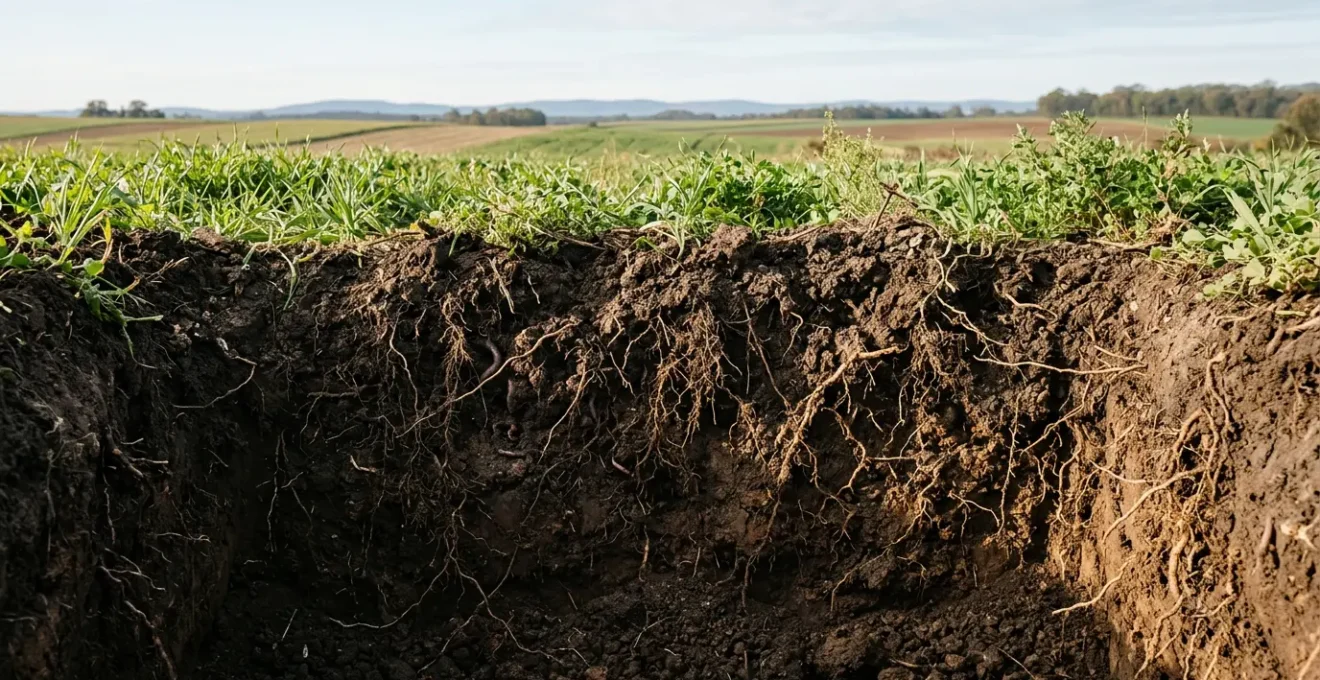
This image of degraded soil is the direct result of that broken cycle. Over-application of synthetic nitrogen can lead to soil acidification, compaction, and a loss of organic matter, which in turn kills off the very soil life that could provide nitrogen for free. It’s a vicious cycle where the « solution »—more fertilizer—actually worsens the long-term problem, requiring even more inputs the following year just to stand still. Transitioning to a living soil model is about breaking this cycle and turning a major cost center into a source of natural, resilient fertility.
Why Adding More Fertilizer Is No Longer Increasing Your Yields?
For decades, the mantra was simple: more fertilizer equals more yield. But many farmers are now hitting a wall. They are applying more and more expensive inputs only to see yields stagnate or even decline. This isn’t a failure of effort; it’s a sign of a system reaching its biological limit. This is the law of diminishing returns in action, and it’s a direct consequence of soil degradation.
The problem lies in efficiency. In a degraded soil with low biological activity, the plant’s ability to take up nutrients is severely compromised. The soil structure is poor, water infiltration is low, and the microbial bridge that transports nutrients to the plant roots is broken. As a result, a shocking amount of the fertilizer you apply is simply lost, washing away into waterways or gassing off into the atmosphere. Recent analysis highlights this inefficiency, showing that up to 50% of fertilizer applied remains unused by crops. You are paying for 100% of the product but only getting, at best, 50% of the benefit.
This is a critical turning point in perspective. The bottleneck to higher yields is no longer the amount of fertilizer you apply; it’s your soil’s capacity to process and deliver it. Continuing to pour more inputs into a broken system is like trying to fill a bucket with a hole in the bottom. No matter how much you pour in, you can never fill it up. The only solution is to fix the bucket. In this case, that means rebuilding your soil’s structure, health, and biological capital.
Key Takeaways
- Acknowledge and budget for a temporary « yield dip » as a planned business expense, not a farming failure.
- Prioritize waking up soil biology with tools like compost tea before making aggressive cuts to inputs. The biology must be in place to do the work.
- Use a data-driven approach, monitoring leading indicators like soil respiration to guide your transition and verify that your investments in soil health are paying off.
Strategies for Input Reduction: Cutting Variable Costs by 15% Without Losing Yield?
Once you’ve started rebuilding your soil’s biological engine, you can begin the most profitable phase of the transition: strategically reducing your input costs. This isn’t about blindly cutting back; it’s about making smart substitutions. You replace a purchased, synthetic function with a free, biological one. This is where regenerative agriculture moves from a cost to a significant profit driver, with some research indicating that mature systems can see 30-40% lower input costs compared to conventional operations.
The strategy is rooted in the 80/20 principle. Identify the 20% of your inputs that are causing 80% of the cost and biological damage, and target those first. This often means focusing on synthetic nitrogen and tillage. By introducing nitrogen-fixing cover crops, you can grow your own nitrogen. By adopting no-till or strip-till practices, you save fuel, labor, and equipment wear while allowing fungal networks to establish themselves. Each step reduces your variable costs and your reliance on volatile external markets.
This is not a theoretical exercise. Real-world farms are proving the financial viability of this model every day. The right combination of practices, tailored to your specific context, can lead to dramatic improvements in profitability, even without a significant change in overall yield.
Case Study: Swede Family Farm’s Profitable Transition
A powerful example comes from the Swede family farm in the US. By implementing strip-till and cover crops on 1,500 acres, they achieved a remarkable result. Their bottom line increased by $55 per acre, for a total annual profit increase of $82,257. This was achieved while simultaneously reducing nitrogen, phosphorus, and sediment losses by 40%, 92%, and 96% respectively. This case study demonstrates that focusing on soil health is a direct path to increased financial performance, turning environmental stewardship into a powerful economic advantage.
The transition to a living soil is a journey, not a destination. By starting with a pilot program, focusing on building biology, and using data to guide a gradual reduction in inputs, you can navigate the process strategically and profitably. Start today by taking a spade to your quietest field and seeing what life is already there, waiting to be unleashed.