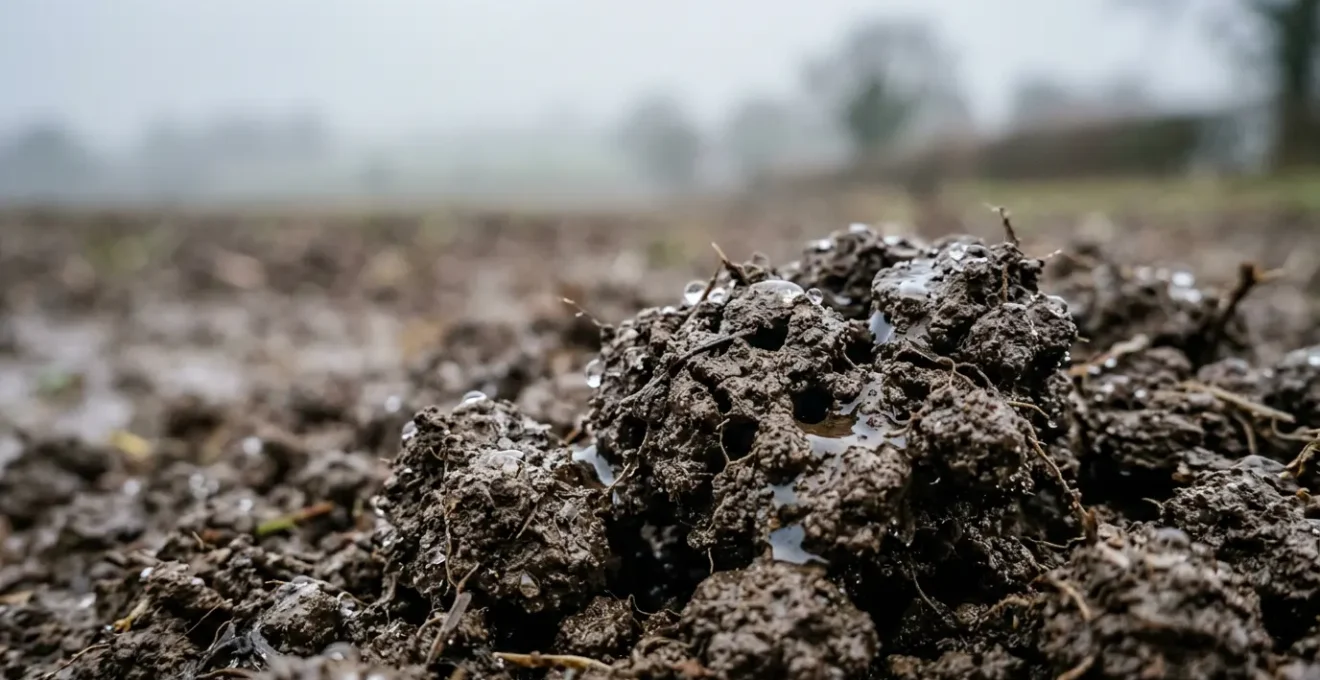
Protecting your farm from winter runoff isn’t about fighting the weather, but building a soil structure that works with it.
- The key is fostering a ‘biological glue’ (glomalin) and physical ‘flocculation’ to create stable aggregates that resist the force of heavy rain.
- Switching from high-disturbance methods like power harrowing to direct drilling and using tailored cover crops creates a lasting ‘structural legacy’ of resilience.
Recommendation: Start by performing a simple porosity and structure test to diagnose your soil’s current health before the next drilling season.
The sight is all too familiar for arable farmers in the UK’s high-rainfall regions: muddy water pooling, then streaming across a field, taking with it the most valuable asset you own – your topsoil. With winters becoming increasingly wet, the battle against erosion and runoff feels relentless. Common advice often revolves around general principles like reducing tillage or planting cover crops, but these recommendations can feel vague when faced with the sheer force of a winter storm.
These practices are part of the solution, but they are not the whole story. True resilience doesn’t come from a single action, but from a deep understanding of your soil’s structural integrity. It’s about transforming your topsoil from a fragile, easily eroded layer into a robust, living system—a ‘Soil Armour’ capable of absorbing and managing water effectively. This requires a shift in perspective: from simply treating symptoms to proactively building a soil with a strong physical and biological foundation.
This guide moves beyond the platitudes. We will dissect the very mechanisms of soil collapse, like slaking, and explore the powerful biological and chemical tools at your disposal to counteract them. We will look at how fungal networks can glue your soil together, how strategic crop choices can build structure from below, and how a change in machinery can preserve the very life you’re trying to foster. The goal is to arm you with the knowledge to create a lasting structural legacy, ensuring your soil not only survives the winter but thrives for years to come.
This article provides a structural, weather-aware framework for building soil resilience. The following sections will guide you through the core principles and practical actions needed to protect your topsoil against the challenges of modern UK winters.
Summary: A Structural Guide to Winter-Proofing Your Soil
- Why Slaking Happens and How It Seals Your Soil Surface?
- How to Use Glomalin from Fungi to Glue Soil Particles Together?
- Power Harrow vs Direct Drill: Which Destroys Soil Aggregates Faster?
- The Over-Grazing Error That Shatters Topsoil Structure in Winter
- Using Gypsum: How to Flocculate Clay Particles to Improve Drainage?
- How to Deepen the A-Horizon by 2cm per Year Using Cover Crops?
- Compaction Busting: How to Ensure Water Enters the Soil Profile Fast?
- How to Perform a Porosity Test to Check for Compaction Before Drilling?
Why Slaking Happens and How It Seals Your Soil Surface?
The primary enemy of soil structure during a wet UK winter is a process called slaking. This is not simply soil getting wet; it’s the rapid disintegration of soil aggregates when they are exposed to water. When a heavy winter downpour hits a poorly structured or bare soil, the force of the raindrops shatters these aggregates. Furthermore, as water rushes into the pore spaces, it traps air, which then expands and explodes the aggregate from within. This collapse releases individual clay and silt particles, which then clog the soil’s surface pores.
The result is a sealed, impermeable crust, almost like a layer of concrete. Once this crust forms, water can no longer infiltrate the soil profile. Instead, it pools on the surface and begins to move downhill, gaining energy and carrying away the fine, fertile particles of your topsoil. This is the genesis of runoff and erosion. The scale of this issue is significant; with UK winter rainfall having increased, the risk of soil degradation is escalating. In fact, sobering research led by Rothamsted Research shows that 38% of arable soils in England and Wales are degraded, with compaction and erosion being major contributors.
The image below provides a stark visual demonstration of this process, comparing a stable, healthy soil aggregate with one that is undergoing slaking.
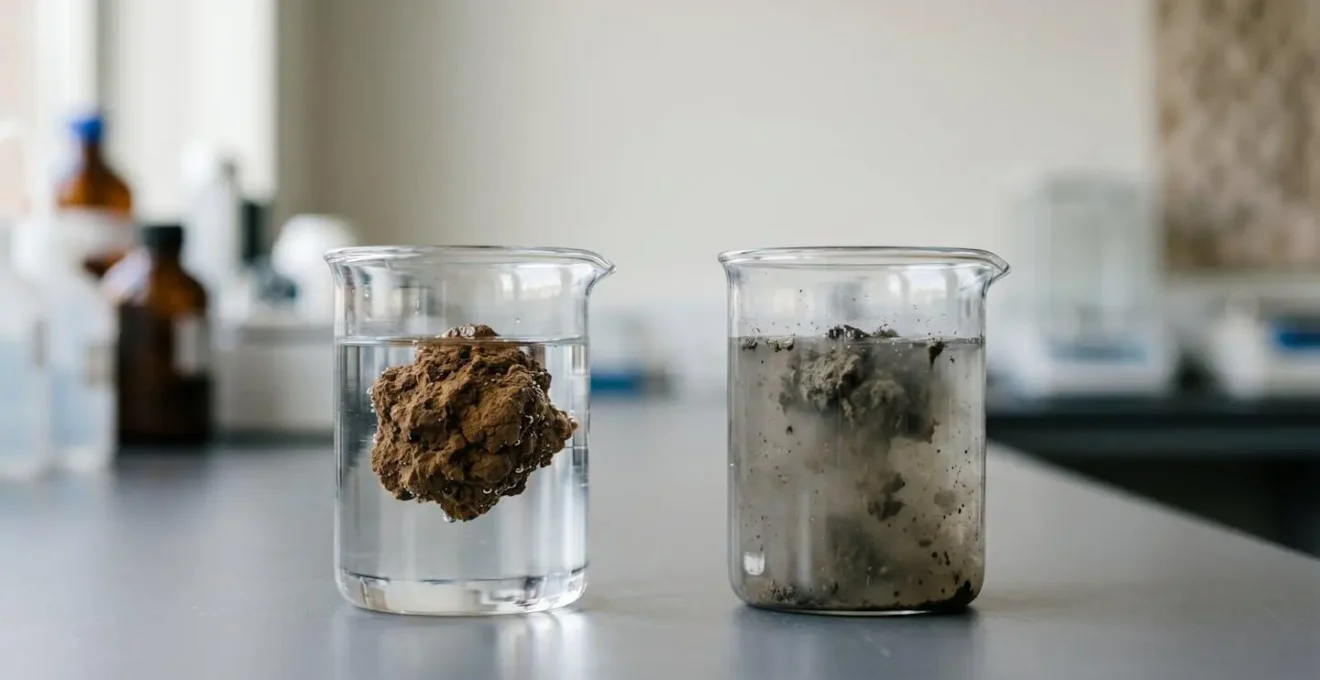
As you can see, the healthy soil on the left maintains its integrity, held together by organic matter and biological activity. The degraded soil on the right collapses into a cloudy suspension, its structure completely lost. Understanding this fundamental process of slaking is the first step in building a defence system. The goal is to create aggregates that are waterproofed and bound tightly enough to resist this explosive disintegration. This is where the biology of your soil becomes your greatest ally.
How to Use Glomalin from Fungi to Glue Soil Particles Together?
If slaking is the enemy, then glomalin is your secret weapon. This remarkable substance is a glycoprotein produced by the hyphae (root-like threads) of arbuscular mycorrhizal fungi (AMF). It acts as a powerful, water-resistant biological glue, binding soil particles—sand, silt, and clay—into stable macroaggregates. These glomalin-coated aggregates are far more resistant to the explosive force of water, effectively waterproofing them against slaking. A soil rich in AMF networks is a soil that can hold itself together during a deluge.
The key to increasing glomalin is to create an environment where AMF can thrive. These fungi form a symbiotic relationship with plant roots, so continuous living roots are essential. Fallowing fields or using aggressive tillage methods that sever the fungal hyphae network are detrimental. Conversely, practices like no-till or direct drilling preserve these delicate underground structures. Indeed, a study of winter wheat systems in Hertfordshire, UK found that glomalin and water stable aggregates were significantly greater in zero tillage versus conventional tillage soils. This demonstrates a direct link between management practice and the production of this crucial soil-binding agent.
Encouraging a diverse and healthy fungal population is a long-term investment in your soil’s structural legacy. It’s about farming the life beneath the surface as much as the crop above it.
Case Study: Fostering Fungal Allies in UK Soils
Recognising the importance of these fungal partners, an AHDB-funded research project at NIAB investigated the impact of UK farm practices on AMF communities. The assessment identified 87 distinct AMF taxa actively supporting British agriculture. A key finding was that while single, one-off cover crops had little measurable impact, the long-term, consistent use of cover crops delivered tangible positive effects on the diversity and health of these vital fungal populations. This underlines the principle that building soil structure is not a quick fix, but a result of sustained, supportive management choices over multiple seasons.
Power Harrow vs Direct Drill: Which Destroys Soil Aggregates Faster?
The choice of establishment method has a direct and profound impact on the structural integrity you are trying to build. At one end of the spectrum is the power harrow, a tool that creates a fine, aesthetically pleasing seedbed. However, its high-speed, aggressive mechanical action is the antithesis of structure building. It pulverises soil aggregates, shatters the mycorrhizal fungal networks that produce glomalin, and leaves a layer of fine particles that is exceptionally vulnerable to slaking and crusting. It is, in essence, a reset button for soil structure every season.
At the other end is the direct drill. This low-disturbance approach aims to place the seed with minimal soil movement. By cutting a narrow slot for the seed and leaving the rest of the soil surface and its residue intact, it preserves the existing aggregate structure, worm channels, and fungal hyphae. This creates what is known as a structural legacy, where the benefits of one season’s root growth and biological activity are carried over to the next. The soil becomes a progressively more resilient hydrological sponge, capable of infiltrating and storing water rather than shedding it.
The economic and structural benefits are deeply intertwined, as high-disturbance methods come with higher costs in fuel, time, and machinery wear. The table below, based on data and principles from UK farm advisors and manufacturers, provides a clear comparison of the impact of these different establishment systems.
This comparison highlights the stark differences in cost and soil impact, as demonstrated by data from a UK-based analysis of drilling systems.
| Establishment Method | Fuel Consumption | Machinery Wear | Cost per Hectare (Estimate) | Soil Structure Impact |
|---|---|---|---|---|
| Power Harrow + Drill | High (multiple passes) | High (£14,267 spare parts annually – pre-2006 example) | Significantly higher | Destroys aggregates through intensive mechanical action |
| Direct Drill (No-till) | Low (single pass, 70% reduction possible) | Low (£2,277 spare parts annually – 2006 example) | £30+/acre (110 euro/ha) savings on lightest soils | Minimal disturbance, preserves mycorrhizal networks and aggregate structure |
| Controlled Traffic Farming (CTF) | Optimized (wheelings cover 22% vs 80-90% without CTF) | Reduced overall | Further savings through reduced compaction remediation | Soil damage isolated to known tramlines, 78% of field undamaged |
While the transition requires a shift in mindset and management, moving away from high-impact tillage is a non-negotiable step for any farmer serious about building a soil armour that can withstand a wet UK winter. The evidence shows that what is good for your soil structure is ultimately good for your bottom line.
The Over-Grazing Error That Shatters Topsoil Structure in Winter
For mixed farms or those incorporating livestock into their rotation, winter grazing management is a critical control point for soil structure. Allowing stock to graze on saturated soils is one of the fastest ways to undo years of careful structure building. The concentrated weight of a hoof on wet ground acts like a piston, destroying aggregates, closing pore spaces, and creating a compacted layer that water cannot penetrate. This is particularly damaging in high-traffic areas like around ring feeders or gateways.
The guidance from authorities is unequivocal. As NetRegs, which provides environmental guidance for Northern Ireland and Scotland, states, farmers should « Avoid over-wintering of stock on waterlogged soils… which can lead to soil compaction, run-off and erosion. » This isn’t just about preventing poaching; it’s about protecting the very porosity that allows your soil to function as a hydrological sponge. When that porosity is lost to compaction, infiltration rates plummet, and runoff becomes inevitable, carrying nutrients and sediment with it.
The solution lies in controlled management. This means having a plan for housing stock or moving them to a designated, well-drained sacrifice paddock during the wettest periods. Rotational or mob grazing systems, where animals are moved frequently, can also mitigate the damage by preventing prolonged pressure on any single area. The key principle is to keep livestock off vulnerable soils when they are wet and plastic. Protecting your soil from hoof pressure during winter is just as important as protecting it from a power harrow.
Using Gypsum: How to Flocculate Clay Particles to Improve Drainage?
On heavy clay soils, which are common across the UK, poor drainage is often exacerbated by a chemical as well as a physical issue. Clay particles carry a negative electrical charge, which causes them to repel each other. In soils with high levels of magnesium relative to calcium, this repulsive force is strong, keeping the clay particles dispersed in a ‘tight’ or ‘blocky’ structure that is slow to drain. The goal is to get these tiny particles to clump together in a process called flocculation.
This is where gypsum (calcium sulfate) can be a powerful tool. The calcium ions (Ca2+) in gypsum have a double positive charge, which acts as a chemical bridge between negatively charged clay particles, pulling them together into small aggregates or ‘floccules’. This process is not the same as building large, stable macroaggregates with organic matter, but it is a critical first step. It improves the soil’s micro-structure, creating tiny channels between the floccules that allow water and air to move more freely. This improves drainage, reduces surface crusting, and makes the soil more friable and easier to work.
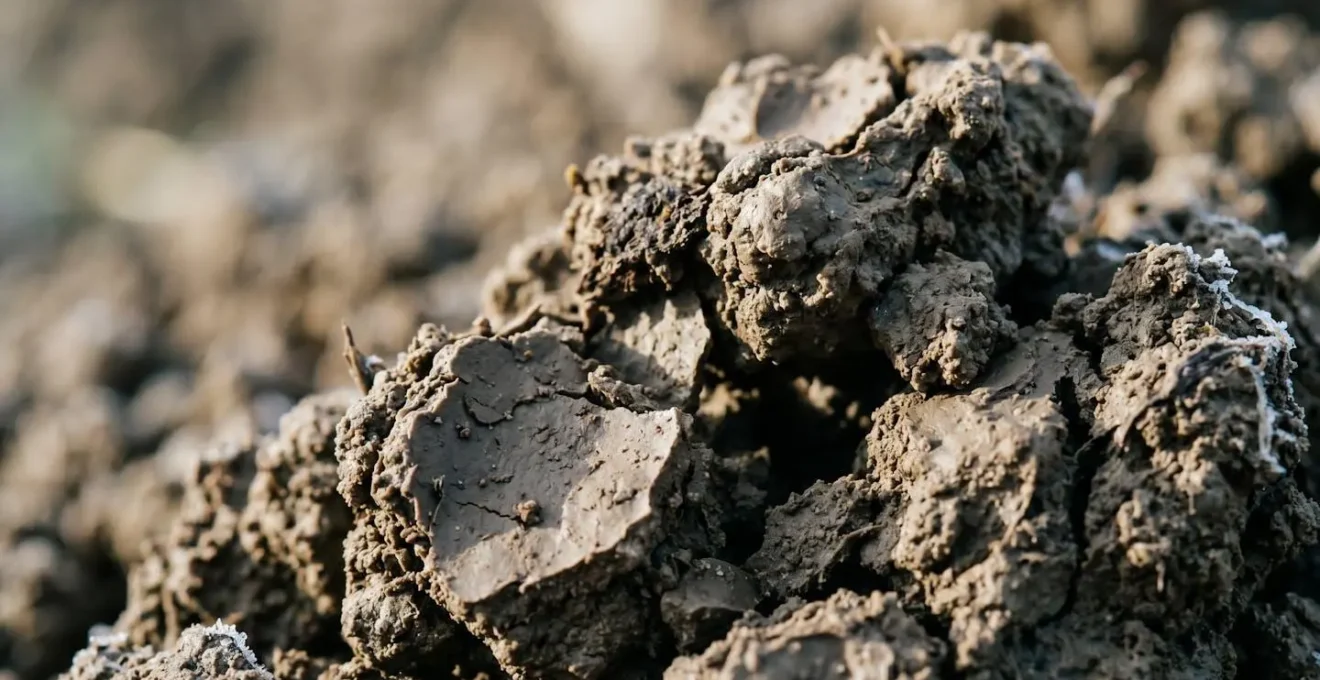
This macro photograph shows the result of good flocculation: a crumbly, well-structured clay soil with visible pores, ready to let water pass through.
However, application requires a measured approach. As a UK farmer’s experience reported by Farmers Weekly demonstrates, a cautious, test-led strategy is wisest. The farmer, facing waterlogging on heavy clay, first conducted a soil assessment that revealed the ‘tight’ structure. A trial was then implemented, applying calcium lime (another source of calcium) to a 100m test strip. This allows for direct comparison against a control area before committing to a whole-field application, ensuring the investment is justified by visible improvements in soil structure and infiltration.
How to Deepen the A-Horizon by 2cm per Year Using Cover Crops?
One of the most powerful long-term strategies for building a resilient soil armour is the consistent use of cover crops. Their role extends far beyond simply protecting the soil surface over winter. The right mix of species can actively build topsoil, deepen the A-horizon (the most productive layer), and create a lasting structural legacy. The goal of deepening the A-horizon by a tangible amount, such as 2cm per year, becomes achievable through the targeted action of different root systems.
The mechanism is twofold: biological and physical. Biologically, the continuous living roots feed the soil microbiome, including the AMF that produce glomalin. They add significant amounts of organic matter as they grow and decay. Physically, different root architectures perform different jobs. Fibrous, shallow roots of cereals like rye and oats are excellent for creating a dense mat that binds the surface soil. Deep, powerful taproots of species like tillage radish or chicory act as ‘bio-drills’, punching through compacted layers, creating deep channels for water infiltration, and bringing nutrients up from the subsoil.
The UK government now actively encourages this practice through financial incentives. For instance, under the UK government’s Sustainable Farming Incentive, farmers can receive £129 per hectare for planting a multi-species winter cover crop (Action CSAM2). This financial support makes the investment in seed and establishment more viable, recognising it as a public good. Choosing the right mix is critical and depends on your specific soil type and goals, as the following table illustrates.
| Soil Type | Cover Crop Mix Name | Recommended Species | Primary Goal | UK Climate Suitability |
|---|---|---|---|---|
| Heavy Clay (London Clay, Mercia Mudstone) | The Clay Buster | Tillage Radish, Phacelia, Vetch | Deep rooting to create drainage channels, break compaction, add nitrogen | Excellent for wet UK winters; radish acts as ‘bio-drill’ |
| Sandy / Light Soils | The Sandy Soil Builder | Cereal Rye, Crimson Clover, Oats | Build organic matter, improve water retention, prevent erosion | Well-suited to UK; winter-hardy species; rye excellent for biomass |
| Silty Loams (East Anglia) | Multi-Species Winter Mix | Rye, Oats, Vetch, Clover (4+ species minimum for SFI eligibility) | Stabilize slaking-prone silts, reduce erosion risk, diverse rooting depths | Ideal for high-rainfall slaking risk areas; rapid establishment essential |
| General Arable (All Soil Types) | Diverse 6-Species Mix | Chicory (deep tap root), Tillage Radish, Phacelia, Vetch, Oats, Clover | Balanced: compaction relief + OM building + nitrogen fixation | Versatile; mix covers SFI requirements (minimum 2 species from 2+ plant families) |
Compaction Busting: How to Ensure Water Enters the Soil Profile Fast?
Even with good aggregate stability, if a dense, compacted layer exists just below the surface, water infiltration will grind to a halt. This ‘plough pan’ or ’tillage pan’ acts as a barrier, causing water to move sideways rather than downwards, leading to waterlogging and increasing the risk of surface runoff. Breaking up this compaction is essential to unlocking your soil’s full capacity as a hydrological sponge. There are two primary approaches: mechanical and biological.
The mechanical solution involves using implements like a subsoiler or aerator. A subsoiler is a strategic, often one-off intervention designed to lift and shatter a deep, dense pan. However, its success is critically dependent on soil moisture; using it in wet conditions will cause smearing and make the problem worse. The ‘plasticine test’ is vital: the soil should be dry enough to crumble, not smear. Aerators are less aggressive, creating smaller channels to improve air and water movement closer to the surface.
The biological solution is a more sustainable, long-term approach that works in synergy with the soil. As we’ve seen, planting deep-rooting cover crops like chicory, sweet clover, or tillage radish can create a network of stable, deep channels. As these roots decay, they leave behind pathways for water to follow deep into the soil profile. This approach builds resilience from within. As Professor Paul Hallett of the University of Aberdeen notes, nature has its own recovery mechanisms.
Some soils will recover if deeper rooted crops in the rotation or cover crops that can push through these layers are sown. Natural shrinking and weathering and the addition of organic matter that works its way down into the profile will also help.
– Professor Paul Hallett, University of Aberdeen
The most effective strategy often combines both methods: a one-time mechanical subsoiling pass to break up a historical pan, followed by a consistent programme of deep-rooting cover crops to stabilize the newly created fissures and build a lasting, self-maintaining drainage system.
Key Takeaways
- Soil resilience to winter rain is built on stable aggregates, created by fostering ‘biological glues’ like glomalin from mycorrhizal fungi.
- Low-disturbance practices like direct drilling are essential to preserve the soil’s ‘structural legacy’ and fungal networks, while power harrowing actively destroys them.
- A combination of biological solutions (deep-rooting cover crops) and strategic interventions (gypsum for clays, occasional subsoiling) creates a robust, self-defending ‘Soil Armour’.
How to Perform a Porosity Test to Check for Compaction Before Drilling?
You can’t manage what you don’t measure. Before investing in seed, fuel, and amendments, the most crucial first step is to understand the current state of your soil’s structure. A simple on-farm assessment can reveal the presence of compaction, the stability of your aggregates, and your soil’s ability to infiltrate water. This diagnostic work provides a baseline, allowing you to target interventions where they are most needed and track your progress over time. The Visual Evaluation of Soil Structure (VESS) method, promoted by the AHDB, is the UK standard and a great place to start. After a record wet winter, the 30% increase in the occurrence of structurally degraded topsoils found by researchers highlights the urgency of such checks.
Performing these tests doesn’t have to be a burden; it can be an investment. In the UK, this diagnostic work itself is recognized and rewarded. For example, undertaking a soil assessment and producing a management plan is the foundation of the SFI action CSAM1, which provides a payment per agreement and per hectare. This turns the essential task of ‘spade-work’ into a financially supported activity, framing it as the first step in a long-term partnership to improve your farm’s most valuable asset. The following checklist outlines the key steps for a comprehensive on-farm porosity and structure audit.
Your 5-Step Soil Structure Audit Plan (VESS Method)
- Gather Your Tools: You’ll need a spade, a 6-inch water pipe or infiltration ring, a smartphone for photos, and a VESS scorecard (available from AHDB) to objectively score what you see.
- Dig and Assess the Profile: Dig a soil block and carefully lay it on a plastic sheet. Evaluate the structure, noting the difference between topsoil and subsoil. Break the block apart by hand to assess the aggregates. Are they crumbly (good) or blocky and hard (compacted)?
- Conduct an Infiltration Test: Drive your infiltration ring 7.5cm into the soil. Pour in a set amount of water (e.g., equivalent to 2.5cm) and time how long it takes to disappear. Compare a spot in the field centre with an un-trafficked area like a hedge-line to see the impact of management.
- Perform a Bulk Density Check: For a more quantitative measure, use a cylinder of a known volume to take a soil core. Dry the soil completely (microwaving in short bursts works) and weigh it. The resulting bulk density figure is a direct indicator of compaction intensity for your soil type.
- Qualify for SFI Funding: Frame this entire assessment as the first step for the SFI action ‘CSAM1’. Document your findings, photos, and test results to create a formal soil management plan, turning your diagnostic effort into a paid activity.
By taking the time to dig, observe, and test, you move from guessing to knowing. This knowledge is the true foundation of a protective, resilient, and profitable farming system ready for any weather.
Start today by scheduling time before your next field operation to conduct this simple but revealing soil audit. The insights you gain from a single hole in the ground will provide the roadmap for building a more resilient and profitable farm for years to come.