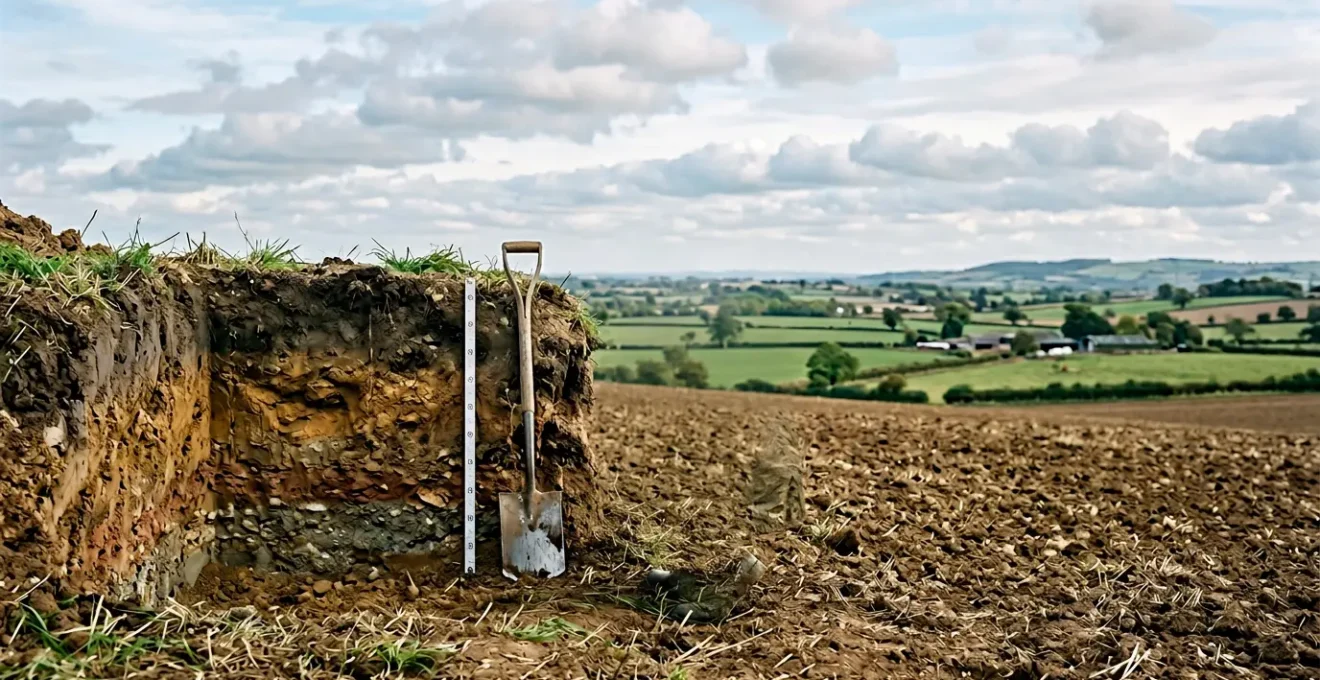
The true value of agricultural land is determined by its hidden pedological structure, not just its location; overlooking deep-seated compaction or drainage flaws can devalue a property by thousands per acre.
- Historical compaction, forming a « plough pan, » is a major hidden liability that throttles root growth and significantly reduces yield potential.
- Simple, low-cost DIY assessments like the ‘Jar Test’ provide crucial data on soil texture, which dictates crop suitability and future management costs.
- A lack of functional land drainage is a ticking financial time bomb, with remediation costs easily running into thousands of pounds per hectare.
Recommendation: Treat deep soil assessment as the most critical component of your financial due diligence, with the same rigour you would apply to a building’s structural survey.
For a new farmer or an investor, the purchase of agricultural land is the foundation of a business. It’s an investment loaded with both opportunity and potential pitfalls. Many buyers focus on location, acreage, and existing infrastructure—all vital considerations. They might even take a cursory look at the topsoil. However, this superficial approach overlooks the most critical and often invisible factor determining the land’s long-term profitability and resilience: its deep pedological foundation.
The most expensive mistakes in land acquisition are not made on a map, but a spade’s depth beneath the surface. Seemingly healthy fields can conceal decades of mismanagement in the form of compacted layers that act as a concrete barrier to roots and water. These are not minor agricultural inconveniences; they are significant financial liabilities that can throttle yields, inflate running costs, and drastically devalue the asset you have just purchased. A picturesque landscape can easily hide a structural nightmare.
This guide moves beyond the basics. We will not just talk about ‘good soil’; we will adopt the cautionary mindset of a land surveyor and soil scientist. The crucial question is not « Is this soil good? » but rather « What are the hidden structural defects and pedological liabilities of this asset, and what will they cost me? » We will provide the framework to dissect the soil profile, quantify risks, and ultimately determine the true commercial potential of a piece of UK agricultural land before you sign on the dotted line.
This article provides a detailed roadmap for your due diligence. Below is a summary of the critical checkpoints we will cover, from identifying historical damage to valuing the land’s natural capital for the future.
Summary: A Due Diligence Framework for Assessing UK Farmland Soil
- Why Historical Plough Pans Can Devalue Land by £2,000 per Acre?
- How to Perform a ‘Jar Test’ to Determine Texture Class in 24 Hours?
- Clay vs Sandy Loam: Which Pedology Suits Market Gardening Best?
- The Drainage Oversight That Turns Good Soil into a Waterlogged Nightmare
- Restoring Structure: How to Fix Capped Soils Within 3 Years
- The Soil Erosion Liability That Devalues Your Land Portfolio
- Blocky vs Crumb Structure: What Your Subsoil Is Telling You?
- Preserving Natural Capital: How to Valuate Your Farm’s Ecological Assets?
Why Historical Plough Pans Can Devalue Land by £2,000 per Acre?
Before any other assessment, you must investigate the primary hidden threat to UK farmland value: soil compaction. A plough pan is a dense, compacted layer in the subsoil, typically formed by years of ploughing to the same depth and heavy machinery traffic. This is not a surface issue; it is a profound structural defect. This layer acts like an underground concrete slab, physically impeding root development, restricting water infiltration, and starving plants of deep soil moisture and nutrients. It is a critical pedological liability.
The financial consequences are staggering. Poor soil structure is a silent drain on profitability, with estimates from Cranfield University suggesting soil compaction is costing UK agriculture over £1 billion per year through reduced yields and increased input costs. Research has demonstrated that as soil density increases from a healthy 1.35t/m³ to a compacted 1.50t/m³, yield losses of 10-15% are common. For high-value crops, this lost revenue, combined with the significant cost of remedial subsoiling, can easily equate to a devaluation of £2,000 per acre or more compared to a parcel with good structural integrity.
When you walk a potential property, you are not just buying land; you are inheriting its history. The presence of a historical plough pan means you are acquiring a pre-existing condition that will require significant investment and time to rectify. Ignoring this during due diligence is akin to buying a house without checking for subsidence.
How to Perform a ‘Jar Test’ to Determine Texture Class in 24 Hours?
While a professional survey is essential, you can gain a significant amount of preliminary information with a simple, low-cost diagnostic tool: the ‘Jar Test’. This procedure allows you to determine your soil’s texture—the relative proportions of sand, silt, and clay. This is a fundamental characteristic that dictates everything from water retention and nutrient holding capacity to how the soil behaves when wet. It’s a cornerstone of any pedological assessment.
Performing this test gives you a first-hand, tangible connection to the soil you are considering buying. It moves the assessment from the abstract to the practical. The following checklist outlines the straightforward process, which requires little more than a jar, water, and 24 hours of patience.
Your Field-Side Checklist: Performing the Soil Jar Test
- Sift the Sample: Use a mesh sieve to remove rocks, roots, and large organic debris from your soil sample. You want a clean representation of the mineral soil.
- Fill the Jar: Take a clear, straight-sided jar and fill it approximately one-third full with your sifted soil.
- Add Water: Fill the rest of the jar with clean water, leaving a small air gap at the top to allow for shaking.
- Add Dispersing Agent: Add one teaspoon of a non-foaming dishwasher detergent or a dispersing agent like Calgon. This helps separate the fine clay particles.
- Shake Vigorously: Secure the lid and shake the jar for several minutes until all the soil clumps are broken down and you have a uniform slurry.
- Settle and Observe: Place the jar on a flat surface. The coarsest sand particles will settle within one minute. The finer silt particles will settle over the next few hours. The finest clay particles can take up to 24 hours to settle out of suspension.
- Measure the Layers: After 24 hours, you will see distinct layers. Use a ruler to measure the total height of the settled soil and then the height of each individual layer (sand at the bottom, silt in the middle, clay on top).
- Calculate Percentages: For each layer, calculate its percentage of the total: (height of individual layer ÷ total height of all layers) × 100.
- Determine Texture Class: Using your calculated percentages of sand, silt, and clay, you can use a USDA soil texture triangle (widely available online) to classify your soil type, for example, as ‘sandy loam’, ‘clay’, or ‘silt loam’.
This simple process reveals the fundamental makeup of the soil. The visual stratification provides an immediate, clear insight into the material you are working with.
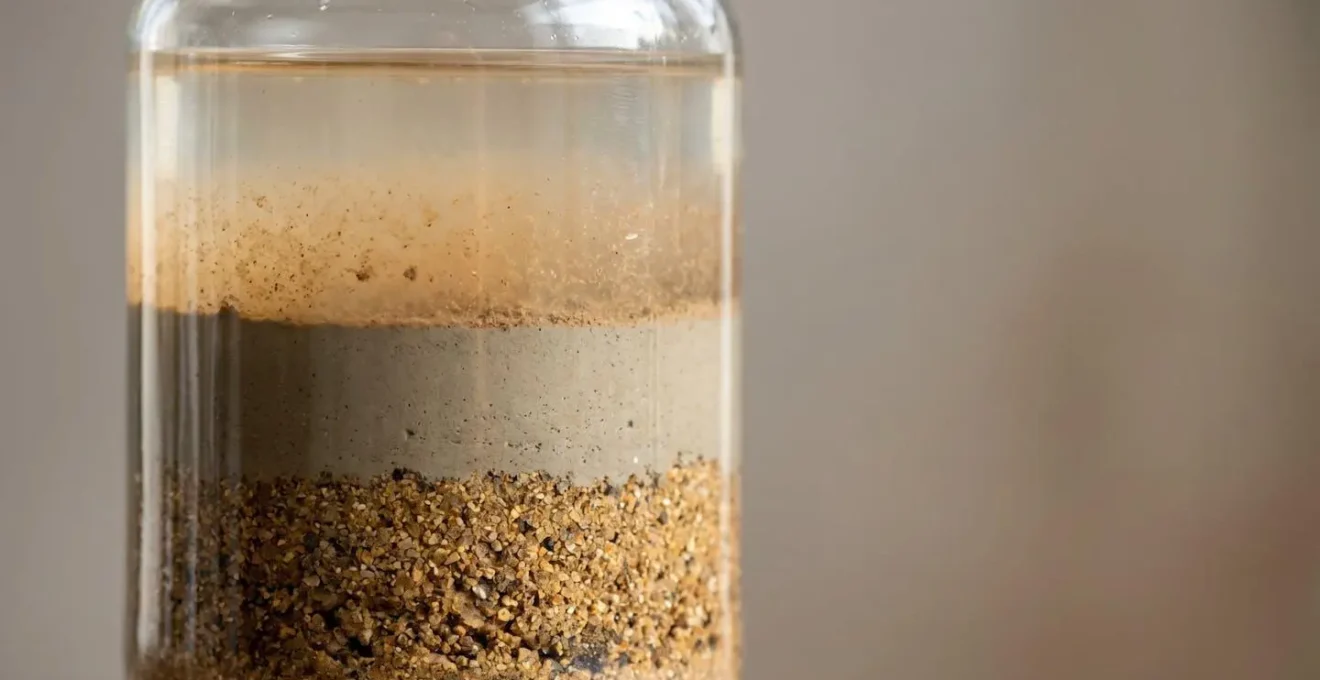
As the image above illustrates, the clear separation into layers is the key to the test. A soil dominated by the bottom sand layer will behave very differently from one dominated by the top clay layer. This test is your first step in translating an abstract piece of land into a tangible asset with specific properties, strengths, and weaknesses.
Clay vs Sandy Loam: Which Pedology Suits Market Gardening Best?
The results of your jar test are not just an academic exercise; they have direct and profound implications for the commercial viability of your intended enterprise, especially for a high-demand sector like market gardening. The texture class you identify determines the land’s workability, its natural fertility, its irrigation needs, and ultimately, which crops will thrive or fail. There is no single « best » soil type, only a « best fit » for a specific purpose.
A prospective buyer must analyse the trade-offs. A sandy loam warms up quickly in the spring, allowing for an early start on high-value crops like salads and carrots. However, its free-draining nature means it requires more frequent irrigation and careful nutrient management to prevent leaching. Conversely, a clay-based soil has excellent nutrient and water retention but is cold, heavy, difficult to work when wet (a major issue in UK winters), and can be prone to waterlogging. The following table, based on guidance from agricultural bodies like the Royal Horticultural Society, breaks down the key operational differences.
| Characteristic | Clay Soil | Sandy Loam | Silt Loam |
|---|---|---|---|
| Spring warming speed | Slow (cold, late start) | Fast (early planting possible) | Moderate |
| Water retention | Excellent (risk of waterlogging) | Poor (frequent irrigation needed) | Good (balanced) |
| Nutrient retention | High (cation exchange capacity) | Low (nutrients leach quickly) | Moderate to high |
| Workability in wet UK winters | Very poor (compacts, smears) | Good (drains quickly) | Moderate (can compact) |
| Drainage | Poor (holds water stubbornly) | Excellent (free-draining) | Good |
| Best crops | Brassicas, beans (on improved clay) | Asparagus, carrots, early potatoes | Most vegetables, salads |
| Amendment needs | Organic matter, grit for structure | Organic matter, compost for retention | Organic matter to prevent compaction |
As a buyer, this table should be a core part of your decision matrix. If your business plan relies on early spring harvests, a heavy clay soil represents a significant operational—and financial—hurdle. If water access is limited or costly, the superior retention of a loam or clay-loam becomes a major asset. Your due diligence must involve matching the soil’s inherent pedological characteristics to your business’s specific economic and operational needs.
The Drainage Oversight That Turns Good Soil into a Waterlogged Nightmare
A perfectly textured soil can become a worthless, waterlogged quagmire through one single, catastrophic oversight: failed or non-existent drainage. In the damp climate of the UK, effective water management is not a luxury; it is critical infrastructure. Much of the UK’s most productive farmland relies on extensive networks of subterranean pipes, known as field drains, installed over decades to channel excess water away from the root zone. AHDB data shows over 6.4 million hectares of agricultural land in England and Wales depend on these piped systems.
The cautionary tale for any investor is that this vital infrastructure is out of sight and, all too often, out of mind. Drains can become blocked by silt, damaged by tree roots, or simply reach the end of their functional life. When they fail, the consequences are swift and severe. Anaerobic conditions develop in the saturated soil, killing beneficial microorganisms and preventing plant roots from respiring. The field becomes inaccessible to machinery, planting and harvesting windows are missed, and crop yields plummet.
For a buyer, this represents a huge hidden liability. Verifying the existence and, crucially, the functionality of a field drainage system is non-negotiable due diligence. Look for drainage plans, inspect outfalls into ditches for signs of flow after rain, and be wary of any persistent wet spots or rushes growing in the middle of fields. The cost of rectifying a failed system or installing a new one is a major capital expense, typically costing between £1,500 and £3,000 per hectare. A failure to budget for this can turn a promising investment into a financial disaster.
Restoring Structure: How to Fix Capped Soils Within 3 Years
Discovering compacted or « capped » soil during your due diligence need not be an immediate deal-breaker, provided you factor in the cost and timescale of remediation. A capped surface is one where the soil aggregates have broken down, often due to heavy rain on bare ground, forming an impermeable crust. This crust prevents water infiltration (leading to runoff and erosion) and can physically stop seedlings from emerging. While mechanical intervention like subsoiling can break up deep compaction, a more sustainable and increasingly favoured approach is biological remediation.
The primary tool for this is the use of cover crops. These are not cash crops, but are grown specifically for the benefit of the soil. Certain species, such as tillage radish, phacelia, and deep-rooting clovers, have powerful root systems that act as « biological drills. » They aggressively penetrate compacted layers, creating channels for air and water, and when they die back, they leave behind a network of organic matter that builds stable soil structure.
This image demonstrates the power of a healthy root system to break apart compacted soil, transforming it from a dense, lifeless block into a friable, living medium.
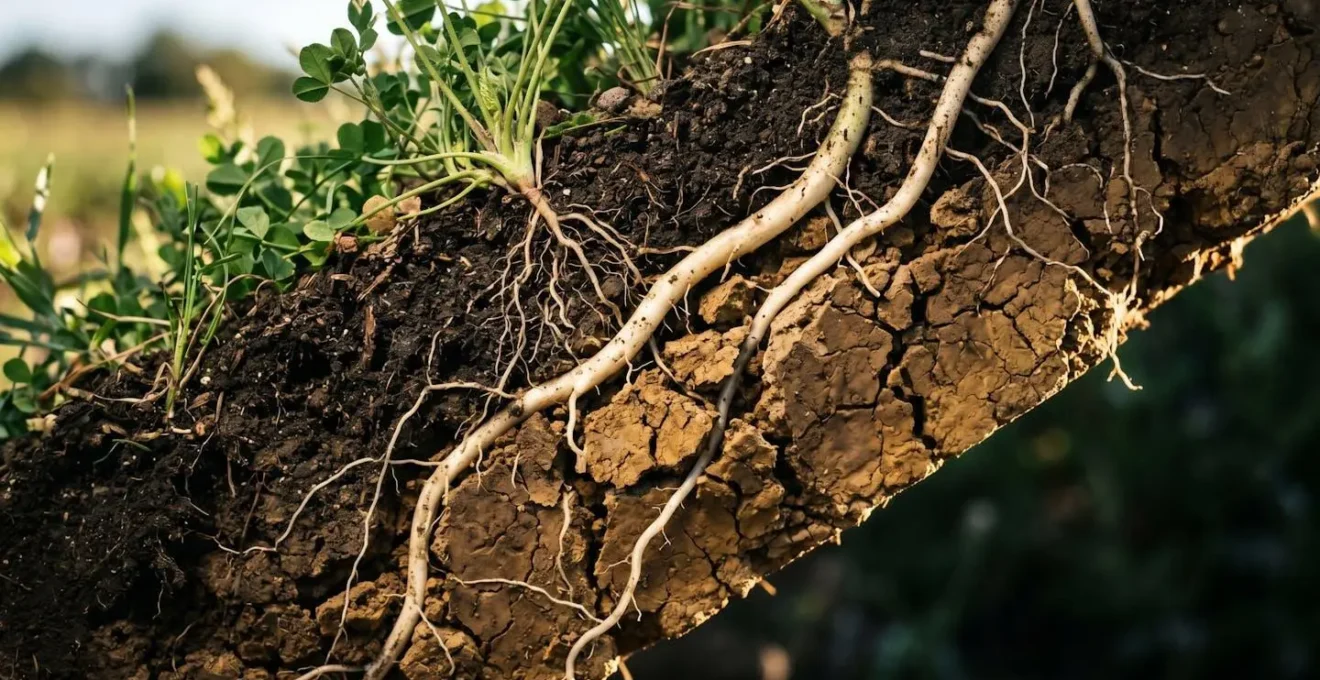
This is not an overnight fix. A dedicated program of cover cropping, combined with reduced tillage and additions of organic matter like compost or manure, can take up to three years to significantly restore the structural integrity of a damaged soil. The cost is a key consideration for any buyer. Fortunately, the investment in seed is relatively low, with practitioners noting a typical cost of around £35 per hectare for the seed, roughly equivalent to a single pass with a cultivator. The real cost is the commitment to a multi-year management strategy that prioritises soil health over short-term returns.
The Soil Erosion Liability That Devalues Your Land Portfolio
Soil erosion is the physical stripping and loss of topsoil, the most fertile and biologically active part of the land. For a landowner, this is not just an environmental issue; it is the progressive and often irreversible depreciation of your primary asset. Each particle of soil washed or blown away represents a tangible loss of natural capital and, therefore, a direct devaluation of your portfolio. This makes assessing erosion risk a critical piece of due diligence.
The risk is highest where poor soil structure meets slope and rainfall. A compacted, capped soil, as discussed previously, cannot absorb heavy rain. Instead, the water sheets across the surface, gathering energy and carrying away precious topsoil, along with any expensive fertilisers and pesticides applied to it. This runoff can cause further liability, polluting nearby watercourses and potentially leading to regulatory fines. The signs are often subtle at first: small channels or ‘rills’ forming after a storm, or deposits of silt at the bottom of a slope.
An investor must learn to see a sloped field of bare earth not as an opportunity, but as a potential liability. The valuation of the land should be directly discounted by the visible evidence and future risk of soil loss. A field with deep erosional gullies has already lost a significant portion of its productive capacity. Correcting this requires costly earthworks and long-term soil-building strategies. Therefore, a prudent buyer will favour land with good ground cover, healthy structure, and management practices (like contour ploughing or terracing on slopes) that explicitly mitigate this financial and ecological risk.
Blocky vs Crumb Structure: What Your Subsoil Is Telling You?
One of the most revealing acts of due diligence you can perform is to simply take a spade and dig a hole. A spadeful of soil tells a story that no map or document can. What you are looking for is its structure: the way the individual particles of sand, silt, and clay are bound together into aggregates, or ‘peds’. This is distinct from texture and is the primary indicator of the soil’s health and functionality.
Ideally, you want to see a ‘crumb’ structure, especially in the topsoil. This looks like breadcrumbs or coffee grounds—small, rounded aggregates with plenty of pore space between them. This structure is the hallmark of a healthy, living soil, rich in organic matter and biological activity. It allows for excellent air and water movement, easy root penetration, and is resilient to compaction. In contrast, a ‘blocky’ or ‘platy’ structure is a red flag. Here, the soil breaks into large, sharp-edged blocks with few pores. This is indicative of compaction and low biological activity. It is a difficult environment for roots to thrive in and can lead to waterlogging on the surface.
Professionals quantify this using frameworks like the Visual Evaluation of Soil Structure (VESS), which scores the soil on a scale from 1 (good) to 5 (poor) based on how easily the aggregates break apart. A score of 1 indicates a friable, crumbly structure, while a score of 5 represents a dense, blocky mass that is severely impeding root growth. As a buyer, you should perform this simple visual and tactile assessment at multiple locations and depths across the property. A healthy crumb topsoil overlying a blocky, compacted subsoil tells you a very different, and more worrying, story than a deep profile of good structure.
Key Takeaways
- Plough pan compaction is a severe, hidden financial liability, not merely a farming inconvenience, which can drastically reduce the land’s intrinsic value.
- Soil texture, easily assessed with a DIY Jar Test, is the primary factor dictating crop suitability, irrigation needs, and long-term management costs.
- Functional field drainage is non-negotiable critical infrastructure; its absence or failure represents a major, and often unbudgeted, capital expense for the buyer.
Preserving Natural Capital: How to Valuate Your Farm’s Ecological Assets?
The modern approach to land valuation is shifting. It no longer views land merely as a commodity for producing food, but as a complex portfolio of ecological assets, collectively known as Natural Capital. This includes the soil’s ability to store carbon and water, the biodiversity it supports, and its overall health and resilience. As a forward-thinking investor or new entrant, your due diligence must extend to assessing and valuing these assets, as they will increasingly dictate the land’s long-term profitability and its eligibility for future environmental payments.
A healthy, well-structured soil with high organic matter is a significant carbon sink, a valuable asset in a world moving towards a net-zero economy. A farm that effectively manages water, prevents erosion, and fosters biodiversity is not just being ‘green’—it is preserving the core capital from which all its future profits will flow. This is becoming formally recognised in land valuation. For instance, the upcoming 2026 Defra Predictive Agricultural Land Classification (ALC) mapping is expected to show that roughly 20% of land moves up by one grade while under 20% moves down, reflecting changes in climate and, importantly, soil health.
Therefore, your assessment must have a future-facing dimension. A cheap parcel of degraded land might seem like a bargain, but it represents a depleted natural capital account that will require massive investment to restore. Conversely, a more expensive property with demonstrably healthy soil, good water management, and high biodiversity may offer far greater long-term returns. Valuing your potential farm’s ecological assets is the final and most crucial piece of the puzzle, transforming your purchase from a simple transaction into a strategic, long-term investment in natural capital.
Before you make an offer on any piece of land, the next logical step is to commission a professional pedological survey to validate your own findings. Assess your potential investment with the same rigour and expert oversight you would apply to a building’s foundations, because that is exactly what the soil is.