
Valuing natural capital is not about abstract environmentalism; it’s a financial imperative for accurately pricing your land portfolio and securing investment.
- Ecosystem services like pollination and water filtration are quantifiable assets with calculable replacement costs that belong on your balance sheet.
- Soil degradation is a direct financial liability, devaluing your primary asset through nutrient loss and reduced productivity, with measurable annual costs.
Recommendation: Conduct a formal baseline assessment. It is the non-negotiable financial starting point required to monetize natural capital assets and mitigate ecological liabilities for investors.
For landowners today, discussions with banks and investors increasingly involve terms like ‘sustainability’ and ‘ESG compliance’. Often, this conversation remains vague, focused on broad commitments rather than concrete financial metrics. The common advice is to adopt ‘greener’ practices, but this fails to answer the critical question from a portfolio manager’s perspective: What is the tangible financial value of these ecological improvements? How does a healthy ecosystem translate into a stronger balance sheet, better loan terms, or a higher property valuation?
The pressure to demonstrate environmental stewardship is real, but treating it as a cost center for compliance is a fundamental error in asset management. The true paradigm shift lies in moving beyond simple environmentalism and adopting the rigorous lens of a natural capital accountant. This involves a radical reframing: your farm’s biodiversity, soil health, and water cycles are not just ‘nice to have’—they are a portfolio of performing assets and potential liabilities that can, and should, be measured, valued, and reported with financial precision.
This guide abandons abstract ideals to provide a valuation-focused framework. We will deconstruct how to move from ecological concepts to financial line items. Instead of merely suggesting you ‘protect pollinators’, we will explore how to assign them a value based on replacement cost. Instead of warning against soil erosion, we will quantify it as a direct liability that devalues your land. This is the language investors understand. By treating natural capital as a core component of your asset register, you can transform your environmental performance from an operational expense into a strategic driver of long-term financial value.
This article provides a structured approach for landowners to understand and articulate the financial worth of their ecological assets. The following sections will detail the specific methodologies and frameworks required to build a credible natural capital valuation for any financial stakeholder.
Contents: Valuating Your Farm’s Ecological Asset Portfolio
- Why Pollinators and Water Filtration Are Assets on Your Balance Sheet?
- How to Conduct a Natural Capital Baseline Assessment for Investors?
- Intensive vs Extensive: Which Model Protects Asset Value Long-Term?
- The Soil Erosion Liability That Devalues Your Land Portfolio
- Public Money for Public Goods: How to Maximize ELMS Income?
- Why You Cannot Claim Carbon Credits Without a Valid Baseline Test?
- Why ‘Regenerative’ Sells Better Than ‘Organic’ to Modern Consumers?
- How to Maximize Carbon Sequestration Payments Under the New UK ELMS Schemes?
Why Pollinators and Water Filtration Are Assets on Your Balance Sheet?
In standard accounting, an asset is a resource with economic value that an entity owns or controls with the expectation that it will provide a future benefit. Ecosystem services, such as crop pollination by insects and natural water filtration by healthy soil, fit this definition perfectly. The challenge has been moving them from an unrecorded, external benefit to a quantifiable line item. The key to this transition is the concept of replacement cost—a valuation method financial stakeholders readily understand. What would it cost to artificially replicate the service nature provides for free?
The economic scale of these services is staggering. For example, recent economic analysis estimates the annual global value of crop pollination by animals at between $235 and $577 billion USD. A farm rich in pollinator habitats is not just ecologically sound; it possesses a productive asset that directly supports yields and resilience, reducing the need for costly interventions. To an investor, this represents lower operational risk and a more secure revenue stream. The presence of these natural systems is a direct, positive contributor to the farm’s enterprise value.
Valuation science provides the tools to formalize this. As a study in the PLOS One journal highlights, the most accurate way to value these services is by calculating their direct economic impact. As the research team states, a crucial metric is the use of:
replacement costs as a more accurate value estimate of insect pollination as an ecosystem service
– Research team on ecosystem service valuation, PLOS One study on valuing pollination services
This approach transforms an abstract ecological benefit into a hard number for a balance sheet. A farm with intact wetlands that purify water is avoiding the capital expenditure on advanced filtration systems. That avoided cost is a quantifiable financial benefit, and therefore an asset. Presenting your farm’s natural capital in these terms—as a portfolio of assets that generate returns and reduce costs—is how you effectively communicate its true value to investors.
How to Conduct a Natural Capital Baseline Assessment for Investors?
An investor’s primary question is not « what do you have? » but « what is the return on my investment? » In natural capital, this return is measured as the improvement—or ‘delta’—from a starting point. Without a scientifically credible and financially legible baseline, any claims of « improvement » are unsubstantiated. Therefore, a Natural Capital Baseline Assessment is the non-negotiable prerequisite for any serious conversation about monetizing ecological assets like carbon credits or securing favorable financing based on environmental performance.
This assessment is a rigorous, data-driven process. It involves mapping and measuring the current state of your ecological assets, from soil organic carbon levels and water quality to biodiversity metrics and habitat extents. This creates a detailed asset register. As Martin Berg, a leader in natural capital investment, noted at an Environmental Finance conference, the lack of a standardized approach has been a major barrier:
It requires a baseline, and this is something that needs to be established. So far, no initiative has developed this baseline.
– Martin Berg, Head of Natural Capital Impact Strategy, HSBC Pollination Climate Asset Management, Environmental Finance
The goal is to produce a snapshot of the farm’s ecological health that can be translated into financial terms. Healthy, carbon-rich soil, as depicted below, is not just dirt; it’s a functioning asset with measurable capacity for water retention, nutrient cycling, and carbon sequestration. The baseline quantifies this capacity.

Once established, this baseline serves as the definitive reference point. All future improvements, whether increased carbon storage or enhanced biodiversity, are measured against it. This ‘delta’ is what investors are funding and what regulators are rewarding. A robust baseline moves the conversation from vague promises to a verifiable, auditable report on asset performance, demonstrating a clear trajectory of value creation. For any landowner seeking investment, this process is not administrative overhead; it is the fundamental mechanism for unlocking the financial value of their natural capital.
Action Plan: The Four-Stage Natural Capital Baseline Assessment
- Asset Baseline Development: Develop a comprehensive natural capital asset register in the form of a habitat map. This involves combining spatial datasets for the region (e.g., land cover, soil type) with on-farm socio-economic factors to create an initial inventory.
- Ecosystem Service Modeling: Use established spatial models to link the identified natural capital assets to the provision of specific ecosystem services. This step quantifies the functional output, such as tonnes of carbon stored, cubic meters of water purified, or pollination service availability.
- Economic Valuation: Quantify the monetary or biophysical value of the identified ecosystem services. This must use established economic methodologies (e.g., replacement cost, avoided cost) aligned with international standards like the System of Environmental-Economic Accounting (SEEA).
- Dynamic Monitoring Plan: Create a forward-looking monitoring plan to track changes and improvements over time. This plan must be designed to demonstrate the ‘delta’ that investors are funding, moving beyond static snapshots to show a clear return on natural capital investment.
Intensive vs Extensive: Which Model Protects Asset Value Long-Term?
The traditional financial view has often favored intensive agriculture, focusing on maximizing short-term yield per hectare through high inputs. However, a natural capital valuation framework fundamentally challenges this assumption. Intensive models frequently lead to the degradation of underlying assets—soil compaction, loss of biodiversity, and water pollution. From a balance sheet perspective, this is equivalent to running machinery without maintenance; the short-term output comes at the cost of long-term asset depreciation. This accumulated ecological debt represents a significant, often unrecorded, financial liability.
In contrast, extensive and regenerative models are designed to enhance the natural capital base. Practices like cover cropping, reduced tillage, and integrated livestock management build soil organic matter, improve water retention, and foster biodiversity. While these systems may sometimes have lower peak yields in the short term, they drastically reduce input costs and, more importantly, they appreciate the primary asset: the land itself. An investor using a natural capital lens sees this not as a concession to environmentalism, but as a superior long-term asset protection strategy.
The financial data is beginning to validate this approach. These systems are not just about reducing ecological risk; they are proving to be more profitable. A landmark study by Boston Consulting Group and the WBCSD found that transitioning to regenerative agriculture delivers a strong return on investment. The report highlights that farms could expect a 15-25% ROI, with profits reaching up to 120% above conventional, high-input farms over the long term. This superior financial performance is driven by lower costs, more resilient production systems, and access to new revenue streams from ecosystem services.
For a landowner negotiating with a bank, this data is critical. It demonstrates that a management model focused on enhancing natural capital is not a compromise on profitability but a direct pathway to a more resilient and valuable asset portfolio. It shifts the argument from one of ideology to one of sound financial management and risk mitigation.
The Soil Erosion Liability That Devalues Your Land Portfolio
While healthy soil is a clear asset, degraded soil represents a direct financial liability. Soil erosion is not merely an environmental issue; it is the physical depreciation of your most critical production asset. Each ton of topsoil lost to wind or water carries with it essential nutrients, organic matter, and water-holding capacity. From a valuation perspective, this is a tangible loss that requires a financial entry on the liability side of the ledger. The global economic cost is immense, with the World Economic Forum reporting that land degradation, primarily from soil erosion, results in losses of approximately $10.6 trillion per annum.
This macro-level cost translates to a direct, measurable expense at the farm level. The loss of nutrients like nitrogen, phosphorus, and potassium must be compensated for with synthetic fertilizers, representing a direct hit to the operating budget. Research has quantified this cost with precision. For instance, a study published in a Brazilian soil science journal calculated the annual nutrient replacement cost due to erosion to be between $28 and $73 per hectare. This is a recurring annual liability that directly reduces farm profitability and, by extension, the land’s capital value.
This visual contrast between eroded and healthy land is the physical manifestation of a devalued asset portfolio. The pale, compacted earth in the foreground has a diminished capacity to produce and a higher cost structure to operate.
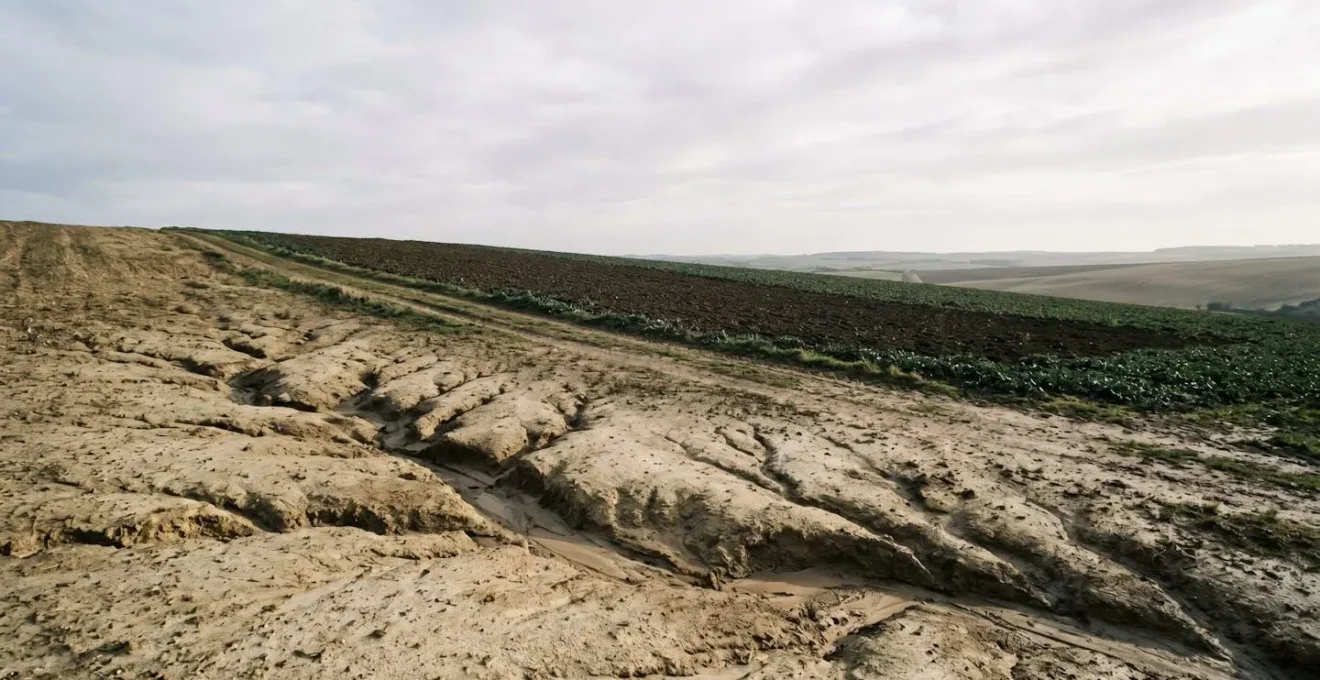
For an investor or a lender, land with a high rate of soil erosion represents a higher-risk, lower-value asset. It is an asset in decline, requiring increasing capital expenditure to maintain productivity. Conversely, a farm with demonstrable soil conservation practices (e.g., no-till, cover crops) is actively managing and mitigating this liability. Presenting data on low erosion rates and high soil organic matter is powerful evidence of sound asset management, justifying a lower risk premium and a higher valuation for your land portfolio.
Public Money for Public Goods: How to Maximize ELMS Income?
The transition from direct payments to the Environmental Land Management Schemes (ELMS) in the UK marks a fundamental shift in agricultural policy. The principle is clear: public money for the delivery of public goods. These « public goods » are, in essence, ecosystem services—clean air and water, thriving wildlife, climate mitigation, and protection from environmental hazards. For landowners, ELMS represents a direct opportunity to monetize their natural capital assets by securing government payments for practices that enhance these services.
Maximizing income from schemes like the Sustainable Farming Incentive (SFI) or Countryside Stewardship Plus requires a strategic, data-led approach, not just an operational one. It’s not enough to simply implement a list of prescribed actions. To secure the most lucrative, multi-year agreements and position the farm for future opportunities, landowners must be able to demonstrate and quantify the ecological uplift they are delivering. This is where a natural capital approach becomes a significant competitive advantage. It provides the coherent framework to justify your actions and prove their value.
Case Study: The UK Government’s ENCA Framework
The UK Government’s own « Enabling a Natural Capital Approach » (ENCA) guidance provides the blueprint for how it assesses value. This structured, four-step framework is designed to inform policy and investment decisions. It includes establishing baselines, understanding natural systems, quantifying ecosystem services, and integrating economic valuation. By aligning your farm’s reporting with the ENCA methodology, you are speaking the same language as the paying body (Defra). This allows for a more robust application, demonstrating not just that you are undertaking actions, but that you understand and can measure their contribution to national environmental targets, making a stronger case for higher-tier funding.
A landowner armed with a baseline assessment and a clear plan for enhancing specific ecosystem services (e.g., increasing soil carbon by X%, improving water quality by Y%) can build a much stronger application for ELMS funding. They are no longer a passive recipient of subsidies but an active business partner with the government, delivering contracted environmental outcomes for an agreed price. This professionalizes the relationship and positions the farm as a reliable supplier of public goods, creating a stable, long-term income stream that is directly tied to the health of its natural capital assets.
Why You Cannot Claim Carbon Credits Without a Valid Baseline Test?
The market for voluntary carbon credits presents a tantalizing revenue opportunity for landowners. However, it is governed by a strict, non-negotiable principle that is often misunderstood: additionality. A carbon credit represents one tonne of CO2 equivalent that has been removed from the atmosphere *in addition* to what would have occurred in a « business-as-usual » scenario. Without proving this additionality, a carbon credit has no legitimacy and no value.
This is precisely why a valid baseline test is not an administrative formality but the absolute foundation of any credible carbon claim. The baseline scientifically documents the « business-as-usual » state of your land’s carbon stocks before any new project or practice change is implemented. It measures the existing soil organic carbon, the carbon in biomass, and the ongoing rate of sequestration or emission. This is your carbon starting line.
Any carbon sequestered *after* this baseline is established and *as a result of* a change in management (e.g., switching to no-till farming, planting new hedgerows) can be considered additional. The verifiers who certify carbon credits will audit this rigorously. As the official Natural Capital Protocol framework clarifies, this evidence is the bedrock of market integrity:
The baseline proves the ‘new’ carbon sequestered is additional to the business-as-usual scenario.
– Natural Capital Protocol Framework, Capitals Coalition
Attempting to sell carbon credits without a third-party-verified baseline is like trying to sell shares in a company without any financial statements. Investors—in this case, the buyers of carbon credits—have no way to verify what they are buying. A claim of « we sequester a lot of carbon » is meaningless. A claim of « we have increased our soil carbon stock by 1.5 tonnes per hectare above our 2024 verified baseline » is a verifiable, tradable asset. For landowners, the investment in a proper baseline assessment is the cost of entry into the high-integrity carbon market.
Why ‘Regenerative’ Sells Better Than ‘Organic’ to Modern Consumers?
For decades, the « organic » certification has been the gold standard for environmentally conscious consumers. However, its dominance is being challenged by the concept of « regenerative. » From a marketing and brand valuation perspective, ‘regenerative’ is gaining traction because it tells a more compelling and, crucially, a more verifiable story. While organic is primarily a standard of *prohibition* (what is not used, e.g., certain pesticides), regenerative is a standard of *outcomes* (what is improved, e.g., soil health, biodiversity, water cycles).
This focus on measurable, positive outcomes gives regenerative brands a powerful tool that organic certification often lacks: data-driven transparency. Modern consumers, and increasingly investors, are wary of « greenwashing » and demand proof behind claims. A brand that can state, « Our farming methods increased soil organic matter by 15% in three years, » has a much more credible and impactful message than one that can only state it is « certified organic. » It connects the product directly to a positive environmental impact that can be quantified.
This is where natural capital accounting provides a decisive advantage. It is the engine that generates the specific, verifiable metrics that underpin the « regenerative » story. A farm that has conducted a natural capital assessment can provide its downstream partners—food brands, retailers—with the exact data they need for credible marketing.
Case Study: Farm-Scale Natural Capital Accounts for Marketing
A 2026 study in Methods in Ecology and Evolution demonstrated this power by creating detailed natural capital accounts for 50 Australian farms. These accounts quantified ecosystem services like pollination support, carbon sequestration, and soil regulation. This provided the farms with transparent, data-driven metrics. A brand using produce from these farms could move beyond generic claims and build marketing campaigns around specific, audited sustainability data, offering a level of credibility that the simple ‘organic’ label cannot match.
For a landowner, embracing regenerative practices backed by natural capital accounting is not just an agronomic choice; it is a strategic market positioning decision. It allows you to produce a premium commodity—not just the crop itself, but the verifiable story of environmental restoration that comes with it. This story has a tangible market value, enabling access to premium markets and appealing to a new generation of consumers and investors who value authenticity and proof of impact.
Key Takeaways
- Valuation is Non-Negotiable: Treating ecosystem services as balance sheet items with quantifiable values (e.g., via replacement cost) is the only way to communicate their worth to financial stakeholders.
- The Baseline is Everything: All credible claims for monetization—from carbon credits to public grants—depend on a scientifically robust baseline assessment that proves ‘additionality’.
- Liabilities are as Important as Assets: Environmental degradation, particularly soil erosion, is a direct financial liability that depreciates your core asset and must be actively managed and reported.
How to Maximize Carbon Sequestration Payments Under the New UK ELMS Schemes?
Maximizing payments for carbon sequestration under the new UK ELMS schemes requires a shift in mindset from being a farmer to being a manager of a carbon asset portfolio. The highest payments will go to those who can not only implement beneficial practices but can also forecast, measure, and verify the resulting carbon uplift with a high degree of confidence. This requires a strategic integration of the principles we’ve discussed: a robust baseline, a clear understanding of additionality, and a system for ongoing monitoring.
The first step is to leverage your natural capital baseline assessment to identify the largest and most cost-effective carbon sequestration opportunities on your land. Is it through agroforestry, enhanced soil management in arable fields, or peatland restoration? The baseline data will reveal which interventions will deliver the greatest ‘carbon delta’ for the least investment, allowing you to prioritize your actions for maximum financial return under the payment-by-results model that ELMS is moving towards.
Secondly, your strategy must be dynamic. Sequestration is not a one-off activity. You must have a monitoring, reporting, and verification (MRV) plan in place. This involves periodic re-sampling of soil and biomass to track the accumulation of carbon over time. This ongoing data stream is your proof of delivery. It validates your claims to the paying agency (Defra) and provides the auditable track record needed to potentially stack other private revenue on top, such as selling credits on the voluntary market. A landowner who can provide a verified annual report on carbon stock changes is in the strongest possible negotiating position.
Ultimately, maximizing ELMS payments for carbon is about professionalizing the management of this invisible asset. It means using the right accounting tools (natural capital valuation), establishing a clear starting point (the baseline), and demonstrating performance through consistent reporting. This transforms your farm into a reliable, high-integrity supplier of carbon sequestration services, securing a stable and lucrative income stream that directly rewards the enhancement of your land’s most valuable natural assets.
To put these principles into practice, the logical next step is to initiate a comprehensive valuation of your own farm’s natural capital. Engaging with accredited advisors to conduct a formal baseline assessment will provide the foundational data needed to unlock new revenue streams and strengthen your financial standing.