Reducing input costs isn’t about arbitrary cuts; it’s about surgically removing waste to boost your net margin per hectare.
- Most arable farms have a 15-20% « inefficiency gap » in fertiliser and spray use that can be closed with zero yield loss.
- Switching from cost-based decisions (cheapest seed) to ROI-based decisions (seed with best disease resistance) consistently lowers total season costs.
Recommendation: Implement economic thresholds for one key pest and calculate the breakeven hectares for one major machine. This is your first step to reclaiming control of your margins.
With the Basic Payment Scheme (BPS) phased out and input prices remaining stubbornly high, the old mantra of « yield is king » is a dangerous liability. The financial pressure on UK arable farms is immense, and the buffer that once protected margins has vanished. Many businesses are responding by chasing every last tonne of yield, often by throwing more expensive inputs at the crop, a strategy that now delivers diminishing, if not negative, returns. The common advice to « test your soils » or « buy cheaper » is no longer sufficient to navigate this new economic reality.
The fundamental model of farm profitability has shifted. Survival and growth are no longer solely dependent on maximising output, but on mastering input efficiency. The crucial question every farm business must now answer for every application is not « will this increase my yield? » but « will this deliver a positive return on investment? ». It requires a mindset shift from agronomist to ruthless financial operator, where every litre of fuel and kilogram of nitrogen is held accountable.
This is about knowing the precise point where an extra £1 spent on inputs no longer returns £1.01 in crop value. It’s a discipline that turns agronomic data into a financial weapon. Instead of making broad-stroke cuts that risk your yield, this guide provides a consultant’s framework for surgically removing waste from your system. We will analyse the key leverage points—fertiliser, pest control, seed selection, and capital expenditure—to build a more resilient and profitable business from the ground up.
To navigate this complex financial landscape, we’ve broken down the core strategies into distinct, manageable components. This structured approach will guide you through the critical decisions needed to enhance your operational efficiency and secure your bottom line.
Summary: A Farm Business Guide to Cutting Input Costs by 15%
- Why Adding More Fertilizer Is No Longer Increasing Your Yields?
- How to Cut Insecticide Use by 50% Using Threshold Monitoring?
- Foliar N vs Granular N: Which Offers Better Uptake Efficiency?
- The Cheap Seed Mistake That Costs More in Disease Control
- Contracting vs Owning: When to Sell the Combine to Save Capital?
- Why Disrupted Nitrogen Cycles Cost UK Farmers £150 per Hectare Annually?
- Rotation Design: How to Break Pest Lifecycles Without Chemistry?
- How to Implement Integrated Pest Management to Meet UK Red Tractor Standards?
Why Adding More Fertilizer Is No Longer Increasing Your Yields?
The law of diminishing returns is hitting nitrogen fertiliser application harder than ever. For decades, the response was simple: more N equalled more yield. That equation is now broken. The biological system of the plant and soil can only process so much, and we have long since passed the point of peak efficiency on many farms. Data consistently shows that across global agriculture, crops absorb only approximately 50% of applied nitrogen, with the rest lost to the environment through leaching or volatilisation. This isn’t just an environmental issue; it is a direct financial drain from your business.
Every kilogram of N that isn’t taken up by the crop represents wasted capital. The focus must therefore pivot from application volume to uptake efficiency. The goal is no longer to simply feed the crop, but to ensure the crop can use what it is given. This involves a more sophisticated approach, integrating detailed soil analysis, tissue testing throughout the growing season, and using nitrogen application timings that match the crop’s peak demand with surgical precision. It’s about moving from a blanket approach to a prescriptive one.
Adopting advanced nitrogen management tools, like models that predict soil nitrogen supply or sensors that measure crop canopy health, provides the data needed to make these precise decisions. While some of these technologies have an upfront cost, their ROI is realised through significant reductions in fertiliser bills without a corresponding drop in yield. The mindset must be that fertiliser is a significant investment to be managed for maximum return, not a bulk commodity to be applied by rote.
Ultimately, continuing to apply more fertiliser in the hope of pushing yields is a flawed strategy. The data proves that the frontier for profitability now lies in optimising the efficiency of every unit of N you apply, turning a major cost centre into a highly managed and productive asset.
How to Cut Insecticide Use by 50% Using Threshold Monitoring?
Prophylactic, calendar-based spraying is one of the most significant and unnecessary variable costs in modern arable farming. The decision to spray should be a calculated economic one, not a matter of habit or fear. The implementation of Integrated Pest Management (IPM), specifically the use of economic thresholds, is the single most powerful tool for cutting insecticide costs. This approach is not about eliminating pesticides but ensuring every application is justifiable and profitable. Studies have demonstrated that this disciplined strategy can lead to a 44% reduction in insecticide use without any negative impact on yield or pest control efficacy.
An economic threshold is the specific pest population level at which the cost of the damage they will cause exceeds the cost of the treatment. Spraying before this point means you are spending money to control a pest that was not going to cause you a financial loss. To implement this, rigorous and regular crop walking is non-negotiable. You must be in the field, identifying not just the pests but also the beneficial insects that act as your allies in free, natural pest control.

As the image above illustrates, effective monitoring is a detailed, micro-level activity. It involves understanding the entire ecosystem within your crop. When you find a pest, the next step is not to reach for the sprayer but to assess the Predator-to-Pest Ratio (PPR). If beneficial populations are high, they may handle the problem for you. This disciplined, data-led approach replaces expensive chemistry with knowledge and observation, directly improving your bottom line. It requires more management time, but the financial return through saved input costs is substantial.
Making the switch from a reactive to a threshold-based system is a critical step towards financial resilience. It stops you from spending money you don’t need to and aligns your farm with the standards required by schemes like Red Tractor, making it a win for both profitability and compliance.
Foliar N vs Granular N: Which Offers Better Uptake Efficiency?
The discussion on fertiliser efficiency must go beyond « how much » and address « how. » The application method—granular versus foliar—has a significant impact on the Nitrogen Use Efficiency (NUE) and, therefore, your return on investment. Granular nitrogen applied to the soil is a reliable workhorse, but it is highly susceptible to environmental losses. Volatilisation, denitrification, and leaching can all occur before the plant root even has a chance to absorb the nutrient, especially if weather conditions are not optimal post-application.
Foliar nitrogen, applied directly to the plant’s leaves, offers a different pathway with distinct advantages in certain situations. It provides a more direct route into the plant, bypassing potential soil lock-up or loss. Field studies show that 36 to 69 percent uptake efficiency can be achieved with foliar applications, with most of the absorption happening within hours, not days. This makes it an excellent tool for « topping up » nitrogen levels at critical growth stages identified through tissue testing, delivering a fast-acting dose precisely when the crop needs it most.
However, foliar N is not a silver bullet. The amount of nitrogen that can be safely applied in a single pass is limited to avoid leaf scorch, making it unsuitable as a primary N source for high-demand crops. The most financially astute strategy is often a hybrid approach, using granular as the foundational application and foliar as a precision tool for tactical, in-season adjustments.
Case Study: Combining Foliar and Granular Fertilisation
Research on creeping bentgrass compared three fertilisation methods: 100% granular, a 50/50 mix of granular and liquid, and 100% liquid. The study, which evaluated treatments at two different annual nitrogen rates, concluded that the combination of both liquid and granular methods was superior to relying on a single method. The hybrid approach provided the most consistent quality and results across varied conditions, demonstrating that a combined strategy can optimise nutrient delivery and plant health more effectively than a one-size-fits-all programme.
The decision should not be « either/or » but « when and why. » By using granular for the bulk of the crop’s needs and foliar for targeted, responsive applications, you can significantly improve your overall NUE, ensuring more of your fertiliser budget ends up in the crop and less is lost to the environment.
The Cheap Seed Mistake That Costs More in Disease Control
In the quest to cut variable costs, seed is often seen as an easy place to make savings. This is a classic « penny wise, pound foolish » error. Choosing a cheaper, older variety with a weaker disease resistance profile might save a few pounds per hectare upfront, but it exposes the business to significantly higher costs and risks throughout the season. From a strict business perspective, seed stocks represent less than 5 to 10 percent of total production costs, yet they have a disproportionately large impact on nearly every other cost centre, from fungicide and herbicide use to final yield potential.
A premium variety with a strong genetic resistance package is an investment in cost prevention. It functions as a built-in insurance policy against disease pressure. This often means fewer fungicide passes are required, saving not just the cost of the chemical itself, but also the associated costs of fuel, labour, and machine wear. Furthermore, vigorous, modern varieties often exhibit faster canopy development, which helps to naturally suppress weeds and can lead to a reduction in herbicide costs.
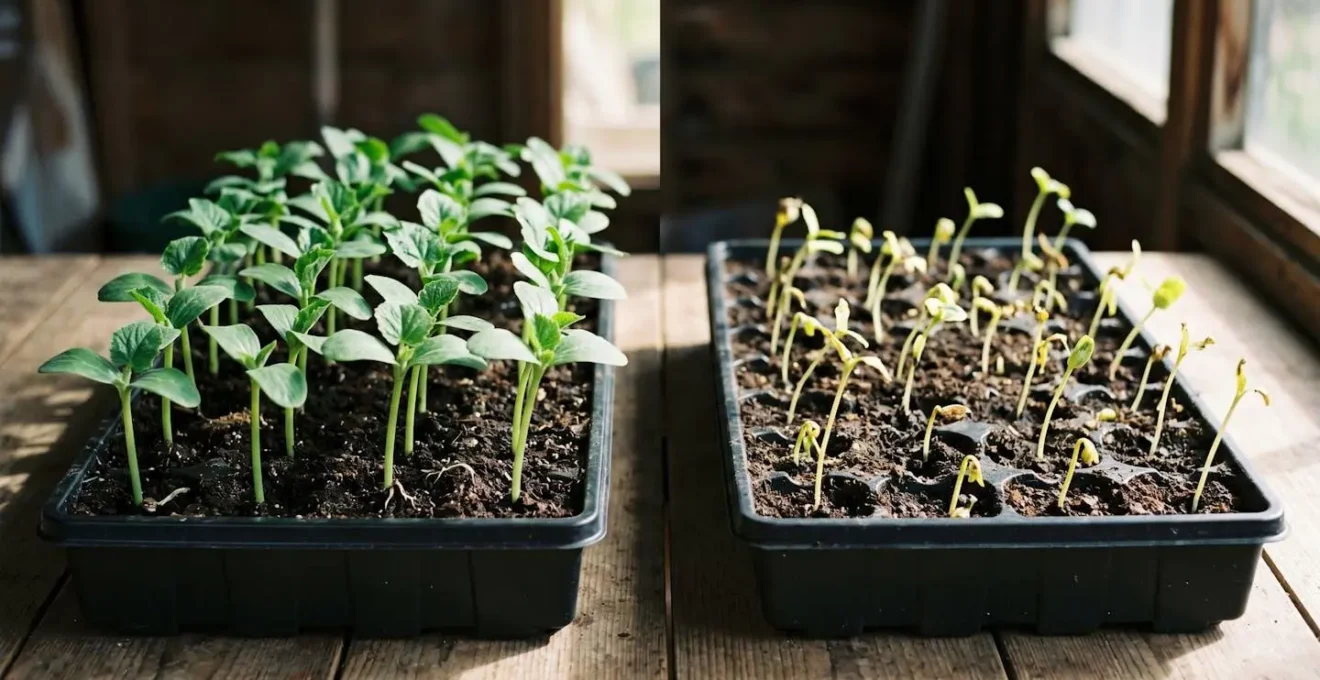
The visual difference between high and low-quality seed genetics is stark. To properly evaluate the decision, you must analyse the Total Cost of Ownership (TCO), not just the upfront purchase price. This involves modelling the entire season’s costs associated with each choice. When you factor in the reduced spray costs and the lower risk of yield loss, the slightly more expensive seed often emerges as the far more profitable option.
| Cost Factor | Budget Seed Variety | Premium Disease-Resistant Seed |
|---|---|---|
| Upfront Seed Cost per Acre | $45 | $50 (10% higher) |
| Fungicide Applications Needed | 2-3 passes | 1 pass or none |
| Fungicide Product Cost | $30-45 | $15 or $0 |
| Application Costs (fuel, labor, time) | $20-30 | $10 or $0 |
| Herbicide Costs (slower canopy = more weeds) | $25-35 | $15-20 |
| Total Season Cost per Acre | $120-155 | $75-90 |
| Net Savings with Premium Seed | — | $30-80 per acre (20-30% reduction) |
Selecting seed based on its contribution to a low-input, high-efficiency system is a cornerstone of modern farm profitability. It shifts the focus from short-term savings to long-term, whole-system financial performance.
Contracting vs Owning: When to Sell the Combine to Save Capital?
Machinery ownership represents a massive capital investment and a significant fixed cost for any arable business. In an era of tight margins, challenging the assumption that you must own every piece of equipment is a critical financial exercise. The decision to own or to use a contractor, particularly for a high-value asset like a combine harvester, should be based on a cold, hard calculation of your breakeven point, not on tradition or convenience.
The breakeven calculation is straightforward: you must determine the total annual cost of owning the machine and divide it by the local contractor’s rate per hectare. The result is the number of hectares you need to harvest to make ownership cheaper than contracting. Total ownership costs must be comprehensive, including not just finance repayments but also depreciation (the single biggest cost), insurance, storage, maintenance, and repairs. Many farm businesses underestimate these « hidden » costs, leading to a flawed justification for ownership.
Of course, the calculation is not purely financial. The primary argument for ownership is timeliness. A contractor’s availability may not align perfectly with your optimal harvest window, and delays can lead to yield and quality losses. This « cost of inaction » must be factored into your decision. A realistic approach is to estimate the potential yield loss (typically 0.5-1% per day of delay) and assign a monetary value to this risk. If your farm’s scale is significantly below the breakeven point, it is highly unlikely that the value of timeliness will outweigh the substantial cost savings of contracting. Freeing up capital tied up in depreciating steel and redirecting it into more productive areas of the business—like land, drainage, or storage—is often the most profitable move.
Your Action Plan: The Breakeven Hectare Calculator Framework
- Calculate total annual ownership costs including depreciation (equipment value loss per year), insurance premiums, maintenance and repairs, storage facility costs, and interest on capital if financed.
- Determine your local contractor rate per hectare by obtaining quotes from 2-3 reliable custom harvest operators in your region.
- Apply the breakeven formula: Breakeven Hectares = Total Annual Ownership Costs ÷ Contractor Rate per Hectare.
- Compare your actual farm size to the breakeven number; if you farm fewer hectares than the breakeven figure, contracting is more cost-effective.
- Factor in timeliness by estimating potential yield loss from delayed harvest (e.g., 0.5-1% per day) and assign a monetary value to this risk to make a fully informed decision.
Re-evaluating your machinery policy is not an admission of failure; it is a mark of a savvy business operator adapting to a new economic climate. For many, selling the combine and switching to a contractor is a direct path to improved profitability and a stronger balance sheet.
Why Disrupted Nitrogen Cycles Cost UK Farmers £150 per Hectare Annually?
The £150 per hectare figure often cited as the cost of a disrupted nitrogen cycle in the UK is not arbitrary; it represents the real, on-farm financial impact of nitrogen inefficiency. This cost is an aggregation of several factors, starting with the direct waste of purchased fertiliser. With uptake efficiency often hovering around 50%, a significant portion of applied N is lost to the environment. This represents an immediate financial loss before any other effects are considered. Globally, research shows that global cropland has an average N balance surplus of 50-55 kg per hectare per year, a clear indicator of systemic over-application.
Beyond the wasted input, the environmental consequences of this lost nitrogen boomerang back as financial costs. Excess nitrogen that leaches into watercourses contributes to pollution, which in turn leads to stricter regulations and potentially higher water abstraction costs or environmental taxes in the future. Nitrogen lost to the atmosphere as nitrous oxide is a potent greenhouse gas, and as agriculture faces increasing pressure to decarbonise, there will inevitably be a price attached to these emissions. Therefore, the cost is a combination of direct input waste and indirect environmental liability.
Addressing this requires a whole-system approach. This includes not just optimising fertiliser applications but also improving soil health to maximise the soil’s own ability to store and supply nitrogen. Healthy soils with good structure and high organic matter are more resilient and less « leaky. » Techniques like cover cropping and including legumes in the rotation can further reduce the reliance on bagged fertiliser, directly cutting costs while also building a more robust and efficient nitrogen cycle within the farm’s ecosystem.
Case Study: Maintaining Profitability with Reduced Inputs
Large-scale trials on cereal fields in western France during 2022-2023, co-designed with farmers, tested the effects of significant nitrogen and pesticide reductions. The results, published in a recent study in Nature, showed that while input reductions led to a minor yield gap of around 5%, the cost savings from the reduced inputs fully compensated for the economic loss. In many cases, the net profit actually increased, proving that well-managed input-reduction strategies can successfully align environmental performance with economic goals.
Reducing this £150/ha loss is not about sacrificing productivity. It is about implementing intelligent farming systems that capture and recycle nutrients more effectively, turning a significant system-wide cost into a competitive advantage.
Rotation Design: How to Break Pest Lifecycles Without Chemistry?
A well-designed crop rotation is your most powerful, non-chemical tool for pest and disease control. It is a proactive, strategic investment in breaking the lifecycles of your most damaging pests, reducing your reliance on reactive chemical sprays. By alternating between different crop families, you create an environment that is inhospitable to host-specific pests and diseases, causing their populations to crash without a single drop of insecticide. Research into mature IPM systems demonstrates that this approach, combined with other cultural controls, can achieve up to a 95% reduction in insecticide applications while maintaining or even enhancing yields.
The key to effective rotation design is a deep understanding of your enemy. You must move beyond simply rotating crops and begin to think like a pest. This involves mapping out the complete lifecycle of your top 3 economic pests. When do they lay their eggs? Where do they overwinter? What are their primary and secondary host plants? Once you have this intelligence, you can design a rotation that strategically inserts a non-host « break crop » at the most vulnerable point in the pest’s lifecycle.
For example, if you have a soil-borne pest that overwinters to emerge in spring, introducing a spring-sown crop from a different family can effectively starve the emerging population. Incorporating functional diversity adds another layer of control. Some crops have allelopathic properties (like rye’s ability to suppress weeds), while others have different rooting architectures that disrupt soil pest habitats. While a break crop may sometimes be less profitable in a single year than a cash crop, the true financial benefit is realised in subsequent years through drastically reduced pest pressure and lower input costs in your main cash crops. It’s a long-term strategy for building system resilience.
Your Action Plan: Pest Lifecycle Mapping for Rotation Planning
- Identify your top 3 most economically damaging pests and document their complete lifecycle stages (egg, larva/nymph, pupa, adult) and timing.
- Map each pest’s lifecycle against a 12-month calendar, noting critical overwintering stages, emergence periods, and peak damage windows.
- Research the host plant specificity for each pest to identify non-host crops that will provide a ‘break’ in their lifecycle.
- Design a rotation sequence that inserts a non-host crop during the pest’s most vulnerable lifecycle stage to disrupt its development.
- Model the economic trade-off by calculating how reduced pest pressure in subsequent cash crops offsets any potential single-year profitability loss from the break crop.
Ultimately, a sophisticated crop rotation moves pest management from a recurring cost centre to a planned, strategic element of a resilient and profitable farming system. It is the definition of working smarter, not harder.
Key Takeaways
- The Law of Diminishing Returns is hitting fertiliser use hard; the new focus must be on uptake efficiency, not application volume.
- Every spray pass must be justified by a documented economic threshold, not the calendar or habit. Spraying below the threshold is a guaranteed loss.
- The « Total Cost of Ownership » for cheap seed is often far higher than for premium varieties due to the increased secondary costs of fungicides, herbicides, and risk.
How to Implement Integrated Pest Management to Meet UK Red Tractor Standards?
Implementing Integrated Pest Management (IPM) is no longer an optional extra; it is a core requirement for compliance with standards like UK Red Tractor and a fundamental component of a profitable farm business. IPM provides the formal framework for all the cost-saving principles we’ve discussed, from threshold monitoring to rotation design. Its successful implementation is built on one non-negotiable foundation: meticulous record-keeping. Without data, you are not managing, you are guessing.
Meeting Red Tractor standards requires you to have a written IPM plan and to be able to demonstrate that you are actively monitoring crops and using non-chemical controls before resorting to pesticides. This means your crop walking notes, pest counts, and threshold calculations are not just aids to decision-making; they are critical compliance documents. Records must justify every single spray decision, linking it to a specific, observed threat that has crossed a pre-determined economic threshold. This discipline has a direct financial benefit, with studies showing growers can achieve a 17-75% reduction in pesticide applications by adhering to this process.
Your records should go beyond simple pest counts. You should be documenting beneficial insect populations to track your farm’s natural control capacity. Logging weather conditions alongside pest data can help you build a predictive model for future outbreaks. Annually, these records should be analysed to identify pest hotspots in certain fields, correlate outbreaks with specific conditions, and, most importantly, calculate the Return on Investment (ROI) for each spray. Did the application save more in yield than it cost? This annual review transforms your records from a box-ticking exercise into a powerful tool for strategic planning and continuous improvement, allowing you to refine your thresholds and strategies year on year.
Your 5-Point Input Efficiency Audit
- Input Mapping: List all variable inputs and their current cost per hectare (seed, specific fertilisers, individual chemicals, fuel) to create a clear cost baseline.
- Performance Baseline: Collect and centralise yield maps, soil/tissue analysis reports, and pest/disease scouting records from the past 3 years to identify performance trends.
- Efficiency Gap Analysis: Compare your actual application rates against industry benchmarks (e.g., RB209). Identify the top three inputs where you are significantly over-applying relative to crop offtake or recommendations.
- Threshold Review: Scrutinise last season’s spray diary. Are decisions linked to documented economic thresholds, or are they based on timing or habit? Identify one spray that, in hindsight, was not financially justified.
- Action Plan & ROI Projection: Select the single biggest cost-saving opportunity from your analysis. Create a simple trial plan (e.g., cut back N on one field) with clear success metrics to measure the impact on both yield and net margin versus a control area.
To put these principles into practice, your next step is to conduct a full Input Efficiency Audit on your own operation. Use the frameworks in this guide to challenge every cost, justify every application, and build a more resilient and profitable business for the years ahead.