True pest resilience isn’t found in companion planting charts; it’s engineered by mimicking nature’s design principles to create a farm ecosystem where pests simply cannot gain a foothold.
- Monocultures act as a perfect buffet for pests; polycultures create sensory and nutritional chaos that disrupts them.
- Lasting pest control relies on building permanent « predator scaffolding » (like beetle banks) rather than just temporarily attracting beneficial insects.
Recommendation: Stop managing individual pests and start designing an integrated ecosystem architecture using guilds, habitat, and flow interruption to make your market garden inherently resilient.
For the small-scale commercial grower in the UK, the battle against pests can feel relentless. The conventional advice often circles around companion planting « recipes » and lists of beneficial insects, treating the garden like a collection of individual plants to be managed. This approach, however, often leads to a constant, reactive cycle of intervention. We meticulously follow the rules, only to find cabbage whites still decimating our brassicas and aphids overwhelming our beans. This constant firefighting is exhausting and, fundamentally, unnatural.
The problem lies in the perspective. We are trying to impose order on a complex system using simplistic rules. But what if the true key to a pest-resistant market garden isn’t about better control, but about better design? What if, instead of fighting nature, we could learn from its three-billion-year R&D department? This is the essence of biomimicry: observing the patterns and strategies of natural ecosystems—forests, wetlands, prairies—and applying them to create a farm that is inherently balanced, productive, and resilient. It’s a shift from being a gardener who « controls » to an ecosystem architect who « enables ».
This guide moves beyond simple companion planting. We will deconstruct the fundamental principles that make wild ecosystems so robust. We will explore how to create « sensory chaos » to confuse pests, build permanent « predator scaffolding, » and even mimic beavers to manage water and resources. By understanding these underlying patterns, you can stop applying temporary fixes and start designing a truly self-regulating and productive market garden that works with nature, not against it.
This article provides a structured path to rethink your growing space. Below is a summary of the core design principles we will explore, from understanding the foundational flaws of monoculture to designing complex, productive plant guilds tailored for the UK climate.
Sommaire: A Designer’s Framework for Ecosystem-Led Pest Management
- Why Monocultures Attract Pests and How Nature Solves This Problem?
- How to Use Trap Crops Like Nature Uses Sacrificial Plants?
- Row Planting vs Polyculture: Which Mimics Forest Resilience Better?
- The ‘Clean Field’ Mistake That Removes Habitat for Beneficial Predators
- Mimicking Beaver Dams: How to Slow Water Flow in Ditches?
- Why You Need All 7 Layers for a Self-Sustaining Guild?
- Why High-Maintenance Crops Must Be Visible from Your Kitchen Window?
- How to Design Polyculture Guild Associations for Productive UK Forest Gardens?
Why Monocultures Attract Pests and How Nature Solves This Problem?
A field of a single crop, perfectly spaced in neat rows, is the definition of efficiency for mechanical harvesting. For a pest, it’s a paradise. A monoculture is an all-you-can-eat buffet where every single dish is the insect’s favourite food, with no interruptions and a consistent, predictable nutrient profile. This is the fundamental weakness of simplified agricultural systems. Nature, by contrast, is a complex, chaotic tapestry. It solves the pest problem not by eliminating pests, but by making it incredibly difficult for them to find their food and thrive. It relies on a strategy of sensory and nutritional chaos.
A groundbreaking study from the University of California, Davis, articulated this perfectly. Researchers found that diverse plantings create ‘nutritional confusion’ for insects. Lead researcher William Wetzel stated: ‘A monoculture is like a buffet for plant-eating insects where every other dish is delicious. A variable crop is like a buffet where every other dish is nasty.’ The mix of different plants, with their varied scents, shapes, and chemical profiles, overwhelms a pest’s senses. They can’t easily locate their target, and even if they do, the surrounding non-host plants dilute their nutrition, slowing their growth and reproduction. This is a core principle of biomimicry: don’t just add « good » plants, create a system of disruptive information that makes your cash crops effectively invisible.
This approach has a measurable impact. For example, recent studies in integrated crop management show that incorporating polyculture principles can lead to an up to 61% reduction in pesticide use, simply by leveraging this natural confusion.

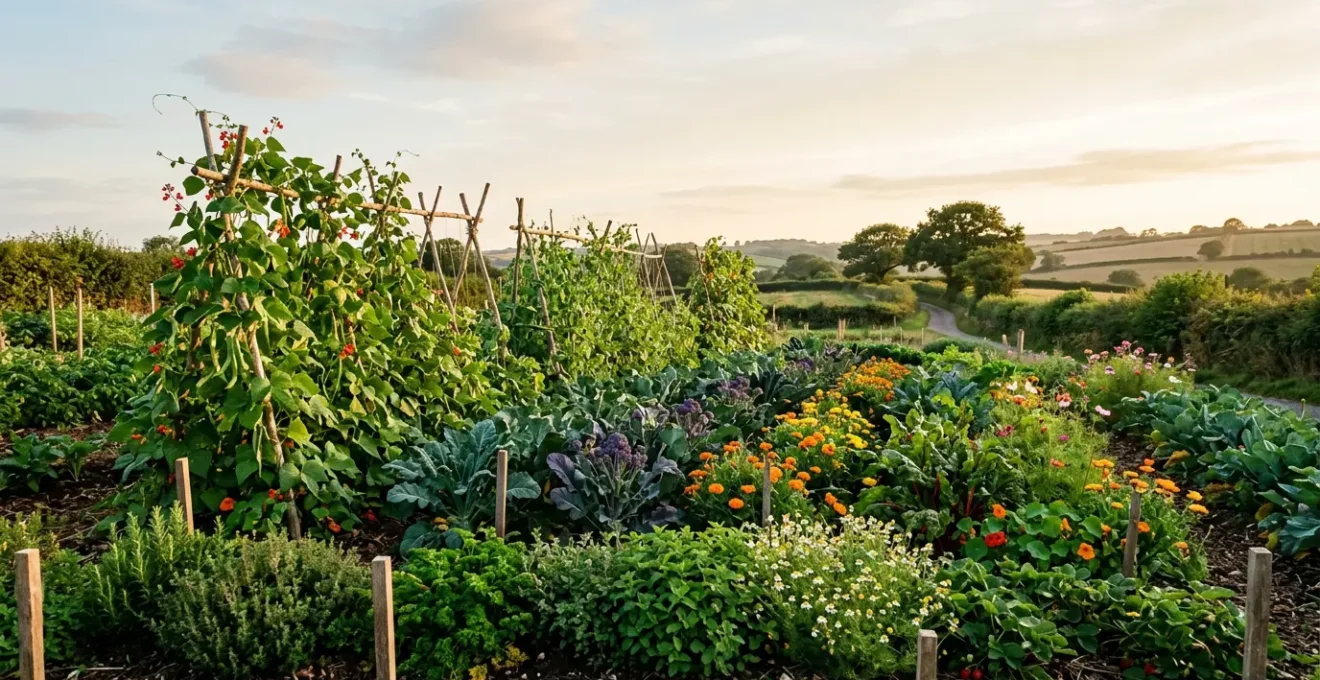
As the image above illustrates, the overlapping textures, colours, and structures create a complex environment. From a pest’s perspective, navigating this landscape is an immense challenge compared to the simple, open highway of a monoculture row. This visual complexity is a physical manifestation of the sensory disruption that forms the first line of defence in a resilient ecosystem architecture.
How to Use Trap Crops Like Nature Uses Sacrificial Plants?
The common advice to plant nasturtiums to « trap » aphids is a classic example of a good idea with incomplete instructions. Too often, the trap crop becomes a breeding ground, creating an even bigger pest problem that then migrates to the main crop. Nature’s use of sacrificial plants is far more sophisticated. It’s not just about trapping; it’s about active management and manipulation of pest behaviour. This is perfectly demonstrated by the biomimetic strategy known as ‘Push-Pull’ technology.
Developed by the International Centre of Insect Physiology and Ecology (ICIPE) in collaboration with Rothamsted Research in the UK, this system is a masterclass in ecosystem design. It uses a clever combination of plants to actively manage pests. A repellent intercrop, such as Desmodium, is planted between the main crop rows. Its scent ‘pushes’ pests away. Simultaneously, a highly attractive trap crop, like Napier grass, is planted around the field’s perimeter to ‘pull’ the pests towards it, luring them away from the valuable crops. This isn’t passive trapping; it’s an active redirection of pest populations.
The results are transformative. A 2009 impact assessment found that 75% of farmers using the technique reported a threefold to fourfold increase in maize yield. The key to success, which applies directly to a UK market garden, is the combination of a repellent and an attractant, and crucially, managing the trap crop. The ‘pull’ plants must be monitored and, if pest populations become too high, cut back or removed before the pests can complete their life cycle and move on. This mimics the natural process where a sacrificial plant might be consumed or die back, breaking the cycle.
Row Planting vs Polyculture: Which Mimics Forest Resilience Better?
The straight, single-file row is the emblem of modern agriculture, designed for the convenience of tools and tractors. A forest, nature’s most resilient ecosystem, has no straight lines. It is a dense, multi-layered, and seemingly chaotic mix of species. For a UK market garden aiming for pest resilience through biomimicry, the challenge is to find a practical balance between the pure chaos of a wild forest and the pure order of a monoculture field. The answer lies in understanding the trade-offs between different planting systems.
Pure polyculture, where multiple crops are intermixed within the same bed, offers the highest level of pest confusion and resilience. It is the closest mimic to a natural ecosystem. However, it can be inefficient to harvest and incompatible with many standard market garden tools. At the other extreme, monoculture rows are efficient but fragile. The most practical biomimetic solutions for a commercial grower often lie in the middle ground, such as strip intercropping or alley cropping. These systems maintain some row structure for accessibility and efficiency while introducing the « edge effect »—the biodiverse boundary between two different habitats—that disrupts pest movement and provides habitat for beneficials.
Research consistently shows the benefits of moving towards more complex systems. For instance, polyculture systems research demonstrates a reduction in the need for inputs like fertilizers and pesticides by 30-40%. This is not just because of pest confusion, but also due to improved nutrient cycling and resource use efficiency among the diverse plant community. The key is to choose the system that best fits your scale, crops, and harvesting methods.
The following table, inspired by resources from the Permaculture Association UK, breaks down the practical considerations for a market gardener.
| System Type | Pest Resilience Mechanism | Harvesting Efficiency | Tool Compatibility | Best For UK Market Gardens |
|---|---|---|---|---|
| Monoculture Rows | Low – uniform crop provides continuous pest habitat | High – mechanized or walk-behind tools work efficiently | Excellent – all standard equipment compatible | High-volume single crops where chemical control acceptable |
| Strip Intercropping | Medium-High – creates ‘edge effect’ zones between crop strips | Medium – each strip harvested separately but systematically | Good – maintains row structure for equipment access | Pragmatic biomimicry solution balancing resilience and efficiency |
| Mixed Polyculture | Highest – maximum diversity and pest confusion | Low – hand-harvesting required, crops intermixed | Poor – paths needed, no mechanization possible | Small-scale, high-value crops, home gardens, or forest garden zones |
| Alley Cropping | Medium-High – perennial rows provide beneficial habitat, annual crops between | Medium – annual strips accessible, perennials permanent | Medium – requires adapted equipment for narrower alleys | Long-term systems combining production with habitat creation |
The ‘Clean Field’ Mistake That Removes Habitat for Beneficial Predators
There’s a pervasive tidiness aesthetic in agriculture that equates a ‘clean’, weed-free field with good farming. From a biomimicry perspective, this is a profound mistake. A sterile field is a habitat desert. By removing every « unwanted » plant and patch of « messy » grass, we inadvertently destroy the homes, nurseries, and hunting grounds of the very predators that would control our pests for free. Ladybirds, lacewings, spiders, and ground beetles don’t just appear when pests arrive; they need a permanent place to live, overwinter, and reproduce. This is the concept of predator scaffolding: intentionally building permanent habitat structures into the farm’s architecture.
A prime example of this from the UK is the ‘Beetle Bank’. Developed by the Game & Wildlife Conservation Trust (GWCT), these are simple raised earth ridges, sown with tussock-forming grasses like Cock’s-foot, that run through the middle of large fields. They are a purpose-built insect infrastructure. Research in Hampshire by the GWCT found that these banks provide critical overwintering habitat, achieving predator densities of up to 764 individuals per square metre, comparable to a natural hedgerow. These predators, primarily ground beetles and spiders, then move out into the crop in the spring to feed on pests like aphids.
This isn’t just about attracting beneficials; it’s about creating a self-sustaining population that is present *before* pest numbers explode. For a market garden, the principle can be scaled down. It means leaving a strip of uncut, tussocky grass, establishing a dedicated perennial herb border, or creating a small log pile. It’s about designing messiness with a purpose. It requires a mental shift from seeing these features as « weeds » or « clutter » to seeing them as essential pieces of your pest control infrastructure.
Your Action Plan: Building a Beetle Bank in a Market Garden
- Choose location: Identify a strip (1-2m wide) along a field edge or between permanent beds. It should be in a sunny, undisturbed location to allow for predator establishment.
- Build the ridge: In autumn, use a plough or simply mound soil with spades to create a raised bank approximately 0.4m high. This improves drainage and creates a warm, dry overwintering site.
- Sow the right mix: Use a seed mix of tussock-forming grasses (like Cock’s-foot, *Dactylis glomerata*) and some wildflowers. The dense base of the tussocks is key for sheltering beetles.
- First-year care: In the first summer, give the bank one high cut to control annual weeds and encourage the perennial grasses to establish. After this, do not cut it again.
- Leave it alone: The true value comes from leaving it completely unmanaged. A stable, dense habitat for thousands of predatory insects per square metre will develop within 2-3 years, providing free pest control indefinitely.
Mimicking Beaver Dams: How to Slow Water Flow in Ditches?
Biomimicry in farming isn’t limited to plants and insects; it extends to the powerful forces that shape the landscape, like water. On many UK market gardens, ditches are designed for a single purpose: to get water off the land as quickly as possible. This is a missed opportunity. Fast-moving water can cause erosion, wash away valuable topsoil, and contribute to downstream flooding. A beaver, nature’s master hydro-engineer, has a different approach. It builds dams not to stop water, but to slow it down, spread it out, and store its energy. We can mimic this strategy on a small scale.
By installing simple ‘leaky barriers’ or ‘check dams’ in our ditches and drainage channels, we can transform them from drains into assets. These structures, made from on-site materials like branches, prunings, or small logs, are semi-permeable. They don’t block the ditch; they just interrupt and slow the flow. This small act has multiple cascading benefits: it raises the water table in the immediate vicinity, passively irrigating nearby crops; it allows nutrient-rich sediment and organic matter to settle out instead of being washed away; and it creates diverse micro-habitats for amphibians and beneficial insects like dragonflies, which are voracious predators of pests.
The effectiveness of this approach is backed by UK-based research. A two-year study by Cardiff University and the University of Worcester on 105 leaky barriers in Shropshire found they were remarkably effective. During a major storm, the barriers stored enough water to fill four Olympic-sized swimming pools, significantly reducing the flood peak. Dr. Christian Webber, the lead researcher, confirmed that they are ‘effective in slowing down the flow of the river’. Similarly, the Pickering natural flood management project in North Yorkshire demonstrates significant flood peak reduction while also enhancing local biodiversity.
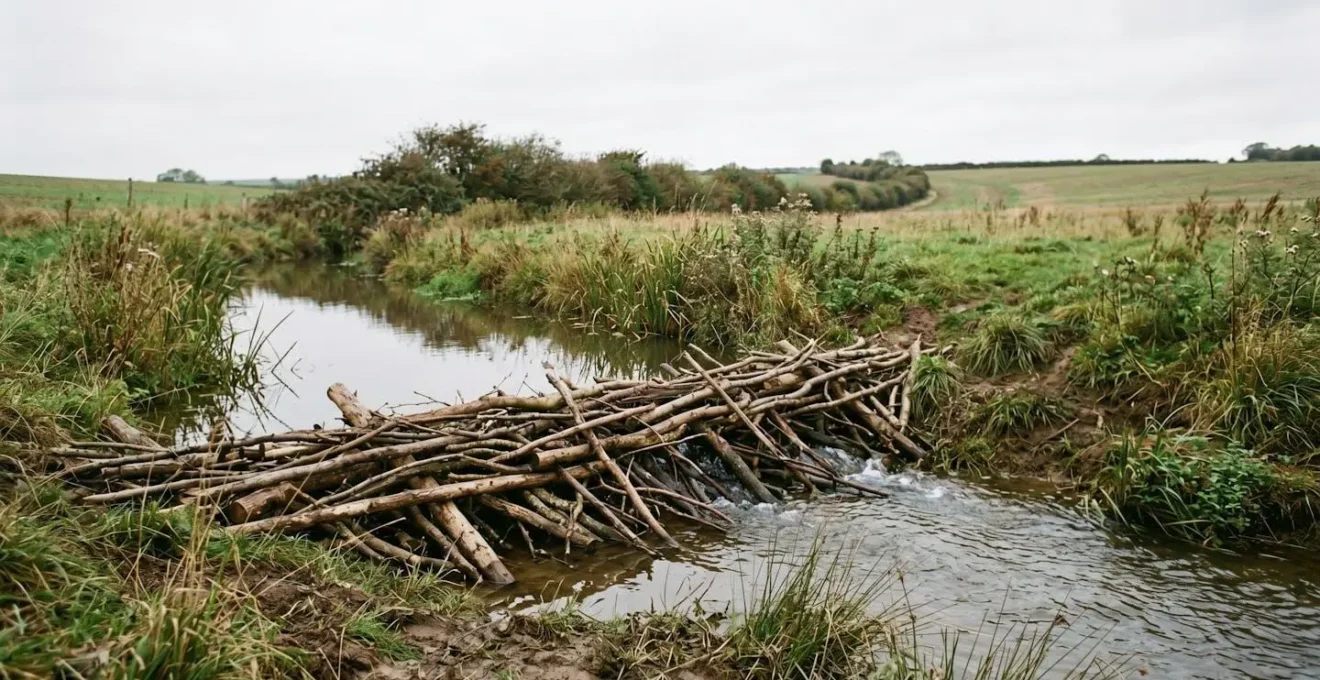
The image above shows the elegant simplicity of a leaky dam. It’s not a heavy-duty engineering project but a light-touch intervention using natural materials. This structure slows the flow, creates a small upstream pool, and recharges groundwater—a perfect example of achieving powerful results with minimal effort by working with, not against, natural tendencies.
Why You Need All 7 Layers for a Self-Sustaining Guild?
A forest garden guild is more than just a random collection of companion plants; it’s a carefully designed community where every member performs multiple functions. The classic model describes seven layers, from the tall canopy trees down to the root systems in the soil. While a market gardener may not be planting a full forest, this concept of functional stacking is a powerful design tool for creating highly productive and resilient polyculture beds. The magic happens when all layers are represented, because they work together to create a closed-loop, self-sustaining micro-ecosystem.
Each layer contributes to pest control. The canopy provides perches for insect-eating birds. The herbaceous layer’s diversity creates the ‘nutritional chaos’ we’ve discussed. The aromatic layer confuses pests with strong scents. The ground cover provides habitat for predatory ground beetles. The rhizosphere (root zone) can harbour beneficial nematodes that attack pest larvae, and the climbing layer adds another dimension of complexity. When these layers are combined, their effects multiply. It’s not addition; it’s synergy.
As a research team from Springer Applied Sciences noted in a 2025 study on crop management, when plants are in close proximity, they communicate stress signals through root systems and airborne chemicals. This leads to a ‘system-wide elevation of defensive readiness across the crop field.’ A complete seven-layer guild maximizes this effect. The absence of a layer creates a vulnerability. For example, without a ground cover layer, the soil is exposed, and you lose your primary habitat for ground beetles, which are key predators of slugs and aphids.
In intercropped or polyculture systems, this phenomenon is amplified due to the close proximity and diversity of plant neighbors, leading to a system-wide elevation of defensive readiness across the crop field.
– Research team from Springer Applied Sciences, Reduced pesticide dependency through crop management study (2025)
Thinking in layers allows you to design a bed that provides its own pest control, mulch, and fertility. Here are the seven layers adapted for a UK market garden context, with their specific pest-control roles:
- Layer 1 – Canopy (Temporary): Climbing beans on trellises create shade that attracts insectivorous birds hunting caterpillars.
- Layer 2 – Low Tree/Shrub (Perennial): Currant bushes at bed ends provide nesting sites and early nectar for parasitic wasps.
- Layer 3 – Herbaceous Layer (Annual/Perennial): Your main crops, whose diverse root exudates signal stress to neighbours, priming defenses.
- Layer 4 – Aromatic/Companion Layer: Basil or coriander between rows, whose volatile oils confuse pest olfactory systems.
- Layer 5 – Ground Cover (Living Mulch): White clover beneath taller crops, providing habitat for predatory beetles.
- Layer 6 – Rhizosphere (Below-ground): Diverse root systems harbouring nematodes that attack soil-dwelling pest larvae.
- Layer 7 – Vertical/Vine Layer (Seasonal): Cucumbers climbing into the canopy, creating microclimate diversity.
Why High-Maintenance Crops Must Be Visible from Your Kitchen Window?
One of the most profound principles in permaculture design, which is deeply rooted in biomimicry, is not about a specific plant or technique, but about the placement of elements relative to human observation. The ‘Kitchen Window’ principle states that the elements needing the most frequent attention—such as a propagation house, a salad bed, or a crop susceptible to a particular pest—should be placed where they are most frequently seen. This isn’t about aesthetics; it’s about creating high-frequency feedback loops.
In a natural ecosystem, feedback is constant and immediate. A predator sees its prey; a plant wilts from lack of water. In our market gardens, the ‘predator’ is often the grower. By placing high-maintenance crops within our daily line of sight, we are more likely to notice the very first sign of a problem—the first aphid, the first cabbage white butterfly, the first touch of mildew—at a stage where it can be managed with a gentle, minimal intervention. When these crops are at the far end of the field, we might only check them weekly, by which time a small problem has exploded into a full-blown infestation requiring a drastic, high-energy response.
As Luke Marion of MIgardener notes, simple biodiversity creates a ‘cocktail of chemical scents that confuses pests.’ This passive defence is our first line, but active observation is the critical second line. The placement of plants is an energy-efficiency strategy. As a general rule from organic gardening best practices, you should observe plants daily for two weeks to see results from any new intervention. Placing those plants where you can’t miss them makes this observation effortless and automatic.
Intercropping to add biodiversity is a favorite method for organic gardeners because it offers a hands-off approach to pesticide use! When different plants are near each other, their pheromones are mixed, creating a cocktail of chemical scents that confuses pests.
– Luke Marion, MIgardener Guide To 100% Organic Pesticides
This principle of strategic placement is the human component of ecosystem design. It’s about designing the farm around your own patterns of movement and attention to make management more efficient and timely. The best pest control strategy is one that is noticed and applied early.
Key takeaways
- True pest resilience comes from designing an ecosystem, not just planting companion plants.
- Mimic nature’s patterns: create sensory chaos, build predator scaffolding, and manage flows of water and energy.
- The most effective system designs integrate the grower’s own behaviour and observation patterns.
How to Design Polyculture Guild Associations for Productive UK Forest Gardens?
We have explored the principles: the ‘why’ behind nature’s resilience. Now we move to the ‘how’—the practical application of these ideas. Designing a polyculture guild is like composing a symphony; you need to bring together different instruments (plants) that play different roles to create a harmonious and functional whole. The goal is to create a plant community that largely takes care of itself by providing its own fertility, pest control, and ground cover. For the UK grower, this means selecting plants that are adapted to our specific climate and soil conditions.
A successful guild isn’t just a mix of plants; it’s a functional matrix. Each plant is chosen for the job it does. You need nitrogen-fixers (like legumes) to feed the system, dynamic accumulators (like comfrey) to mine nutrients from deep in the soil, aromatic pest confusers, plants that attract beneficial insects, and a living mulch ground cover. The following blueprints offer starting points for different UK conditions, but the real power comes from understanding the functions so you can design your own.
- UK Damp Soil Guild: A combination of coppiced Willow (for biomass and beneficial insect habitat), Comfrey (as a dynamic accumulator and shelter for ground beetles), Mint (as an aromatic pest repellent), and a White Clover understorey (to fix nitrogen).
- UK Chalky/Alkaline Soil Guild: This guild thrives on thin soils, using Hazel (for nuts and hoverfly nectar), Wild Marjoram (to attract parasitic wasps), Thyme (as a ground cover), and Salad Burnet (a drought-tolerant edible).
- UK Urban Container/Raised Bed Guild: For small spaces, a dwarf apple tree can be underplanted with Nasturtiums (as an aphid trap crop), Chives (as a pest deterrent), and Strawberries (as a productive ground layer).
To move beyond these recipes and become a true ecosystem designer, you need to think in terms of these functions. The following table provides a matrix of plant roles and UK-specific examples, giving you the building blocks to create endless combinations tailored to your specific site and crops.
| Functional Role | Ecosystem Service | UK Plant Examples | Placement in Guild |
|---|---|---|---|
| Nitrogen Fixer | Improves soil fertility for all guild members | Broad beans, Crimson clover, Lucerne, Lupins | Intercrop or understorey |
| Dynamic Accumulator | Mines deep nutrients, makes available when leaves decompose | Comfrey, Dandelion, Yarrow, Chicory | Margins or deliberately harvested for mulch |
| Aromatic Pest Confuser | Disrupts pest olfactory signals with volatile oils | Rosemary, Lavender, Sage, Basil, Coriander | Interspersed throughout main crops |
| Beneficial Insect Attractor | Provides nectar/pollen for predatory wasps, hoverflies | Fennel, Dill, Poached egg plant, Calendula | Flowering layer, succession planted for continuous bloom |
| Ground Beetle Habitat | Dense ground cover shelters nocturnal predators of slugs/aphids | Creeping thyme, White clover, Strawberries | Ground layer, living mulch |
| Trap Crop | Sacrificial plant more attractive to pests than cash crop | Nasturtiums, Chinese cabbage, Radish | Perimeter or interspersed, regularly removed |
By applying these biomimetic principles, you can begin to transition your market garden from a high-input, high-labour battlefield into a resilient, complex, and largely self-regulating ecosystem. Start small, observe closely, and build on your successes. The journey to a truly pest-resistant farm begins with a change in design philosophy.