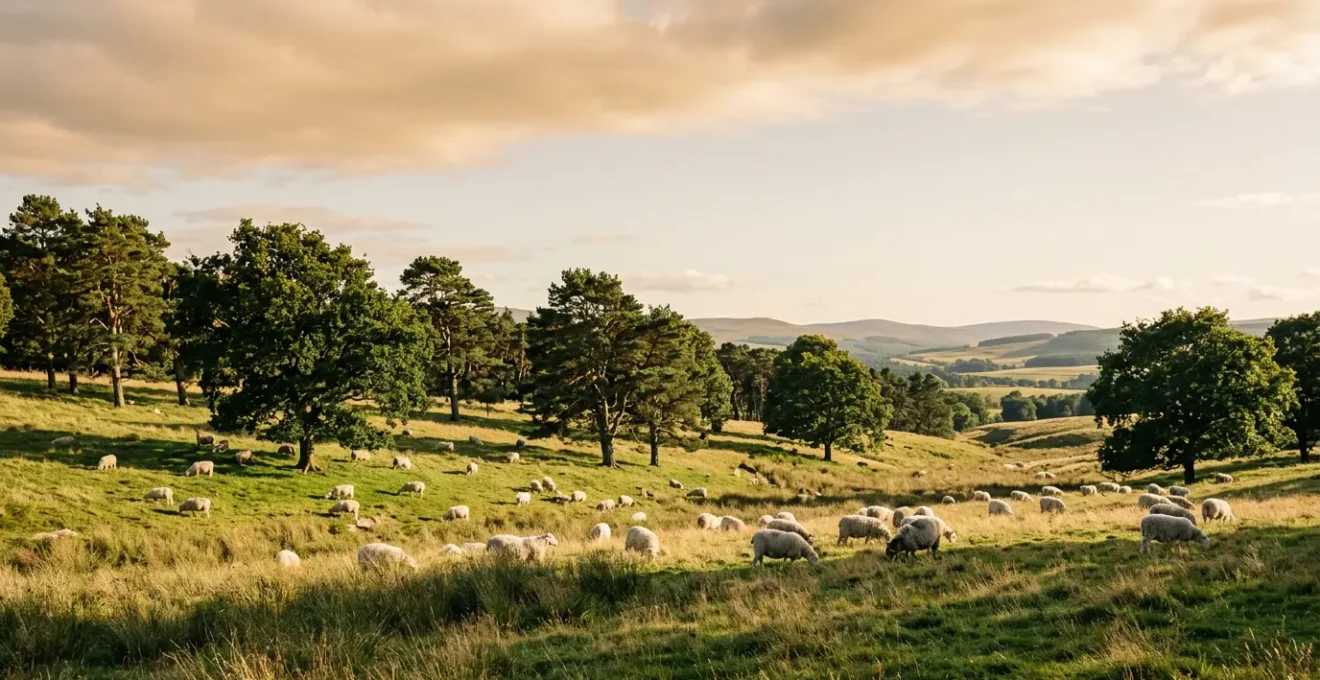
Integrating trees is not about sentiment; it’s about engineering a more profitable and resilient sheep farm.
- Purpose-built shelter belts can drastically reduce lamb mortality from exposure, directly boosting your bottom line.
- The right trees provide targeted nutritional and medicinal benefits that cut feed and vet costs, while correct system design ensures full compatibility with modern machinery.
Recommendation: Start by analyzing your farm’s key vulnerabilities (e.g., wind exposure, late-season feed gaps) and select tree species and layouts that directly solve those economic problems.
For many sheep farmers, the idea of introducing trees into pasture feels like adding an obstacle. It brings to mind images of stock damaging saplings, reduced grazing area, and awkward machinery access. The conventional wisdom often focuses on the basic, passive benefits of shelter, overlooking the enormous potential for a well-designed system. This approach treats trees as a background feature rather than what they truly are: a high-performance, multi-functional farm asset.
But what if the real key to unlocking the value of silvopasture wasn’t just planting trees, but engineering a system with precision? The shift in perspective is moving from « adding trees to a farm » to « designing a farm with trees as an integral component. » This is where profitability is found—not by accident, but by design. It involves a deeper understanding of the mechanics: how a semi-permeable hedge manipulates wind flow, how specific mineral deficiencies drive destructive animal behaviour, and how to stack forage availability across seasons to close feed gaps.
This guide provides the practical frameworks to make that shift. We will move beyond the generic advice and delve into the specific calculations, design choices, and management protocols that turn trees into a source of diversified income and resilience. We’ll explore how to reduce lamb mortality through strategic shelter, protect your investment in young trees without breaking the bank, select species that actively feed your flock, and ensure your entire system works in harmony with your existing equipment. This is about making trees work for your sheep system, profitably and practically.
This article breaks down the essential components for designing and implementing a successful silvopasture system for sheep. The following sections provide detailed, practical guidance on everything from the science of shelter to the specifics of forage calculation.
Summary: Silvopasture Integration Methods: How to Introduce Trees into Sheep Systems Profitably?
- Why Shelter Belts Reduce Lamb Mortality Rates in Spring?
- How to Guard Young Trees from Sheep Without Spending a Fortune?
- Alley Cropping vs Clump Planting: Which Suits Modern Machinery?
- The Bark Stripping Mistake: Which Mineral Deficiency Causes Sheep to Eat Trees?
- Dual Purpose: How to Select Trees That Provide Fodder and Fruit?
- How to Calculate Paddock Sizes for Daily Moves of 50 Cattle?
- How to Position Hedges to Reduce Wind Chill Without Casting Shade?
- How to Maximize Rotational Grazing Impact to Double Pasture Yields?
Why Shelter Belts Reduce Lamb Mortality Rates in Spring?
The primary economic driver for establishing shelter belts in a sheep system is the direct and measurable reduction in lamb mortality. Newborn lambs, particularly twins and triplets, are extremely vulnerable to hypothermia caused by the combination of cold, wet conditions, and wind. A well-designed shelter belt is not just a simple wall against the wind; it’s an engineered system that modifies the microclimate of the lambing paddock, creating a pocket of calm, warmer air that is critical for survival in the first 48 hours of life. The energy a lamb expends just to stay warm is energy it cannot use for growth or to get its vital first intake of colostrum.
The science behind this is clear. Shelter belts work by disrupting airflow, forcing wind up and over the protected area and creating a zone of significantly reduced wind speed on the leeward side. This reduction in « wind chill » is the key factor. Research has quantified the impact, with Australian studies on shelter effectiveness showing an average mortality reduction of 17.5% for twin-born lambs and 7% for singles. The effect is profound; trials have demonstrated up to a 99% wind speed reduction in the most sheltered zones compared to open pasture.
For a sheep farmer, this translates directly into more lambs weaned per ewe, a fundamental metric of flock profitability. The initial investment in establishing a shelter belt is therefore not a cost, but a capital improvement that pays dividends every lambing season. By creating a ‘living barn’, you are providing essential protection at the most critical point in the production cycle, using a natural asset that also improves soil health and biodiversity. It is a classic example of using ecological design to solve an economic problem.
How to Guard Young Trees from Sheep Without Spending a Fortune?
Protecting young trees during their establishment phase (typically the first 3-5 years) is non-negotiable in a silvopasture system, but it doesn’t have to be prohibitively expensive. The key is to use robust, cost-effective, and reusable materials. While commercial tree guards are an option, a DIY approach using standard farm materials can significantly lower the initial capital outlay. The goal is to create a physical barrier that prevents sheep from rubbing, browsing, or ring-barking the sapling while still allowing for air circulation and easy maintenance.
One of the most effective and economical methods involves using heavy-gauge weld mesh. This material is strong enough to withstand rubbing from sheep and can be formed into cylinders that provide 360-degree protection. A crucial detail for a successful guard is cushioning the top edge to prevent it from damaging the growing tree in high winds. This small step makes a huge difference in preventing bark abrasion and stem-snapping. Below is a practical method for constructing these guards.
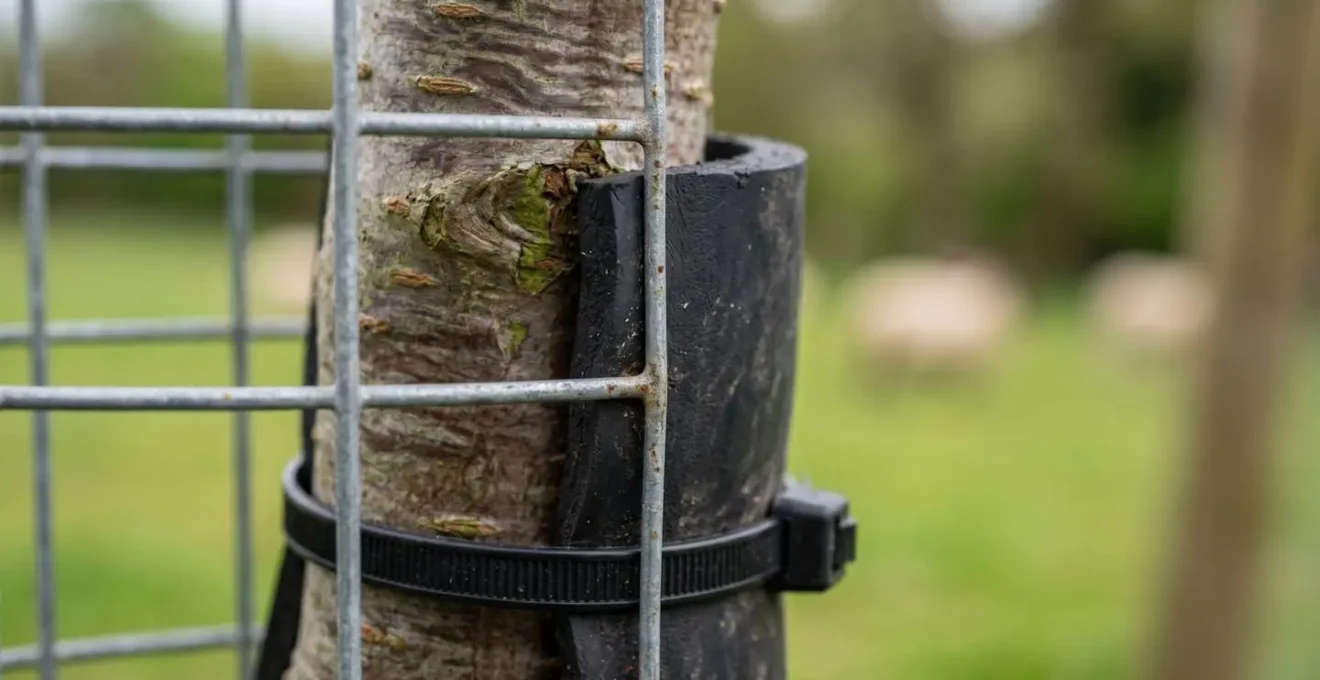
As the illustration shows, the construction is straightforward but effective. The combination of the rigid mesh, a sturdy post, and the protective hosepipe cushioning creates a durable guard that can be removed and reused elsewhere once the tree is large enough to withstand stock pressure. The following steps outline the process:
- Purchase pre-formed weld mesh cylinders or cut mesh to a minimum height of 1.3 meters for sheep.
- Slice a section of old hosepipe along one side and fit it over the top edge of the mesh to create a soft cushion.
- Secure the hosepipe in place with durable cable ties.
- Drive a sturdy post deep into the ground, which will serve as both the tree support and the anchor for the guard.
- Install the guard, leaving a small gap between the ground and the base. This allows sheep to graze right up to the tree, preventing vegetation from swamping the sapling.
- If rabbits are a concern, add a smaller-gauge rabbit guard around the base of the trunk inside the main guard.
Alley Cropping vs Clump Planting: Which Suits Modern Machinery?
Choosing between planting trees in linear rows (alley cropping) or in small, dense groups (clump planting) is a foundational design decision with long-term implications for farm operations, especially machinery access. There is no single « best » layout; the optimal choice depends on your equipment, your long-term goals, and your landscape. As an agroforestry consultant, my advice is to prioritize operational efficiency. A system that is difficult to manage with your current equipment will quickly become a liability rather than an asset.
Alley cropping is often the preferred model for farms using large, modern machinery guided by GPS. The straight, parallel rows of trees create wide « alleys » for cultivation, spraying, or forage harvesting. This layout standardizes field operations, making headland turns predictable and efficient. It’s a design that integrates seamlessly into a precision agriculture framework. However, it can be rigid, locking in a field layout for decades, and may require extensive linear fencing during establishment.
Clump planting, or creating small « islands » of trees, offers greater flexibility. It leaves larger, unobstructed areas of pasture open for grazing and machinery, with operators simply navigating around the clumps. This can be more forgiving on uneven terrain and is excellent for targeting specific areas for shelter or biodiversity. While it may seem less compatible with autosteer systems, it is highly adaptable to future technologies like autonomous mowers or grazer drones, with the clumps potentially serving as service or charging nodes. The following table provides a detailed comparison to aid in this critical design choice.
This comparative analysis, based on guidance from leaders in the field, highlights the trade-offs. The decision should be guided by a clear understanding of your operational priorities, as shown in the recent analysis of silvoarable systems.
| Design Aspect | Alley Cropping (Tree Rows) | Clump Planting (Island Clusters) |
|---|---|---|
| Current GPS Autosteer Compatibility | Optimal – perfectly straight rows ideal for GPS-guided equipment | Moderate – requires manual navigation around irregular cluster shapes |
| Machinery Turning Efficiency | Standardized headland turns, predictable patterns | More frequent turns, variable distances between clusters |
| Future Robotics Readiness | Good for autonomous mowers if row spacing ≥ equipment width | Excellent – clusters can serve as service/charging nodes for robotic systems |
| Keyline Water Management | Can integrate if rows follow contour keylines rather than straight grid | Clusters positioned at keyline intersection points for maximum water distribution |
| Forage Access Percentage | High – alleys maintain full cultivation/grazing access until canopy closure | Maximized – concentrates trees, leaves larger unobstructed grazing zones |
| Initial Establishment Cost | Higher fencing needs for linear protection during establishment | Lower – individual cluster fencing or strategic placement near natural barriers |
| Long-term Flexibility | Fixed layout limits future land use adaptation | High – can expand or modify clusters without disrupting entire system |
The Bark Stripping Mistake: Which Mineral Deficiency Causes Sheep to Eat Trees?
When sheep start stripping bark from trees, the common assumption is boredom or a lack of forage. While these can be contributing factors, the most frequent underlying cause is a specific mineral deficiency, a behaviour known as ‘pica’. Pica is an appetite for non-nutritive substances and is a clear signal that the flock’s diet is missing something essential. Simply fencing off trees without addressing the root nutritional problem is a missed diagnostic opportunity. The most common culprit in sheep is a deficiency in sodium.
However, sodium is not the only potential cause. Phosphorus, cobalt, copper, and zinc deficiencies can also induce pica. The behaviour can even be driven by a simple lack of sufficient roughage in the diet. Therefore, a systematic diagnostic approach is required rather than guesswork. As the Merck Veterinary Manual highlights, providing access to the correct minerals is fundamental to livestock health. In their guidance on sheep nutrition, they state:
Trace mineralized salt provides an economical way to prevent deficiencies of sodium, chlorine, iodine, manganese, cobalt, copper, iron, and zinc.
– Merck Veterinary Manual, Nutritional Requirements of Sheep – Management and Nutrition
This underscores the importance of not just providing a salt lick, but ensuring it is a trace mineralized salt that covers a broad spectrum of potential deficiencies. To correctly identify and resolve the issue, farmers should follow a clear diagnostic protocol.

Action Plan: Diagnosing Bark Stripping Behaviour
- Check Sodium Access: First, ensure trace mineralized salt is freely and easily accessible to all animals. Sodium deficiency is the number one cause of pica in sheep.
- Test Forage Phosphorus: If sodium is adequate, send pasture samples for analysis, focusing on phosphorus levels. Mature or dry forage is often deficient.
- Analyze Trace Minerals: For persistent issues, work with your vet to conduct blood or liver biopsy sampling. Focus on copper, cobalt, and zinc, as deficiencies directly cause pica.
- Assess Pasture Fibre: Evaluate the amount of roughage and biodiversity in the pasture. A lack of fibre can drive animals to seek it from bark.
- Evaluate Mineral Interactions: Be aware of antagonists. For example, high molybdenum in pasture can induce a copper deficiency even if copper intake appears adequate.
Dual Purpose: How to Select Trees That Provide Fodder and Fruit?
Strategic tree selection transforms a simple shelter belt into a productive, multi-functional asset that actively contributes to flock nutrition. The goal is to choose species that provide more than just shade and shelter; we are looking for trees that offer high-protein leaf fodder (tree hay), energy-rich nuts or fruits, and even medicinal compounds that can improve animal health. This approach, known as ‘temporal stacking’, involves selecting a mix of species that provide forage at different times of the year, closing seasonal feed gaps and reducing reliance on purchased supplements.
For example, some species provide a protein boost in the summer ‘slump’ when grass quality declines, while others drop high-energy mast (nuts and acorns) in the autumn, helping ewes gain condition before winter. Furthermore, many of these species contain beneficial secondary compounds. The condensed tannins found in willow, for instance, have a natural anthelmintic (anti-worm) effect. The nutritional benefits can be remarkable; research has shown that willow leaves can provide zinc and cobalt at concentrations up to 17 times the requirements for sheep, acting as a natural mineral supplement.
Choosing the right mix requires careful planning. You need to consider your specific climate, soil type, and management system (e.g., will you actively harvest branches for hay, or rely on direct browsing?). The following selection matrix provides a starting point, outlining several high-value species and their respective benefits, helping you engineer a year-round forage supply directly from your tree assets.
| Tree Species | Seasonal Availability | Nutritional Benefit | Anti-Parasitic Properties | Harvest Method |
|---|---|---|---|---|
| Willow (Salix spp.) | Early Spring (catkins) + Summer (leaf browse) | High cobalt & zinc – up to 17x sheep requirements; excellent mineral correction | Condensed tannins provide anthelmintic effect | Coppicing for active harvest; direct browsing |
| Mulberry (Morus spp.) | Summer (leaf + fruit June-August) | High digestible protein (15-22% crude protein in leaves) | Moderate tannins support gut health | Leaf stripping for tree hay; fruit naturally drops |
| Oak (Quercus spp.) | Autumn (acorn mast September-November) | High energy (carbohydrates), moderate protein; closes late-season feed gap | Tannins require moderation – limit to 25% of diet to avoid toxicity | Natural mast drop; controlled access grazing |
| Black Locust (Robinia pseudoacacia) | Late Spring-Summer (leaf fodder) | Nitrogen-fixing improves soil; very high protein fodder (20-25%) | Natural compounds may deter some pests | Pollarding or leaf harvest for tree hay/silage |
| Linden/Lime (Tilia spp.) | Summer (leaf harvest July-August) | Palatable, moderate protein, good energy | Mild medicinal properties support digestion | Dried branches for winter tree hay storage |
| Hazel (Corylus avellana) | Autumn (nuts September-October) | High fat/energy for condition building pre-winter | Leaves browsed in summer provide trace minerals | Natural nut drop; coppice management for browse access |
How to Calculate Paddock Sizes for Daily Moves of 50 Cattle?
While this title specifies cattle, the underlying mathematical principle for calculating forage availability is universal for all rotational grazing systems, including sheep. The critical adjustment in a silvopasture context is accounting for the variable forage productivity caused by tree canopy. Pasture under dense shade simply does not produce as much dry matter as pasture in full sun. Ignoring this fact will lead to overestimation of available feed and potential under-nutrition of your flock.
The solution is to use a ‘canopy coefficient’ to create a weighted average of forage availability for each paddock. This involves mapping your paddock into different zones based on sunlight exposure and applying a reduction factor to the shaded areas. For example, open alleys might have a coefficient of 1.0 (100% productivity), while areas under a partial canopy might be rated at 0.7 (70% productivity), and dense shade at 0.4 (40% productivity). This provides a far more accurate picture of the true carrying capacity of a silvopasture paddock.
The following steps outline the methodology for calculating paddock sizes in a way that accounts for the presence of trees, ensuring your sheep receive their required daily dry matter intake. This method turns a potentially complex calculation into a manageable, step-by-step process.
- Establish Baseline Productivity: First, calculate your baseline forage productivity for open pasture (coefficient 1.0). The formula is: (Daily Dry Matter Intake per ewe × Number of ewes × Grazing days) ÷ Forage utilization rate.
- Apply Canopy Coefficients: Assign coefficients to your different shade zones. For example: open alleys = 1.0, partial canopy = 0.7, dense shade = 0.4.
- Map Your Paddock: Use visual assessment or drone imagery to measure the area of each productivity zone within the paddock.
- Calculate Weighted Average: Determine the adjusted coefficient for the whole paddock: [(Open area × 1.0) + (Partial shade area × 0.7) + (Dense shade area × 0.4)] ÷ Total paddock area.
- Adjust Paddock Size: Divide your standard, open-pasture paddock size by the adjusted coefficient to get the true required size for your silvopasture paddock.
- Add Trampling Allocation: Increase the final size by 30-40% to account for the biomass you want trampled into the ground to feed soil biology. This is a key part of regenerative grazing.
How to Position Hedges to Reduce Wind Chill Without Casting Shade?
The ideal shelter belt provides maximum wind protection during the critical spring lambing season without casting excessive shade that would reduce pasture growth during the main growing season. This is a design challenge that can be solved with careful orientation and species selection. The mistake is to think of a hedge as a solid wall. A solid barrier actually creates turbulence on the leeward side, which can be just as stressful for livestock. The most effective windbreak is semi-permeable.
Research into wind dynamics shows that a hedge with 40-60% porosity is optimal. This density filters and slows the wind rather than blocking it, creating a much larger and calmer zone of protection that can extend 10 to 30 times the height of the hedge. Achieving this porosity is a matter of correct plant spacing and species choice. But the real engineering comes from positioning the hedge to manage sunlight throughout the year.
Using modern, free tools, you can model the exact shadow your proposed hedge will cast on any day of the year at your specific location. This allows you to design a system that lets precious winter and spring sunlight reach your pastures while providing valuable shade in the heat of summer. The following strategy outlines how to achieve this balance.
- Use Solar Modeling Software: Download free 3D modeling software like SketchUp and use a solar path plugin. Input your farm’s coordinates and model your proposed hedges (height, width, orientation).
- Run Seasonal Analysis: Simulate the shadow patterns for critical dates: the winter solstice (longest shadows), the equinoxes, and the summer solstice (shortest shadows).
- Orient for Prevailing Wind: Position your main windbreaks perpendicular to the prevailing wind direction to maximize their effectiveness.
- Use a Hybrid Strategy for East-West Hedges: For hedges running east-west, plant deciduous species on the southern side. Their bare branches in winter will let sunlight pass through. Plant dense evergreens on the northern side to provide a year-round windbreak.
- Optimize Permeability: Space trees and shrubs to achieve the target 40-60% porosity. This filters the wind effectively.
- Validate the Design: Export the shadow maps for each season to ensure your key lambing and grazing areas receive adequate sunlight when it’s most needed.
Key Takeaways
- Integrating trees is an engineering decision that directly impacts farm profitability by reducing mortality and input costs.
- The cause of stock damaging trees is often a manageable mineral deficiency, not just bad behaviour.
- System layout (alleys vs. clumps) must be chosen based on current machinery and future operational goals to ensure long-term efficiency.
How to Maximize Rotational Grazing Impact to Double Pasture Yields?
Maximizing the impact of rotational grazing is not just about the frequency of livestock moves; it’s about creating the optimal conditions for rapid pasture recovery and growth. Integrating trees into a rotational grazing system for sheep acts as a powerful catalyst, enhancing the very biological processes that drive pasture productivity. The trees create a more stable and favourable microclimate at the soil level, which is where the magic of grass growth happens. This goes far beyond the simple benefit of shade.
One of the key mechanisms is temperature moderation. On a hot summer day, the soil surface in an open pasture can become scorching hot, stressing cool-season grasses and slowing or stopping their growth. In a silvopasture system, the dappled shade from the tree canopy keeps the ground cooler. Comparative studies have measured that air temperatures near the soil surface are consistently cooler in silvopastures, with reductions of up to 7% compared to open pastures. This temperature buffer reduces plant stress and moisture loss from the soil, allowing grass to continue growing for longer periods during hot, dry spells. This extends the grazing season and improves the resilience of your pastures to drought.
Furthermore, the tree roots create channels in the soil that improve water infiltration, and the annual leaf drop provides a vital source of organic matter, feeding the soil biology that drives nutrient cycling. In essence, the trees and the pasture work in a symbiotic relationship. Your rotational grazing management builds soil organic matter through trampling, and the trees protect that soil and the pasture, allowing them to function at a higher level of productivity. It is this combination of effects—managed grazing plus the moderating influence of trees—that can lead to significant increases in overall farm yield.
By applying these system-design principles, you can begin to engineer a silvopasture system that is not an expense, but a core profit-center for your sheep operation, enhancing resilience and productivity for decades to come.