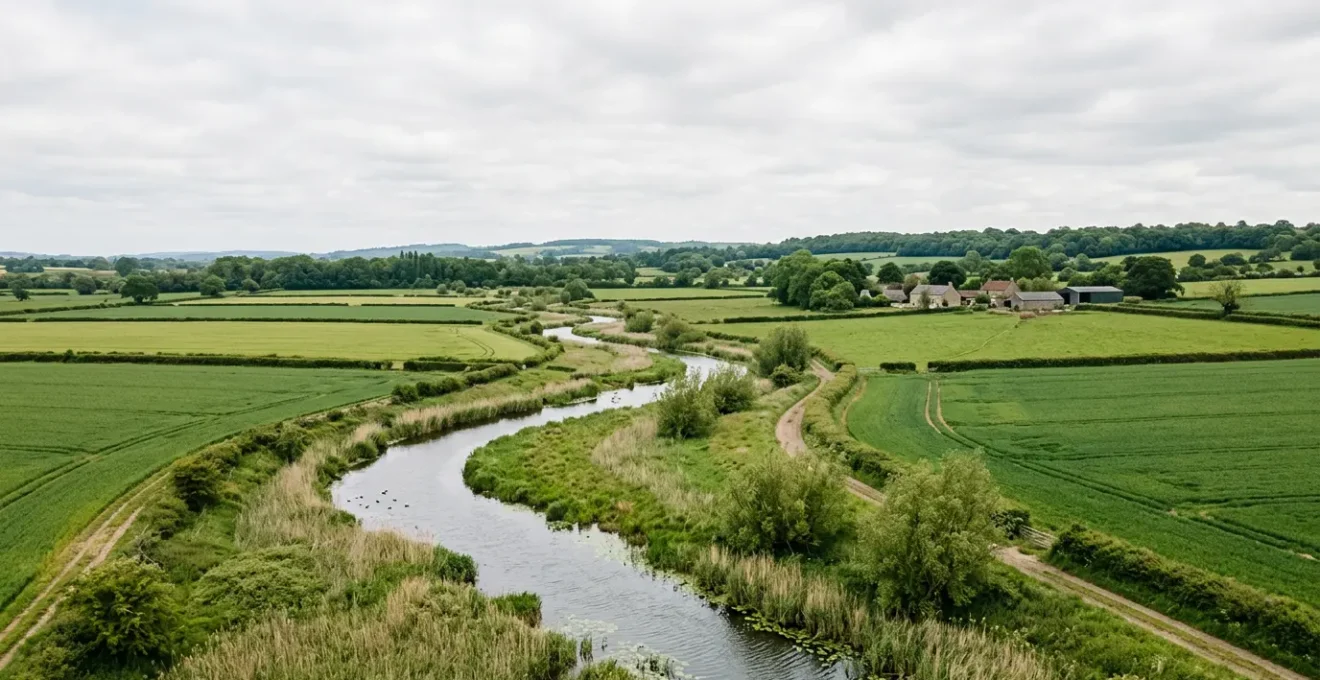
The solution to waterlogged land isn’t faster drainage; it’s smarter water management inspired by nature’s own engineering.
- Conventional straight ditches and plastic pipes often worsen erosion and require constant maintenance.
- Mimicking meandering rivers and beaver activity slows water, recharges groundwater, and builds resilient, self-sustaining ecosystems.
Recommendation: Shift your focus from water evacuation to water retention and purification. By working with natural patterns, you can turn a drainage liability into a valuable on-farm asset.
For any landowner, seeing fields submerged in standing water is a familiar source of frustration. The conventional response has always been to fight the water: dig deeper, straighter ditches; lay more extensive networks of plastic tile drains; and rush the water off the property as quickly as possible. This approach treats water as an enemy to be expelled. But what if this decades-old strategy is fundamentally flawed, creating more problems with erosion, downstream flooding, and soil degradation than it solves?
The emerging field of biomimicry offers a radically different perspective. Instead of imposing rigid, man-made solutions onto the landscape, it asks a simple question: how has nature been solving this problem for millions of years? Wetlands, beavers, and even microscopic fungi have perfected the art of water management. They don’t expel water; they slow it, spread it, clean it, and store it, creating resilient, fertile, and balanced ecosystems in the process. This is nature’s engineering, and it’s an open-source blueprint available to any landowner willing to observe and adapt.
This article moves beyond the common advice of more pipes and bigger ditches. We will explore the core principles of biomimetic hydrology, demonstrating how you can transform your waterlogged land from a persistent problem into a productive, self-regulating asset. By learning to direct water’s energy instead of fighting its presence, you can implement low-cost, high-impact solutions that restore your land’s natural balance and long-term health.
To help you navigate these natural engineering principles, this article is structured to build from the core problem to the large-scale benefits. Explore the sections below to understand how to apply these concepts directly to your land.
Contents: Applying Nature’s Engineering to Your Land
- Why Straight Ditches Fail and Meandering Channels Succeed?
- How to Use Beavers (or Beaver Mimicry) to Regulate Water Levels?
- Plastic Pipes vs Biological Roots: Which Drainage Lasts Longer?
- The Over-Engineering Mistake That Destroys Natural Water Purification
- Reed Beds: How to Mimic Kidneys to Clean Farm Runoff?
- How to Re-Wiggle Rivers to Restore Natural Hydrology?
- Mimicking Beaver Dams: How to Slow Water Flow in Ditches?
- Managing the Hydrological Cycle to Prevent Downstream Flooding Liability?
Why Straight Ditches Fail and Meandering Channels Succeed?
The standard agricultural drainage ditch is a model of human efficiency: a straight, deep channel designed to move water from Point A to Point B as fast as possible. But this efficiency comes at a great cost. In nature, water rarely moves in straight lines. It meanders. This « inefficiency » is actually a highly sophisticated method for managing energy. A straight channel concentrates water’s erosive force into a single, high-velocity jet, scouring the channel bed and banks, carrying away valuable topsoil, and causing incision—where the channel cuts itself deeper, disconnecting from its floodplain.
A meandering channel does the opposite. With every bend, the water is forced to slow down, dissipating its energy. The slower water on the inside of the bend deposits sediment, building up point bars. The slightly faster water on the outside of the bend gently erodes the bank, but this process is balanced by the deposition. This dynamic equilibrium is what keeps a river healthy and connected to its floodplain, allowing water to spill over during high flows and naturally irrigate surrounding land. The patterns of erosion and deposition are complex, as recent research from UC Santa Barbara shows, with sediment load and bank characteristics interacting to shape the river.
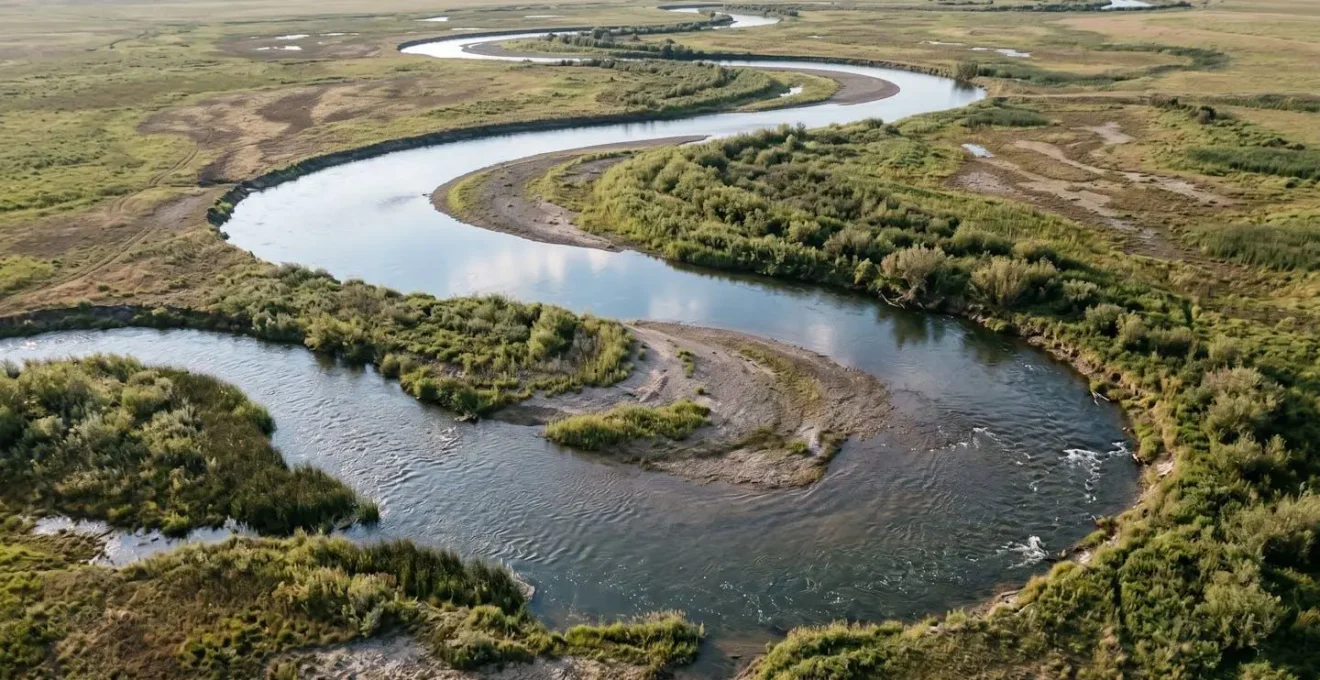
By straightening a stream, we turn a complex, energy-dissipating system into a simple, energy-concentrating firehose. This not only destroys the habitat within the channel but also exports the problem downstream, contributing to flash floods. The biomimetic solution, therefore, isn’t to dig the ditch deeper, but to reintroduce the sinuosity that allows the water to do its geomorphic work of slowing down and spreading out.
How to Use Beavers (or Beaver Mimicry) to Regulate Water Levels?
Beavers are nature’s master hydrologists. For millennia, they have been creating wetlands, raising water tables, and moderating streamflow with nothing more than wood and mud. Their dams are not impermeable walls like concrete dams; they are leaky, semi-permeable structures designed to slow water, not stop it. This simple act has profound effects, forcing water out of the channel and into the surrounding floodplain, creating what is essentially a sponge that stores water during wet periods and slowly releases it during dry spells.
For landowners, reintroducing beavers can be a powerful but sometimes unpredictable restoration tool. A more controlled approach is « beaver mimicry, » using man-made structures called Beaver Dam Analogues (BDAs). These are low-tech, low-cost structures made of wooden posts and woven branches, installed in series within a stream or ditch. They function just like beaver dams, slowing the flow, capturing sediment, and raising the local water table to sub-irrigate pastures and reconnect the stream to its floodplain. The results can be astonishingly fast and effective.
Case Study: The Bridge Creek Restoration Success
In central Oregon’s Bridge Creek, researchers installed a series of BDAs in a degraded stream system. The project’s success, documented in the journal *Science*, was transformative. Beaver activity in the area increased eightfold, the stream’s submerged area tripled, and the length of side channels grew by over 1200%. Critically, habitat changes that were expected to take a decade occurred in just one to three years. The restored creek produced nearly three times more steelhead fish than a control stream, with young fish being 52% more likely to survive, proving that restoring hydrological processes directly translates to ecological abundance.
By thinking like a beaver, landowners can shift from a mindset of drainage to one of hydration. Instead of a single, incised channel draining the landscape, a series of BDAs can create a complex, multi-threaded wetland system that holds onto water, builds soil, and creates drought and fire resilience. It’s a prime example of process-based restoration: creating the conditions for nature to do the healing work itself.
Plastic Pipes vs Biological Roots: Which Drainage Lasts Longer?
Subsurface tile drainage is another cornerstone of conventional agriculture. A network of perforated plastic pipes is buried to lower the water table and carry excess water away. While effective in the short term, this system is a form of life support. The pipes can clog with sediment or roots, they can be crushed by heavy machinery, and they do absolutely nothing to improve the soil’s own ability to manage water. They are a static, high-maintenance, and ultimately temporary solution.
Nature offers a far more sophisticated and durable alternative: biological infrastructure. A healthy soil ecosystem is already equipped with an intricate drainage and absorption network created by plant roots, earthworm burrows, and fungal hyphae. Deep-rooted perennial plants create vertical channels that allow water to infiltrate deep into the soil profile. Even more impressive is the vast, microscopic network created by mycorrhizal fungi, which partners with plant roots.
Mycorrhizal fungi form a living secondary root system for the plant, which has a huge effect on the plant’s overall absorptive surface area and allows the plant to source and utilize resources that would not be available by the plant’s root system alone.
– Mycorrhizae Biostimulants Research, Mycorrhizae.com Root Enhancement Documentation
This living network is self-repairing, adaptive, and actively builds soil structure. Unlike a plastic pipe that only removes water, a root system holds soil in place, enhances aggregation, and increases organic matter, which in turn improves the soil’s capacity to both absorb and hold water like a sponge. This creates a positive feedback loop: better soil structure allows for healthier plants, which in turn create even better soil structure. It’s a system that gets stronger over time, whereas plastic infrastructure only degrades.

The choice is between a brittle, high-entropy system that requires constant inputs and a resilient, living system that maintains and improves itself. By fostering a diverse community of plants and soil life, you are investing in an infrastructure that will outlast any plastic pipe.
The Over-Engineering Mistake That Destroys Natural Water Purification
When we think of drainage, we rarely think of water quality. But in a natural system, the two are inextricably linked. A slow-moving, meandering stream with a rocky bed and abundant aquatic plants is not just a conduit for water; it is a living water treatment facility. The surfaces of rocks, fallen logs, and plant stems are coated in a slimy layer known as periphytic biofilm. This complex community of bacteria, algae, and fungi is the river’s digestive system.
As water flows over these surfaces, the biofilm traps sediment and absorbs excess nutrients like nitrogen and phosphorus from farm runoff. The microbes then break down these pollutants, effectively « cleaning » the water as it moves downstream. This self-purification capacity is a powerful, free service provided by the ecosystem. However, our engineering instinct often leads us to destroy it. To « improve » flow, we may line a channel with concrete or riprap, or dredge it to create a smooth, uniform bed. These actions sterilize the stream, removing the complex surfaces that biofilms need to colonize. A concrete channel is an aquatic desert, incapable of supporting the microbial life needed for purification.
The result is that we move polluted water downstream faster, concentrating the problem for others. The effectiveness of these natural systems is well-documented; indeed, early water treatment plants in the 1860s were designed to mimic this process using sand filters that acted as a substrate for biofilm growth. Scientific studies continue to confirm the immense cumulative contribution to river self-cleaning processes made by these biofilms. By over-engineering for speed, we disable one of the most important functions of a healthy watershed.
Reed Beds: How to Mimic Kidneys to Clean Farm Runoff?
If a healthy stream acts as a digestive system, then a constructed wetland acts as a kidney. These engineered ecosystems are a perfect example of biomimicry in action, designed specifically to replicate and amplify the water-purifying functions of natural marshes and reed beds. For a farm, a constructed wetland can be an incredibly effective end-of-pipe solution to treat nutrient-rich runoff from fields or feedlots before it enters a major waterway.
The system is elegantly simple. Runoff is directed into a shallow basin or channel filled with a substrate like gravel and planted with a diverse mix of wetland plants, such as reeds, rushes, and cattails. The magic happens in the root zone. The dense network of roots physically traps sediment, while also creating a massive surface area for the beneficial biofilms we’ve discussed. The plants themselves absorb nutrients, and the low-oxygen conditions in the substrate promote denitrification, a bacterial process that converts harmful nitrates into harmless nitrogen gas.
Unlike a simple vegetated ditch, a well-designed constructed wetland is a polyculture system, where different plant species are chosen for specific jobs: some are excellent at taking up phosphorus, others host nitrogen-fixing bacteria, and still others are hyperaccumulators of heavy metals. This creates a robust and multi-functional treatment train that transforms polluted runoff into cleaner water, while also providing valuable wildlife habitat. It turns a waste stream into a resource that recharges groundwater and supports biodiversity.
Your Action Plan: Key Points for Designing a Constructed Wetland
- Assess Site & Load: Identify the catchment area and estimate nutrient loads to size the wetland appropriately (typically 2-5% of the catchment). Select plant guilds for specific functions, like hyperaccumulators for metals and dense-rooted species for trapping sediment.
- Choose Your Flow: Decide between a horizontal subsurface flow system (best for organic matter and pathogen removal) and a vertical flow system (superior for oxygenating water and nitrifying ammonia).
- Configure the System: Plan a layout. Hybrid systems that combine vertical and horizontal flow stages can maximize both nitrification and denitrification while minimizing water loss from evaporation.
- Plan for Resource Recovery: Design a biomass harvest cycle. The nutrient-rich reed biomass can be composted or used for other purposes, transforming the wetland from a pollution sink into a productive resource.
- Ensure Treatment Efficacy: Calculate and design for adequate water residence time. The amount of time water is in contact with the root zone and substrate is critical for effective bacterial treatment.
How to Re-Wiggle Rivers to Restore Natural Hydrology?
For landowners with a channelized or straightened stream running through their property, the idea of restoring its natural meanders can seem daunting and expensive, involving heavy machinery and massive earth-moving. But a biomimetic approach, known as process-based restoration, offers a more subtle and cost-effective path. The goal is not to force a new channel shape onto the landscape, but to create small interventions that encourage the river to do the « geomorphic work » of reshaping itself.
The first step is often historical detective work: using old aerial photos and soil maps to identify the « ghost river »—the historical meander path that still exists as a subtle depression in the landscape. A common strategy is the « two-stage channel » design. This involves carving a smaller, meandering low-flow channel inside the larger, straightened flood channel. This preserves the overall flood capacity of the ditch while restoring the ecological function of a meandering stream at normal flow levels, all with minimal loss of adjacent arable land.
To kickstart the process, large woody debris (LWD) or Beaver Dam Analogues (BDAs) can be installed at strategic points. These structures don’t define the final channel, but act as anchors and flow deflectors. They force the water to slow, scour, and deposit sediment in new patterns, initiating the re-wiggling process naturally. This approach has been successfully deployed on private lands, such as in California’s Scott River basin, where ranchers and conservationists collaborated. As a USDA report on the project notes, these efforts can achieve ecological goals while respecting agricultural needs, though they often require collaborative permitting processes to overcome initial regulatory challenges.
By making small, intelligent nudges, you allow the immense power of the water itself to become your primary restoration tool. You are not building a river; you are creating the conditions for the river to rebuild itself. This saves enormous costs and results in a more stable, resilient, and natural channel form in the long run.
Mimicking Beaver Dams: How to Slow Water Flow in Ditches?
On a smaller scale, such as in drainage ditches or small gullies, the principles of beaver mimicry are just as potent. The traditional engineering solution for slowing water in a ditch is a « check dam »—a small, often solid barrier made of rock or wood placed across the channel. While it does slow the immediate flow, its primary function is limited. A check dam is a wall; a Beaver Dam Analogue (BDA) is a sieve.
The fundamental difference lies in permeability and purpose. A check dam is designed to create a small pool of water directly behind it. A BDA is designed to be leaky, forcing water to not only slow down but also to spread out laterally, raising the water table in the surrounding banks. This provides sub-irrigation to adjacent pasture or cropland, effectively turning a drainage ditch into an irrigation system. It recharges local groundwater instead of just impeding surface flow.
This conceptual difference is critical for landowners looking for solutions that do more than just fight erosion. The table below, drawing on concepts from the National Park Service’s work with BDAs, highlights the functional advantages of mimicking beavers over simple engineering. As this comparative analysis from the National Park Service shows, the goals are fundamentally different.
| Feature | Simple Check Dam | Beaver Dam Analogue (BDA) |
|---|---|---|
| Primary Function | Barrier to slow in-channel flow | Leaky structure to elevate water table in surrounding banks |
| Water Retention Zone | Limited to channel itself | Extends into floodplain via raised water table and sub-irrigation |
| Permeability | Often solid or minimally permeable | Semi-permeable by design—slows and spreads water, not stops it |
| Groundwater Recharge | Minimal lateral recharge | Significant aquifer recharge and pasture sub-irrigation |
| Construction | Posts and horizontal barrier | Wider structure using wattle fences, post lines, or postless woody debris weave |
| Maintenance Philosophy | Build-and-forget engineering | Adaptive management—structures adjusted based on flow conditions |
Furthermore, BDAs are designed for adaptive management. Like a real beaver, a landowner can adjust the structures, add more material, or build new ones in response to how the system evolves. This contrasts with the static, « build-and-forget » nature of a check dam. By choosing to build a leaky, wide, and adaptive structure, you are working with the water’s properties to achieve multiple benefits beyond simple erosion control.
Key Takeaways
- Hydrological problems are often symptoms of an over-simplified landscape; complexity is the solution.
- Slowing and spreading water, rather than concentrating and speeding it up, is the foundation of resilient water management.
- Biological and process-based solutions (roots, BDAs, wetlands) are adaptive and self-maintaining, unlike static concrete and plastic infrastructure.
Managing the Hydrological Cycle to Prevent Downstream Flooding Liability?
Ultimately, adopting a biomimetic approach to water management is about more than just fixing a soggy field; it’s about fundamentally changing your relationship with the hydrological cycle. By treating every drop of rain that falls on your property not as a waste product to be disposed of, but as a resource to be managed, you transform a potential liability into a profound asset. Each BDA, each restored meander, and each square foot of wetland acts as a small buffer in the landscape.
Individually, their effect is local. But collectively, across a watershed, they create immense resilience. By holding water on the land and releasing it slowly, these features reduce the peak flows that cause downstream flooding. This not only protects your own land from erosion but also reduces your legal and ethical liability for exporting a flood problem to your neighbors. As research from the Bridge Creek watershed demonstrates, ranchers and funding agencies are increasingly recognizing the ability of BDAs to prolong streamflow and improve riparian health, shifting the perception from liability to asset.
The benefits extend even further. Landscapes that are well-hydrated, with high water tables and lush vegetation, are significantly more resistant to fire. They provide critical habitat for wildlife, support greater biodiversity, and can even moderate local microclimates. In an era of increasing climate uncertainty, with more intense droughts and deluges, building this « sponge » capacity into your land is one of the most powerful insurance policies you can have. You are no longer just a farmer of crops or livestock; you become a steward of your local watershed.
Start today by observing the flow of water on your land. Identify the areas where water moves too fast and where it could be slowed, spread, and soaked into the ground. By applying these biomimetic principles, you can begin the process of restoring your land’s natural hydrology and turning your biggest water problem into your greatest asset.
Frequently Asked Questions on Biomimetic Drainage
Is implementing biomimicry for drainage expensive?
While there are initial costs for labor and materials (like for BDAs), process-based restoration is often significantly cheaper than conventional engineering. It avoids the high costs of heavy machinery, concrete, and plastic pipes by leveraging the « geomorphic work » of the river itself and using on-site natural materials.
Do I need special permits to install Beaver Dam Analogues (BDAs)?
Permitting requirements vary significantly by location. As these are in-stream structures, consultation with local and state environmental or water resource agencies is almost always necessary. The Scott River case study shows that while regulatory challenges exist, collaborative processes can lead to successful permitting, especially as agencies become more familiar with these techniques.
How long does it take to see results from these natural solutions?
Results can appear surprisingly fast. The Bridge Creek restoration project demonstrated that major ecological changes, such as a tripling of submerged area and a 1200% increase in side channels, occurred within 1 to 3 years—a process that was expected to take over a decade. While full system maturity takes longer, initial benefits like a raised water table and increased water retention can be observed quickly.