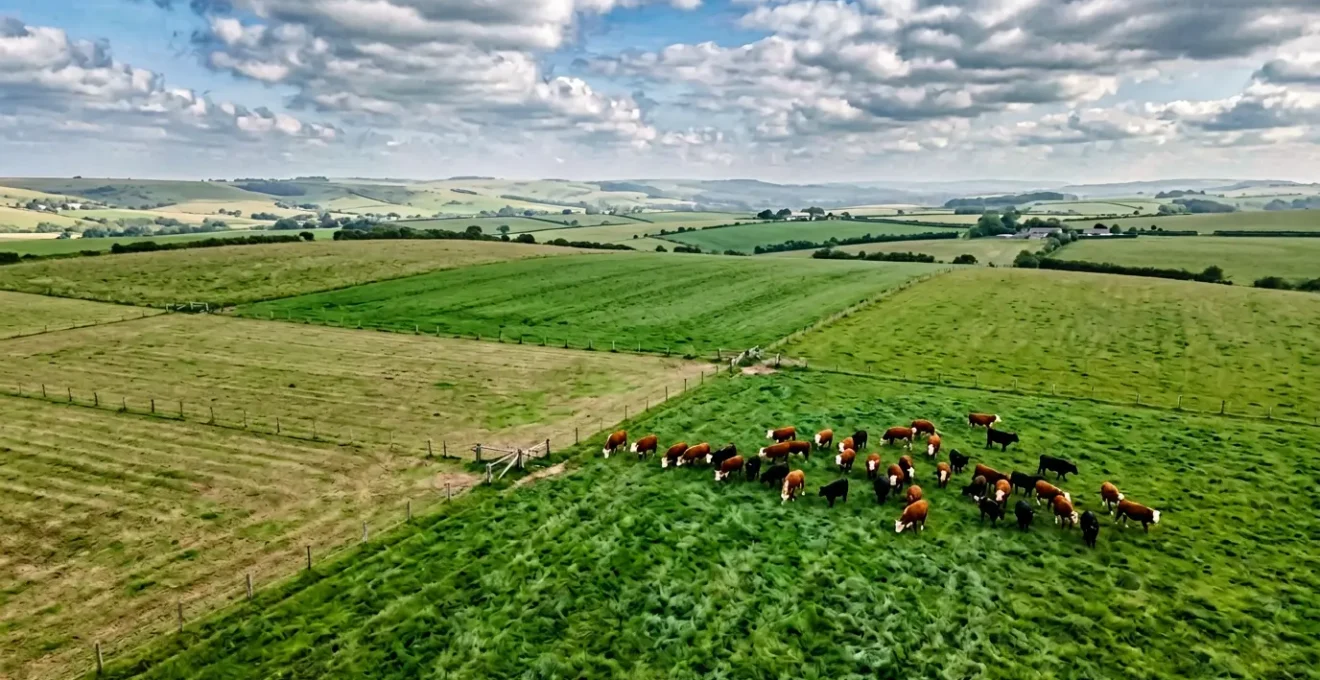
High-density rotational grazing isn’t about crowding animals; it’s a precision tool for building soil and doubling your forage production by mastering the grass growth curve.
- Rest periods are the primary driver for building deep, resilient root systems and the biological capital in your soil.
- Animal impact, when timed correctly, is your cheapest and most effective tool for pasture renovation and kickstarting soil health.
Recommendation: Shift your focus from « how long to graze » to « how long to rest » to truly unlock your pasture’s potential.
For many livestock farmers, the pressure to expand feels constant. The conventional paths—buying or renting more land, or pouring money into synthetic fertilizers—seem like the only ways to increase stocking rates. These options are expensive, risky, and often lead to a treadmill of ever-increasing inputs. Many have heard the general advice to « move animals frequently » and « give pastures a rest, » but these platitudes barely scratch the surface of what’s possible.
But what if the key to doubling your productivity was already under your feet? The secret isn’t just in rotating animals, but in understanding and managing the pasture as a living, solar-powered system. The true leverage comes from shifting your mindset: you are not a livestock manager, but an energy manager. Your primary role is to optimize the capture of sunlight by your grass engine, converting it into energy stored in deep roots, which in turn feeds the soil biology that fuels explosive regrowth. This is about building your farm’s greatest asset: its biological capital.
This guide moves beyond the basics. We will deconstruct the critical mechanisms that drive pasture productivity. We’ll explore the science behind rest periods, provide the practical math for paddock design, compare methods for building soil carbon, highlight critical mistakes in parasite management, and reveal how to use your animals as a positive force for pasture improvement, even integrating them profitably with trees. It’s time to learn how to work with nature’s systems, not against them, to unlock the immense potential of your land.
This article provides a comprehensive framework, breaking down the essential strategies to transform your grazing management. The following sections offer a deep dive into each key component, from the foundational science to advanced integration techniques.
Summary: Maximizing Your Pasture’s Potential with Advanced Rotational Grazing
- Why Rest Periods Are More Important Than Grazing Periods for Root Growth?
- How to Calculate Paddock Sizes for Daily Moves of 50 Cattle?
- Mob Grazing vs Strip Grazing: Which Builds Soil Carbon Faster?
- The Re-Grazing Mistake That Spikes Worm Burdens in Lambs
- Animal Impact: How to Use Hooves to Incorporate Seed into Pasture?
- Improved Leys vs Herbal Leys: Which Scores Higher for Biodiversity?
- Why Shelter Belts Reduce Lamb Mortality Rates in Spring?
- Silvopasture Integration Methods: How to Introduce Trees into Sheep Systems Profitably?
Why Rest Periods Are More Important Than Grazing Periods for Root Growth?
The single most common mistake in rotational grazing is focusing on the grazing period. The real magic, the engine of productivity, happens during the rest period. Think of a grass plant’s leaves as solar panels. When an animal grazes, it removes these panels. To regrow, the plant must draw energy from its battery: the root system. If it’s grazed again too soon—before the battery is fully recharged—the roots shrink. Repeat this cycle, and you create shallow-rooted, brittle pastures that wither in a dry spell. Research from the University of California confirms that well-managed rotational systems can result in up to a 40% increase in forage production, a gain driven almost entirely by proper rest and recovery.
A long rest period allows the grass to enter its most explosive growth phase (Phase II on the S-curve), fully rebuilding its leaf area and, crucially, replenishing its root energy reserves. This doesn’t just grow more forage; it grows a bigger, deeper root system. These deep roots are your insurance policy against drought, as they can access water far below the surface. Furthermore, healthy roots release root exudates—sugars that feed the soil microbiome, building soil structure and unlocking nutrients. You are literally building new topsoil with every successful rest cycle.
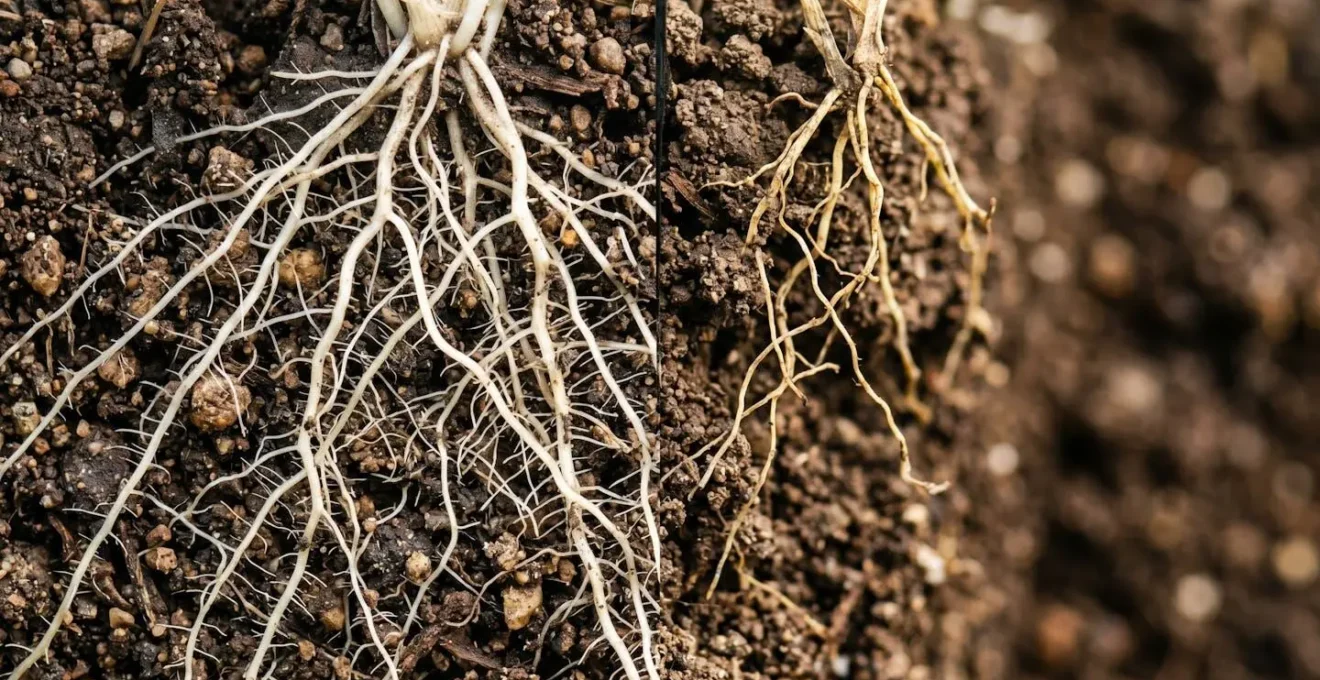
As the image above vividly illustrates, the difference is stark. On one side, you have a dense, deep mass of fibrous roots, creating a resilient and productive « grass engine. » On the other, a sparse, weak system, vulnerable to stress. The length of the grazing period is secondary; the length of the recovery period is what determines which of these root systems you are building. It’s the difference between farming for this week and farming for the next generation.
How to Calculate Paddock Sizes for Daily Moves of 50 Cattle?
Once you understand that rest is paramount, the next step is planning for it. Effective planning requires some simple but essential math to ensure you give your herd what it needs for one day without compromising the pasture’s recovery. The goal is to create a paddock size that provides the correct amount of Dry Matter (DM) for your herd’s daily intake, forcing them to graze evenly and then move on. This avoids both overgrazing (which damages the plants) and under-grazing (which leaves mature, low-quality forage behind).
The calculation hinges on four key variables: the daily Dry Matter Intake (DMI) of your herd, the amount of available forage in the pasture, the utilization rate (how much you let them eat), and the desired grazing period (in this case, one day). It’s a systematic process, not guesswork. Don’t forget practicalities: paddock shape and access to water are critical. Long, narrow paddocks encourage trampling, while square shapes are more efficient. And remember that cattle shouldn’t have to walk too far for a drink; grazing management research indicates that water should be within an 800-foot walking distance for optimal intake and even grazing.
Your Action Plan: Calculating Daily Paddock Size
- Calculate Dry Matter Intake (DMI) per animal: Multiply the average animal weight by 3% (or 2.5% for cow-calf pairs) to determine daily forage consumption.
- Determine herd’s total daily DMI: Multiply individual animal DMI by the total number of animals in the herd (e.g., 50 cattle).
- Assess available forage per acre: Use pre-grazing height charts or a rising plate meter to estimate pasture mass (typically 2,000-3,000 lbs DM/acre at optimal height).
- Calculate utilization rate: Apply the « take half, leave half » rule by multiplying available forage by 0.5 to determine the actual grazable forage.
- Determine paddock size in acres: Divide the herd’s total daily DMI by the available grazable DM per acre. This gives you the precise acreage needed for one day’s grazing.
By following these steps, you replace estimation with precision, ensuring your animals are well-fed and your pasture is set up for a full and rapid recovery. This is the operational heart of managing your grass engine.
Mob Grazing vs Strip Grazing: Which Builds Soil Carbon Faster?
While both mob grazing and strip grazing are forms of rotational grazing, they operate on different principles and have different impacts on soil. Strip grazing typically involves moving a wire daily across a larger paddock, providing fresh grass without the intense « animal impact » of a dense herd. Mob grazing, in contrast, involves concentrating a large number of animals on a small area for a very short period (often just a day), followed by a very long rest period (60-120 days). This high density is the key to its soil-building power.
The intense, short-term pressure forces animals to eat everything, not just the tastiest plants, and their hooves trample a significant amount of organic matter (what they don’t eat) onto the soil surface. This trampled material acts as a protective « armor » for the soil, conserving moisture and feeding the soil biology—especially fungi. It’s this combination of high-volume manure deposition and trampled carbon that makes mob grazing a superior tool for rapidly building soil organic matter. While strip grazing is efficient for forage utilization, it doesn’t create the same level of biological stimulation.
Case Study: Mob Grazing as a Carbon Sink
Compelling evidence for mob grazing’s carbon-building potential comes from a five-year study detailed by the pasture-fed livestock association Pasture for Life. The research compared a mob-grazed beef system to a conventional feedlot system. The results were astounding: the mob-grazed pastures sequestered an average of 3.59 tonnes of carbon per hectare per year. When the full greenhouse gas lifecycle was accounted for, the mob-grazed system was a net carbon sink, sequestering 6.65kg of CO₂ equivalent for every kilogram of carcass weight produced, while the feedlot system was a significant net emitter. This demonstrates that mob grazing isn’t just a production method; it’s a powerful climate solution.
The choice between them depends on your goals. For maximum, rapid soil carbon sequestration and building biological capital, mob grazing is the more powerful lever. It is a more advanced technique that requires careful management, but its potential to transform soil health is unparalleled.
The Re-Grazing Mistake That Spikes Worm Burdens in Lambs
One of the most dangerous and costly mistakes in grazing management, especially with sheep and goats, is re-grazing a pasture too soon. This isn’t just about plant recovery; it’s about animal health. The lifecycle of internal parasites, like the devastating barber’s pole worm (Haemonchus contortus), is directly tied to grazing height. Parasite eggs are shed in manure, hatch, and the infective larvae crawl up blades of grass, waiting to be ingested. But they don’t climb very high. Pennsylvania State University research confirms that the vast majority of these larvae are concentrated in the first 2 inches of forage from the ground.
When you allow lambs to re-graze a pasture before the grass has grown well beyond this « danger zone, » you are essentially forcing them to eat from a parasite-laden buffet. The common mistake is to move animals back when the grass « looks green again. » This early regrowth, often just 3-4 inches tall, is precisely where the highest concentration of larvae resides. This leads to a spike in worm burdens, poor growth rates, increased need for chemical dewormers, and potential death. True parasite control is about staying ahead of the larval cycle by managing rest periods and grazing height.
A highly effective strategy is « leader-follower » grazing. Cattle, which do not share the same primary parasites as sheep, graze a paddock first, consuming the bulk of the forage and many of the sheep parasite larvae. After a sufficient rest period for the grass to regrow to a safe height (at least 4-6 inches), the sheep (« followers ») can then graze the paddock with a much-reduced parasite risk. It’s about using one species to « clean » the pasture for another, breaking the parasite lifecycle naturally.
Animal Impact: How to Use Hooves to Incorporate Seed into Pasture?
In conventional agriculture, improving a pasture often means expensive and destructive tillage, plowing, and reseeding. But in a holistic grazing system, your animals’ hooves are your most valuable and inexpensive renovation tool. This concept, known as « animal impact, » uses high stock density for a short duration to positively disturb the soil surface. Far from being destructive, this action can be used with surgical precision to incorporate new seeds and revitalize a tired pasture sward.
The technique is simple but powerful. After broadcasting seed onto an existing pasture—particularly effective with techniques like frost seeding in late winter—you bring the herd in at a high density. Their hooves act like a thousand tiny cultivators. They press seeds into the soil, ensuring the vital seed-to-soil contact necessary for germination. This hoof action also breaks the hard seed coats of legumes like clover, a process called scarification, which significantly boosts germination rates. The animals simultaneously add a coating of nutrient-rich manure and urine, providing a perfect starter fertilizer for the new seedlings.
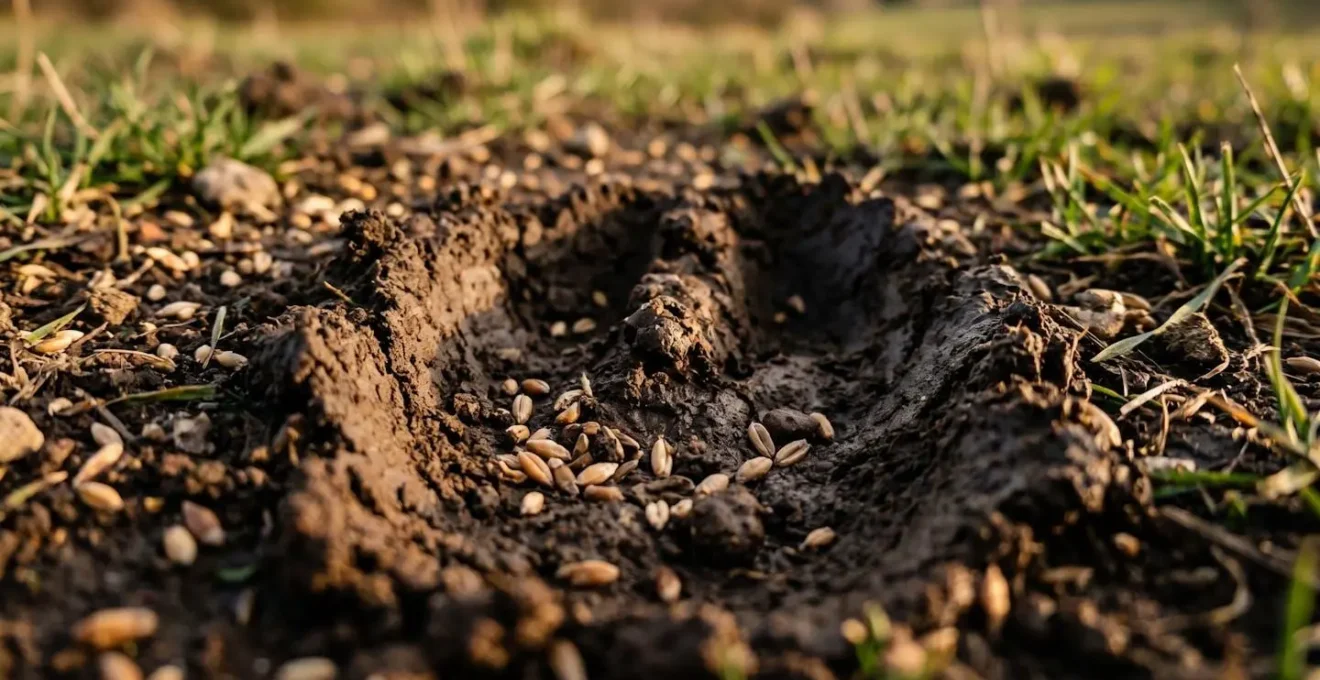
Case Study: Tillage-Free Pasture Renovation with Hoof Action
The effectiveness of this technique is well-documented. As highlighted by the University of Minnesota Extension, the practice of combining frost-seeding with subsequent animal impact is a proven, low-cost method for pasture improvement across the Upper Midwest. This method successfully establishes legumes and other beneficial species without destroying the existing sod base. It avoids the costs and erosion risks of conventional tillage, brings forage online more quickly, and builds soil structure rather than degrading it. It’s a clear example of using livestock as a solution to regenerate the land they live on.
By timing seeding with planned grazing events, you can overseed desirable species, fill in bare patches, and increase the diversity and productivity of your pastures without ever starting a tractor. It’s the ultimate expression of working with nature’s patterns.
Improved Leys vs Herbal Leys: Which Scores Higher for Biodiversity?
For decades, the standard « improved » pasture has been a simple, low-diversity mix, often just perennial ryegrass and white clover. While productive in the short term under high-input systems, these monocultures or near-monocultures are ecological deserts. They offer little for pollinators, have uniform root structures that can lead to soil compaction, and provide a narrow nutritional profile for livestock. The alternative is the herbal ley, a complex mix of grasses, legumes, and deep-rooting herbs like chicory, plantain, and borage.
Without question, herbal leys score dramatically higher for biodiversity, both above and below ground. Above ground, the variety of flowering plants provides a continuous food source for pollinators and other beneficial insects from spring through fall. Below ground, the real work happens. Each species has a different root architecture—fibrous, tap-rooted, shallow, deep—which breaks up compaction at different soil layers. This diversity of roots also means a diversity of root exudates, feeding a much wider array of soil bacteria and fungi, which builds more complex and stable soil organic carbon.
Case Study: The Carbon and Biodiversity Gains of Herbal Leys
The Carbon Assets for Soil Health (CASH) project, run by Innovative Farmers, analyzed hundreds of soil samples to see how farming practices affect soil carbon. The results clearly showed that grasslands and herbal leys were correlated with the highest carbon stocks. The study emphasized that less cultivation leads to more soil organic carbon, and that herbal leys provide « functional biodiversity. » This includes varied rooting depths that improve soil structure, different flowering times that support a wide range of pollinators, and the ability to draw up essential minerals from deep in the soil profile, offering natural, medicinal benefits to livestock that a simple ryegrass ley cannot provide.
Choosing a herbal ley is an investment in the entire farm ecosystem. It provides drought resilience, natural parasite control, improved livestock health, and builds your most important asset—your soil. It’s a shift from a simple production system to a thriving, self-regulating biological system.
Why Shelter Belts Reduce Lamb Mortality Rates in Spring?
Spring lambing season is a time of high risk, and one of the biggest killers of newborn lambs is hypothermia. A lamb is born wet into a potentially cold and windy world. Its ability to regulate its own body temperature is extremely limited in the first few hours of life. The combination of being wet and exposed to wind creates a rapid and often fatal drop in body temperature, a phenomenon known as wind chill. Even on a moderately cool day, a steady breeze can be deadly.
This is where shelter belts—strategically planted rows of trees and shrubs—become a critical piece of infrastructure for any sheep operation. Their primary function is to reduce wind speed. By creating a porous barrier, a well-designed shelter belt can reduce wind speed by over 50% for a distance of up to ten times its height downwind. For a lambing flock, this creates a microclimate of relative calm. By dramatically reducing wind chill, you give newborn lambs a crucial window of time to dry off, stand, and get their first vital drink of colostrum before their energy reserves are depleted simply trying to stay warm.
The benefits don’t stop there. Shelter belts provide shade in the summer, reducing heat stress on the entire flock. They can act as a « living barn, » offering protection from driving rain and snow. They also create a visual barrier, which can reduce stress from nearby roads or activities and provide cover from predators. By providing these basic protections, shelter belts directly contribute to lower stress levels in ewes, leading to better mothering and, ultimately, higher lamb survival rates. They are a simple, permanent investment in animal welfare and farm profitability.
Key Takeaways
- Master Rest, Not Grazing: Your pasture’s productivity is determined by the length and quality of its recovery period, which builds the deep roots that fuel regrowth.
- Math Equals Management: Precise paddock calculations based on Dry Matter Intake (DMI) are non-negotiable for ensuring optimal animal nutrition and pasture recovery.
- Density Builds Soil: High-density mob grazing, with its associated animal impact and long rest periods, is a superior tool for rapidly sequestering carbon and building topsoil.
- Graze High for Health: Keep animals out of the bottom 2-3 inches of the sward to dramatically reduce internal parasite loads, especially in lambs.
Silvopasture Integration Methods: How to Introduce Trees into Sheep Systems Profitably?
Silvopasture, the intentional integration of trees and forage and livestock, represents the pinnacle of stacked, regenerative systems. It’s not just about having trees in a field; it’s about designing a multi-layered system where each element benefits the others. For sheep systems, this can be an incredibly profitable and resilient model. It builds on the productivity gains of excellent grazing management and adds entirely new dimensions of value. As data from the University of Minnesota Extension shows, intensive rotational grazing alone can yield 30-50% more forage production per acre over continuous grazing. Silvopasture builds on this foundation.
Introducing trees can be done in several ways. One common method is alley cropping, where wide rows of trees (for timber, nuts, or fruit) are planted with wide « alleys » of high-quality forage in between. This allows for efficient grazing while the trees mature into a long-term cash crop. Another method is to thin existing woodlands and overseed the understory with shade-tolerant forages, creating a savanna-like environment. This provides immediate shelter and browse for the animals.
For sheep, the benefits are numerous. Trees provide essential shade, which reduces heat stress and increases forage intake during hot weather. Some tree species, like willow or mulberry, can be coppiced to provide high-protein « tree hay, » a valuable feed source during dry periods. The trees’ deep roots act as nutrient pumps, drawing minerals up to the surface where they are deposited via leaf fall, enriching the pasture. This stacking of enterprises—meat/wool from the sheep, timber/nuts/fruit from the trees, and improved soil health for all—creates multiple revenue streams and makes the entire farm more economically and ecologically resilient.
Stop guessing and start measuring. The next step is to walk your fields, assess your recovery periods, and begin managing the energy flow on your farm. Your land holds the potential; it’s time to unlock it.