In summary:
- Achieving a 30% water reduction requires shifting from assumption-based watering to data-validated, precision application.
- Capacitance probes provide real-time, root-zone data that is fundamentally more accurate than surface-level rain gauge measurements.
- Upgrading from traveling guns to boom irrigators can improve water application uniformity to over 90%, directly cutting waste.
- Variable Rate Irrigation (VRI) enabled by soil mapping allows for zone-specific dosing, eliminating over-watering in low-lying areas.
- Adopting dynamic scheduling based on real-time weather and soil data makes fixed, 30-year climate averages obsolete and inefficient.
For potato and vegetable growers, the pressure is mounting. Abstraction license restrictions are tightening, and the cost of water is a significant and unpredictable line item on the budget. The common advice to « be more efficient » with water is no longer sufficient. Many growers have already adopted basic conservation methods, yet they still face the challenge of maximizing yield and quality with an increasingly scarce and expensive resource. The margin for error is shrinking, and irrigation strategies based on habit or visual inspection are becoming a high-stakes gamble.
The standard solutions—scheduling based on weather forecasts or installing a basic drip system—are a starting point, but they often fail to address the core inefficiencies hidden within a field. These approaches treat the entire field as a uniform entity, ignoring critical variations in soil type, topography, and real-time crop water demand. This leads to a cycle of over-watering some areas to compensate for others, wasting water, leaching expensive nutrients, and potentially creating conditions for disease.
The fundamental shift required is not just about new hardware, but a new philosophy: moving from assumption-based irrigation to a system of precise, data-validated water application. What if the key to unlocking a 30% reduction in water use wasn’t just about applying less water, but about applying the exact right amount of water, in the exact right place, at the exact right time, verified by accurate, in-field sensors? This is the core principle of precision irrigation.
This guide will deconstruct the technologies and methodologies that enable this shift. We will move beyond platitudes and into the data-driven specifics, examining the measurable advantages of advanced sensors, the mechanics of uniform water delivery, and strategies for managing soil to turn it into a more effective water reservoir. The following sections provide a technologist’s blueprint for systematically eliminating water waste in high-value potato crops.
Summary: Achieving 30% Water Reduction in Potato Farming with Precision Technology
- Why Capacitance Probes Are More Accurate Than Rain Gauges?
- How to Retrofit Drip Irrigation in Field Scale Vegetables?
- Boom vs Gun: Which Delivers More Uniform Water Application?
- The Scab Control Mistake That Wastes Water and Leaches Nutrients
- Variable Rate Irrigation: How to Map Soil Types for Precise Dosing?
- The Bare Soil Mistake That Loses 5mm of Water per Day
- The Historic Data Mistake: Why 30-Year Averages Are No Longer Reliable
- Increasing Water Holding Capacity: How to Drought-Proof Sandy Soils?
Why Capacitance Probes Are More Accurate Than Rain Gauges?
The foundational error in many irrigation schedules is relying on surface-level data to make decisions about a subterranean environment. A rain gauge, while useful, only answers one question: « How much water arrived at the surface? » It provides zero information about what happens next—how much was lost to runoff, how much evaporated, and, most critically, what the actual moisture level is in the active root zone where the crop needs it. This is where capacitance probes create a paradigm shift from estimation to direct measurement.
A capacitance probe measures the dielectric constant of the soil, which changes in direct proportion to its water content. By placing sensors at multiple depths throughout the root profile (e.g., 15cm, 30cm, 50cm), a grower gets a high-resolution, real-time picture of water availability. This allows for data-validated decisions: irrigating only when the root zone begins to dry, and stopping precisely when it reaches optimal capacity, preventing both crop stress and deep drainage losses. It’s the difference between guessing how full the tank is and having an accurate fuel gauge. However, it’s crucial to note that installation inconsistency is a primary barrier to good accuracy, emphasizing the need for proper deployment to ensure data integrity.
Case Study: Zone-Specific Management in Wisconsin
A 2018 Wisconsin study on commercial Russet Burbank potato production evaluated Variable Rate Irrigation (VRI) systems guided by capacitance-based monitoring. In fields with significant elevation differences (up to 15 feet), the probes allowed the system to identify and reduce water application in the naturally wetter, low-lying areas. The results showed significant irrigation efficiency improvements in these zones compared to areas receiving the field-average rate. This demonstrates a capability that is impossible with rain gauges alone: managing water based on in-field variability rather than a single, uniform measurement.
Ultimately, a rain gauge measures an input, while a capacitance probe measures the result. For an efficiency-obsessed operation, managing based on outcomes is the only logical approach. This direct feedback loop is the first step in building a truly precise irrigation strategy and eliminating waste from incorrect assumptions.
How to Retrofit Drip Irrigation in Field Scale Vegetables?
For field-scale vegetable production, the concept of drip irrigation can seem economically or logistically daunting compared to overhead systems. However, the efficiency gains in water, fertilizer, and disease management create a compelling business case. Drip irrigation moves from « broadcasting » water to « placing » it directly in the root zone, virtually eliminating evaporative losses and runoff. This targeted approach is the key to maximizing the impact of every gallon.
The economic justification is powerful. An economic analysis from terraced potato systems demonstrates that drip irrigation at 75% of crop evapotranspiration (ETc) achieved a net income of $3,097 per hectare, a stark contrast to the $1,664 per hectare from traditional surface irrigation. This doubling of profitability is driven by higher yields from consistent moisture and reduced input costs. Retrofitting is not an all-or-nothing proposition; a phased approach allows for manageable investment and a clear proof of concept before scaling.
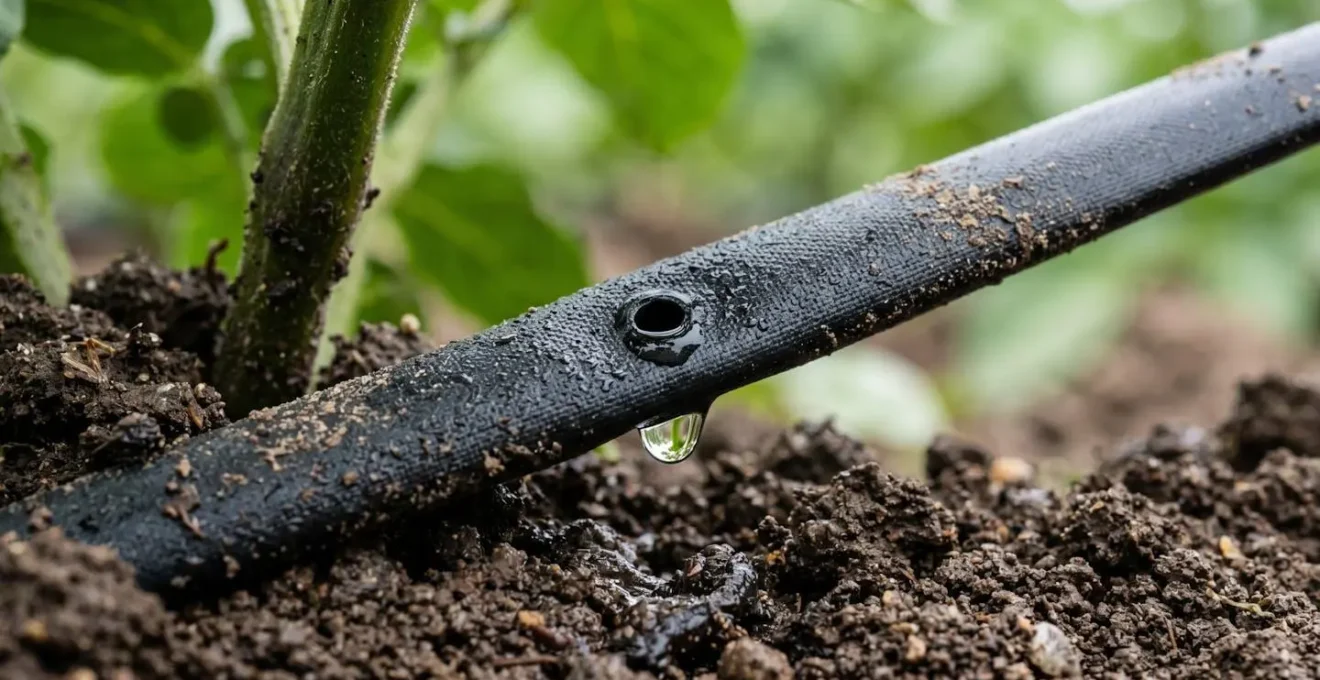
The image above highlights the precision of this method. Installing drip tape at a shallow depth, often simultaneously with planting, ensures water is delivered exactly where it’s needed from the very start of the growth cycle. This process can be implemented systematically:
- Pilot Field Selection: Start with a manageable block (e.g., 10 hectares) that represents your farm’s typical soil, such as clay loam.
- Budget and Design: Plan for materials and installation. A typical budget for drip tubes, PVC pipes, filtration, and an automated control system can be around $5,000 per hectare.
- Installation: Use an injection tool coupled to the planter to install drip tape at a 5cm depth on ridge tops. This combines planting and tape installation into a single, efficient pass.
- Monitoring and Validation: Install tensiometers or capacitance probes to monitor soil moisture and verify that the system is maintaining optimal levels (typically 60-80% of field capacity) without over-saturating.
- ROI Analysis: Document water savings, yield increases, and any reduction in fungicide applications. Use this data to calculate the return on investment before expanding the system to additional acreage.
By treating the retrofit as a series of controlled experiments, growers can de-risk the investment and build a data-backed case for farm-wide adoption, turning a capital expenditure into a highly profitable efficiency upgrade.
Boom vs Gun: Which Delivers More Uniform Water Application?
In the world of overhead irrigation, the choice between a traveling gun and a boom irrigator is a critical decision that directly impacts water efficiency. While a traveling gun offers simplicity in setup, its performance is highly susceptible to an unpredictable variable: wind. This results in poor water application uniformity, leading to significant waste and inconsistent crop growth. A boom irrigator, by contrast, is an engineered solution designed to overcome this very problem.
The core advantage of a boom is its ability to deliver water from a lower height and through multiple, smaller nozzles. This drastically reduces the water’s « hang time » in the air, minimizing both wind distortion and evaporative losses. The result is a much higher Coefficient of Uniformity (CU), often exceeding 90-95%, compared to the highly variable performance of a big gun. This superior uniformity means water is applied evenly across the pass, eliminating the under-watered and over-watered strips common with gun systems. While a boom requires a more involved setup, the operational benefits, including lower energy costs from reduced pressure requirements and significant water savings, are substantial.
The data below, drawn from a comparative analysis by Washington State University, quantifies the performance differences between the two systems. The contrast in uniformity and wind sensitivity is particularly telling.
| Performance Factor | Boom Irrigator | Traveling Gun |
|---|---|---|
| Coefficient of Uniformity | 90-95% | Variable (heavily wind-dependent) |
| Operating Pressure | Low to medium pressure | High pressure (higher energy costs) |
| Wind Sensitivity | Low – water travels less distance through air | High – pattern distortion and tightening in 10+ mph winds |
| Water Evaporation Loss | Reduced due to lower trajectory | Higher due to high throw and air travel time |
| Setup Complexity | Requires folding/unfolding (6-7 minutes) | Simple one-person operation |
| Overlap Strategy | Consistent spacing regardless of wind | Requires adjustment (65-90 rows) based on wind |
| Water Consumption | 30% reduction vs guns | Baseline |
For a data-driven grower, choosing a system with a verifiable 90%+ uniformity over one with unpredictable performance is a clear decision. The boom represents a move from brute-force watering to controlled, uniform application—a cornerstone of precision irrigation.
The Scab Control Mistake That Wastes Water and Leaches Nutrients
Managing common scab (Streptomyces scabies) in potatoes is a delicate balancing act that directly intersects with water efficiency. The conventional wisdom is to keep soil consistently moist during the tuber initiation phase (typically 2-6 weeks after emergence) to suppress scab development. However, this often leads to a critical mistake: over-irrigation. Growers, fearing scab, apply excessive water as an insurance policy, but this creates a cascade of negative consequences including nutrient leaching, increased risk of other diseases like Pythium leak, and significant water waste.
The key is precision. The goal is not saturation, but maintaining soil moisture within a specific, narrow band. As the UC Integrated Pest Management Program notes, the risks of mismanagement are twofold. Their guidance highlights the complexity of the task:
Too little water reduces yields, induces tuber malformations, or increases severity of common scab or Verticillium wilt after infection has occurred. Excess or poorly timed irrigation may reduce yields and quality, cause several disease problems in the field or in storage, or leach nutrients from the root zone.
– UC Integrated Pest Management Program, Potato Irrigation Management Guidelines
This expert guidance underscores that both deficit and excess are detrimental. The solution lies in data. Instead of aiming for 100% field capacity, which can lead to anaerobic conditions and leaching, research points to a more efficient and equally effective target. For instance, recent scientific trials on potato irrigation thresholds found that maintaining soil moisture at 66% of field capacity during tuber initiation delivered the highest water use efficiency. This strategy maintained commercial yields that were statistically indistinguishable from those under full irrigation, all while effectively managing scab pressure.
This data-driven approach transforms scab management from a wasteful, defensive tactic into a precise, efficient strategy. It requires moving away from guesswork and using soil moisture probes to maintain a quantified, optimal moisture level, thereby conserving water and protecting both yield and nutrient investment.
Variable Rate Irrigation: How to Map Soil Types for Precise Dosing?
Variable Rate Irrigation (VRI) technology is the ultimate expression of data-driven water management. It allows a center pivot or linear move system to apply different amounts of water to different parts of a field during a single pass. This capability is revolutionary, but it’s only as good as the map that drives it. The objective of soil mapping for VRI is to move beyond treating a field as a single entity and instead manage it as a mosaic of distinct « management zones » based on their ability to hold water.
Creating these zones doesn’t have to be prohibitively expensive. It can be approached in tiers, from low-cost observational methods to high-precision sensor-based surveys. A low-cost start involves using historical yield maps, elevation data, and the grower’s own experience to identify obvious wet and dry areas. A more advanced method involves contracting services for soil electrical conductivity (EC) mapping. Sensors like the Veris or EM38 are pulled across the field, measuring soil texture variability by how well it conducts electricity—sands, loams, and clays all have different EC signatures. This data creates a detailed, sub-surface map of soil texture, which is the primary factor determining water-holding capacity.
The final step is to overlay these data layers—EC, yield, and topography—to delineate practical and effective management zones. Field research on precision irrigation in commercial potato production indicates that VRI can significantly improve water efficiency, especially in low-lying areas prone to saturation. By reducing or shutting off water in these zones, the system prevents waste and improves crop health. Implementing VRI successfully is a methodical process of auditing your field’s variability.
Your Action Plan: Field Audit for VRI Readiness
- Identify Application Points: Start by defining the entire area under irrigation. Acknowledge that the default is a single, uniform application rate across this entire zone.
- Collect Existing Data Layers: Inventory all available historical information. This includes multi-year yield maps, topographical elevation maps, and aerial imagery, noting any persistent patterns of high or low performance.
- Ensure Data Coherence: Commission a soil electrical conductivity (EC) survey. Overlay this new, high-resolution texture map with your historical data. Identify areas where low yields consistently match up with sandy soil (low EC) or where high yields correspond to loam (high EC). This confrontation of data layers builds coherent, defensible management zones.
- Assess Map Viability: Review the generated zone map. Is it practical? A map with 20 tiny zones may be technically accurate but operationally impossible. Consolidate into 3-5 logical, large-scale zones that are distinct and manageable for an irrigation system.
- Develop an Integration Plan: Create a VRI prescription (e.g., Zone 1/Sand: 100% rate; Zone 2/Loam: 85% rate; Zone 3/Clay-lowland: 60% rate). Finalize the plan by strategically placing capacitance probes in each zone to validate that the prescription delivers the intended moisture levels throughout the season.
This audit process transforms a variable field into a precisely managed asset, ensuring water is directed only where it is needed, maximizing efficiency and crop potential.
The Bare Soil Mistake That Loses 5mm of Water per Day
One of the most significant and overlooked sources of water loss in potato farming is direct evaporation from bare soil. Uncovered, unshaded soil exposed to sun and wind can easily lose up to 5mm of water per day to the atmosphere. This is water that is paid for, applied, and then lost before it ever has a chance to reach the crop’s root system. During early growth stages, before the potato canopy closes over the rows, this loss is particularly severe. Leaving soil bare is an unforced error that directly undermines irrigation efficiency.
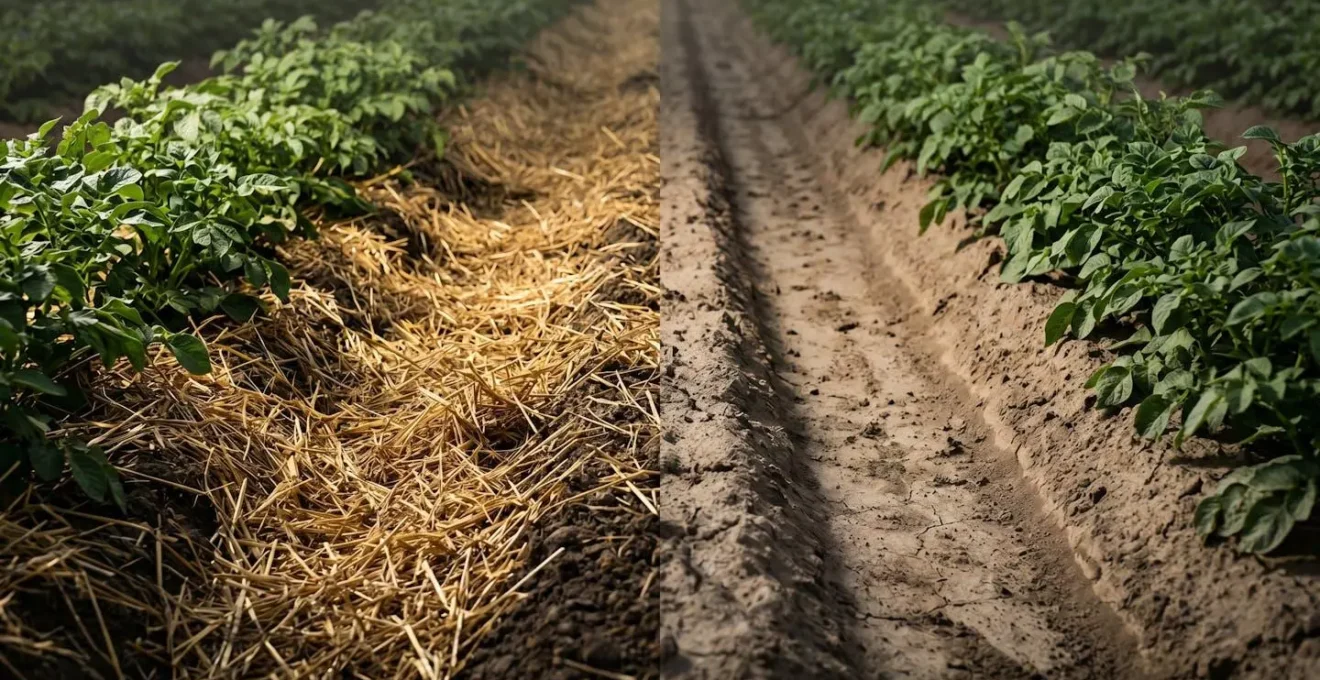
The solution is simple in principle: cover the soil. This can be achieved in several ways. The most common is encouraging rapid canopy development to shade the soil surface. Another highly effective method is the use of organic mulches, such as straw, applied to the inter-row space. This physical barrier dramatically reduces evaporation, suppresses weeds, and keeps the soil surface cooler. While mulching represents an additional operational step, the water savings can be substantial, especially in arid climates or on sandy soils.
An even more advanced, engineering-based solution is Subsurface Drip Irrigation (SDI). By burying the drip tape a few centimeters below the surface, water is applied directly to the root zone, leaving the soil surface dry. This almost completely eliminates evaporation. For instance, a four-year study in Inner Mongolia found that shallowly buried drip irrigation tape reduced evaporation during the early growth stages of potatoes by 8-26% compared to surface drip. This highlights that even with an efficient system like drip, preventing surface evaporation provides an additional, significant layer of water savings.
Whether through cultural practices like mulching or technological solutions like SDI, protecting the soil surface from direct exposure to the elements is a non-negotiable principle for any grower serious about maximizing water use efficiency.
The Historic Data Mistake: Why 30-Year Averages Are No Longer Reliable
For decades, irrigation planning often relied on static, 30-year historical climate averages to predict crop water needs. This approach assumes that the weather of the next season will be, on average, similar to the weather of the past 30 years. In the current era of increasing climate volatility, this assumption is not just outdated; it’s a recipe for inefficiency and risk. A single heatwave or an unexpected dry spell can render schedules based on historical averages completely inadequate, leading to crop stress and yield loss, or panic-driven over-watering.
Relying on static data is a critical mistake because it ignores the reality of dynamic, real-time conditions. As researchers in the field of climate-smart agriculture point out, this backward-looking approach is no longer viable for effective risk management.
Using static 30-year averages for irrigation planning in a climate of increasing weather volatility is inadequate for risk management. The impact of climate change is affecting mostly smallholder farmers in developing regions, with increasing moisture deficit due to climate dynamics demanding innovative water management systems.
– International Water Resources Research, Water Use Efficiency and Climate-Smart Irrigation Study
The modern, data-driven solution is to shift from static planning to dynamic scheduling. This involves integrating real-time data from multiple sources to calculate daily crop evapotranspiration (ETc)—the actual amount of water the crop is using. This is achieved by combining data from on-site weather stations (temperature, humidity, solar radiation, wind speed) with soil moisture data from capacitance probes. This live feed of information allows an irrigation system to replace *exactly* what the crop used yesterday, rather than guessing what it might need based on a 30-year-old average.
The efficiency gains from this approach are well-documented. Comprehensive research on dynamic irrigation scheduling demonstrates that these IoT-based systems can reduce water waste by 25-30%. A 2022 study in Spain, for example, found that such systems saved 150-200mm of water per season in potato production. This proves that investing in real-time data provides a direct and substantial return by eliminating irrigation based on unreliable historical guesswork.
Key Takeaways
- True water efficiency is achieved by measuring and managing the result (soil moisture) rather than just the input (rainfall or irrigation volume).
- Improving application uniformity through technology like boom irrigators provides a direct, measurable reduction in water consumption compared to less precise methods.
- Dynamic scheduling using real-time sensor data consistently outperforms static plans based on historical averages, especially in a volatile climate.
Increasing Water Holding Capacity: How to Drought-Proof Sandy Soils?
Sandy soils present a unique irrigation challenge. Their large particle size and low organic matter result in high hydraulic conductivity, meaning water drains through them very quickly. An irrigation cycle that is perfectly adequate for a loam soil can be incredibly wasteful on sand, as a large portion of the water drains straight past the root zone before the crop can use it. The solution is not simply to apply more water, but to change *how* it is applied and to fundamentally improve the soil’s structure over time.
For immediate efficiency gains, a technique called pulse irrigation is highly effective. Instead of applying the total required water in one long cycle, it is broken down into multiple short bursts with rest periods in between. For example, a 60-minute irrigation cycle could be replaced by three 20-minute pulses separated by 30-minute rests. This allows the water to move laterally through the soil profile via capillary action, wetting a wider root volume instead of just a narrow vertical column. This technique is particularly well-suited to drip irrigation systems, where timers can be precisely controlled.
The long-term strategy involves increasing the soil’s organic matter content. Incorporating compost, cover crops, or manure adds fine organic particles that create micropores in the soil structure. These micropores act like a sponge, holding water against the force of gravity and making it available to plant roots for longer. An annual application of 10-20 tons of compost per hectare can gradually transform a soil’s water-holding capacity. These methods, when combined with efficient delivery systems, can make potato farming viable and profitable even in challenging soil conditions. Indeed, field trials in Middle Eastern sandy soil conditions show that drip irrigation combined with fertigation has boosted potato yields to 25-30 tons per hectare, all while cutting water use by 20% compared to traditional methods.
The process of pulse irrigation can be implemented systematically:
- Implement multiple short irrigation bursts instead of single long applications to prevent rapid vertical drainage.
- Set drip irrigation timers for 15-20 minute application cycles with 30-45 minute rest periods between cycles to allow for lateral water movement.
- Monitor soil moisture at 15cm and 30cm depths with probes to verify that water is spreading into the root zone rather than draining below it.
- Adjust pulse frequency based on the soil’s infiltration rate; faster infiltration requires more frequent, shorter pulses.
- Combine pulse irrigation with long-term organic matter additions to improve soil structure and create micropores that hold water against gravity.
The next logical step is to audit your current water use to identify the single biggest point of inefficiency. Implementing even one of these data-driven solutions is the first step toward significant water and cost savings for your operation.