
High synthetic fertilizer prices are eroding farm profitability, but relying on legumes without a clear strategy is a gamble.
- Biological nitrogen fixation is not passive; it’s an active system you can manage by controlling key biochemical levers like micronutrients and soil nitrate levels.
- Moving from estimation to measurement is critical. You can accurately quantify the nitrogen contribution (N-credit) from a cover crop to make precise, data-driven reductions in your fertilizer plan.
Recommendation: Begin treating biologically-fixed nitrogen as a quantifiable on-farm asset, not an abstract soil health benefit, to directly and predictably replace purchased inputs.
For the conventional farmer, the nitrogen line item on the annual budget has become a source of significant economic pressure. Volatile prices and increasing legislative scrutiny on nutrient runoff have transformed synthetic fertilizer from a simple input into a complex liability. The common response is to look towards biological solutions, with legumes and cover crops touted as the answer. Yet, many who try this path are left disappointed, seeing inconsistent results that don’t allow them to confidently cut back on their bagged N.
The conventional wisdom— »just plant clover »—misses the fundamental point. Harnessing the power of the atmosphere is not a passive act of seeding; it is an active agronomic management process. Success requires a shift in perspective: from simply hoping for a soil health benefit to actively managing a biological production system. This means understanding the specific biochemical triggers that turn the system on or off, and learning how to quantify its output in pounds of N per acre.
But what if the key wasn’t just about choosing the right legume, but about understanding the metabolic cost to the plant and the precise environmental signals it responds to? This guide moves beyond the platitudes. We will treat biological nitrogen fixation not as a vague ecological concept, but as a quantifiable, on-farm asset. We will explore the critical levers you can pull, from micronutrient applications to species selection and termination strategy, to turn your fields into predictable nitrogen factories.
This article provides an economic and agronomic roadmap to making biological nitrogen work on your terms. We will deconstruct the science, present the data, and offer practical, step-by-step methods to measure and manage your on-farm nitrogen cycle. The goal is to give you the confidence to systematically replace expensive synthetic fertilizer with a biological asset you grow yourself.
Summary: A Farmer’s Guide to On-Farm Nitrogen Fixation
- Why Rhizobia Bacteria Need Molybdenum to Fix Nitrogen Efficiently?
- How to Establish White Clover in Permanent Pasture Without Ploughing?
- Vetch vs Crimson Clover: Which Fixes More N Over Winter?
- The Nitrate Mistake: Why Adding Fertilizer Stops Legumes from Working?
- Following Legumes: How to Quantify the N-Credit for the Next Wheat Crop?
- Why Disrupted Nitrogen Cycles Cost UK Farmers £150 per Hectare Annually?
- Why Rye and Vetch Are the Heavy Land Workhorses?
- How to Leverage Biogeochemical Cycles to Cut Farm Input Costs by 20%?
Why Rhizobia Bacteria Need Molybdenum to Fix Nitrogen Efficiently?
The symbiotic relationship between a legume and its rhizobia bacteria is a biological contract. The plant provides carbohydrates—energy from photosynthesis—and in return, the bacteria operate a highly sophisticated molecular machine called the nitrogenase enzyme to convert atmospheric nitrogen (N₂) into plant-available ammonia (NH₃). This process, however, is incredibly energy-intensive for the plant. It’s a significant investment, and like any good businessperson, the plant won’t make it if the necessary tools are missing. One of the most critical and often overlooked of these tools is molybdenum.
Molybdenum is a direct, irreplaceable component of the nitrogenase enzyme complex. Without sufficient molybdenum, the bacterial factory cannot be built, and nitrogen fixation grinds to a halt, regardless of how healthy the plant appears or how well-nodulated its roots are. This is not a minor influence; it’s a fundamental biochemical bottleneck. In fact, targeted application of this single micronutrient can have a dramatic impact. Recent research demonstrates a 30% increase in both BNF and grain yield in soybeans simply by ensuring molybdenum availability. This highlights that managing micronutrients is a key « biochemical lever » for unlocking the full potential of your legume investment.
For a farmer, this means shifting focus from solely the macronutrients (N-P-K) to a more holistic view of plant nutrition. The first step is diagnostics, but not through a standard soil test. The availability of molybdenum in the soil does not guarantee uptake by the plant. Therefore, a targeted approach is required to ensure this critical cog is in place for your nitrogen-fixing machine to run at full capacity.
Your Action Plan: The Micronutrient Trinity for Nitrogen Fixation
- Diagnose the Plant, Not the Soil: Conduct tissue or sap analysis of the legume itself. Aim for molybdenum levels above 0.5 mg/kg in clover tissue. This provides a true picture of what the plant is actually absorbing, bypassing the complexities of soil chemistry.
- Select a Targeted Application: For severe deficiency, apply molybdenum to the soil (0.63 mg Mo/kg). For moderate deficiency or as a preventative measure, a seed treatment with a sodium molybdate solution (0.5 g/L) is highly effective. A foliar spray during early vegetative growth can also correct in-season issues.
- Calculate the Return on Investment (ROI): A typical molybdenum application costs around $5 per hectare. This small investment can unlock an additional 30 kg/ha of fixed nitrogen, which at a price of $1.50/kg N, is worth approximately $45. This represents a 9:1 return on investment.
- Check Your Work: Two to three weeks after planting, gently dig up a few plants and inspect the root nodules. Slice one open. A pink or red internal color indicates the presence of leghemoglobin and active, efficient nitrogen fixation. Gray or white interiors signal a problem, often a micronutrient limitation.
- Complete the Trinity: Ensure cobalt and iron are also available. Cobalt is essential for vitamin B12 synthesis in rhizobia, another key process for fixation, while iron is a direct component of both the nitrogenase enzyme and the leghemoglobin that gives active nodules their signature pink color.
How to Establish White Clover in Permanent Pasture Without Ploughing?
Introducing legumes into an existing grass sward without a full cultivation pass presents a significant challenge: competition. The established pasture has a head start on light, water, and nutrients, making it difficult for small clover seedlings to gain a foothold. Simply broadcasting seed onto the surface often results in failure due to poor seed-to-soil contact and being out-competed by the existing thatch. Success in a low-disturbance system, therefore, hinges on tactical establishment techniques that give the clover a fighting chance.
The first strategy is timing. Frost seeding is a powerful, low-cost method where clover seed is broadcast onto frozen ground in late winter. The natural freeze-thaw cycles work the seed into the soil, ensuring good contact. The clover germinates early but grows slowly under the canopy of the winter cash crop or spring grass, only taking off after harvest or mowing provides an opportunity for light to penetrate. Another effective mechanical approach is using a slot-seeder or a drill with tine harrows. These implements cut a narrow slot or create minimal disturbance in the soil, placing the seed directly into a protected micro-environment with excellent soil contact, away from surface-level competition.
Finally, consider biological enhancements. In compacted arable or pasture soils, inoculating the clover seed with both its specific rhizobia strain and mycorrhizal fungi can dramatically improve establishment. The fungi act as an extension of the plant’s root system, helping it access phosphorus and water more efficiently, which is critical for a young seedling fighting for resources. These combined strategies transform establishment from a game of chance into a calculated agronomic operation.
Case Study: Frost Seeding Red Clover for Corn Nitrogen Supply
A Michigan State University study perfectly illustrates the power of low-disturbance establishment. Researchers frost-seeded red clover into a standing winter wheat crop in late winter. The clover established but remained small until the wheat was harvested in summer. After harvest, the clover grew vigorously. The following spring, corn was no-tilled directly into the living clover, which was then terminated with herbicide. The result was remarkable: the field only required 60 pounds of synthetic nitrogen per acre to achieve a 250-bushel-per-acre corn yield. This stands in stark contrast to the typical 150-180 lbs N/acre usually required for corn in that system, demonstrating a massive reduction in fertilizer inputs achieved through a simple, low-cost establishment technique.
Vetch vs Crimson Clover: Which Fixes More N Over Winter?
When selecting a winter legume, the choice between hairy vetch and crimson clover is not merely aesthetic; it’s a strategic decision that profoundly impacts the timing and quantity of the nitrogen asset you are growing. Both are excellent nitrogen fixers, but they operate on different schedules and offer distinct agronomic benefits. The « best » choice depends entirely on the needs of the following cash crop and your overall management system. Hairy vetch is the high-octane sprinter, while crimson clover is the steady marathon runner.
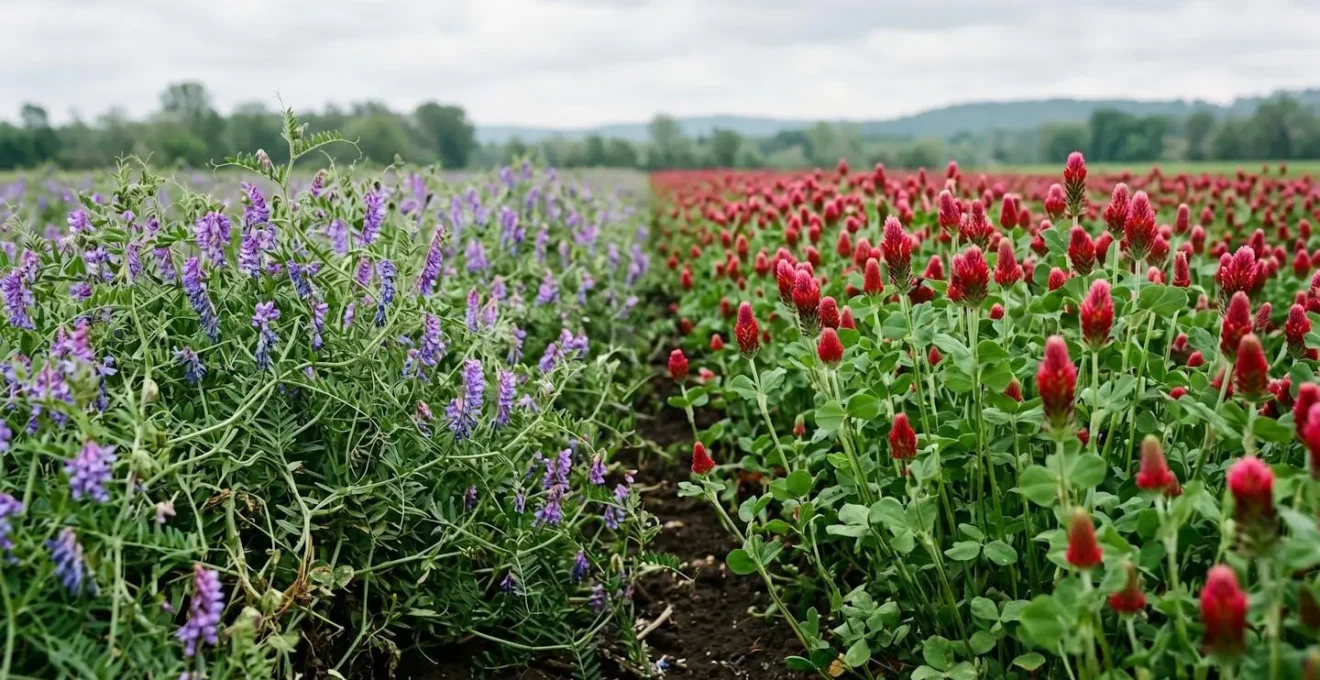
The primary difference lies in their carbon-to-nitrogen (C:N) ratio. Hairy vetch has a very low C:N ratio (around 11:1), meaning its biomass is rich in nitrogen and breaks down very quickly after termination. This provides a large, rapid flush of available N, with some field trials showing up to 70 lbs N/acre released within the first four weeks of decomposition. This makes it the ideal choice ahead of a high-demand crop like corn. Crimson clover, with a higher C:N ratio (around 20:1), decomposes more slowly, providing a more sustained, season-long release of nitrogen. This gradual supply is better suited for crops with a lower or more prolonged N demand. However, this high N-fixation from vetch comes with a trade-off: its hard seed can become a weed problem in subsequent crops, a risk not associated with crimson clover.
| Selection Criterion | Hairy Vetch | Crimson Clover |
|---|---|---|
| Total N Fixed | 100-150 lbs N/acre (high) | 60-100 lbs N/acre (moderate) |
| C:N Ratio & Release Speed | Low C:N (~11:1) – Fast N release (70 lbs N in 4 weeks) | Higher C:N (~20:1) – Slower, sustained N release |
| Best Following Crop | Corn, sorghum (high early N demand crops) | Soybeans, wheat (moderate N demand, soil building) |
| Soil Type Preference | Heavy clay soils – Bio-drilling effect on compaction | Loam soils – Better establishment, less aggressive |
| Planting Window | Narrow (late summer/early fall only) | Flexible (fall or early spring frost seeding) |
| Termination Method | Easy – Roller-crimper at flowering (creates dense mat) | Difficult – Requires herbicides or repeated mowing |
| Seed Cost | $40-70 per acre | $12-38 per acre |
| Weed Suppression | Good (dense canopy) | Excellent (superior allelopathic effect) |
| Pollinator Benefit | Moderate | High (extended bloom period) |
| Weed Risk | High (hard seed can persist, becomes weed in following crops) | Low (annual, no hard seed) |
The Nitrate Mistake: Why Adding Fertilizer Stops Legumes from Working?
One of the most common and costly mistakes in managing legume cover crops is the application of nitrogen fertilizer. The logic seems intuitive: give the plant a little boost to get it started. In reality, this action directly sabotages the very process you are trying to encourage. The symbiotic relationship is based on a trade. When the plant can get nitrogen « for free » from the soil, it has no incentive to pay the high energy price to its rhizobia partners. The entire nitrogen-fixing system is shut down by a process called nitrate inhibition.
This isn’t a passive process; it’s an active, genetic down-regulation controlled by the plant. As the New Mexico State University Agricultural Extension explains, the plant is making a pragmatic, metabolic choice:
The plant actively down-regulates the ‘nif’ genes responsible for fixation when it senses abundant soil nitrate. It is metabolically ‘cheaper’ to absorb free N than to spend up to 20% of its photosynthetic energy feeding rhizobia.
– New Mexico State University Agricultural Extension, Nitrogen Fixation by Legumes Extension Guide A-129
This « nitrate signal » acts as a powerful off-switch. The threshold for this to occur is surprisingly low. Controlled studies on common bean show that complete inhibition of nodulation and fixation can occur at a soil nitrate concentration of just 15 mM. For a farmer, this translates to approximately 45-50 kg/ha (40-45 lbs/acre) of available nitrogen in the soil. Applying a « starter » N fertilizer of 30 lbs/acre can easily push the soil over this threshold, especially if there is any residual nitrogen from the previous crop. The result is that you pay for the legume seed and the fertilizer, and get the benefit of neither, effectively growing a green manure crop that isn’t fixing any atmospheric nitrogen.
Following Legumes: How to Quantify the N-Credit for the Next Wheat Crop?
The ultimate goal of growing a legume cover crop is to replace purchased fertilizer. To do this with confidence, you must move from a vague « soil health benefit » to a hard number: the Nitrogen Credit (N-Credit). This is the quantifiable amount of nitrogen, in pounds or kilograms per acre, that your cover crop will make available to the following cash crop. Quantifying this N-Credit transforms the cover crop from a cost into a measurable nitrogen asset on your farm’s balance sheet, allowing you to make a direct, one-for-one reduction in your synthetic N application rate.
The process is more straightforward than it sounds and requires only a few simple tools and some basic calculations. It involves measuring the total biomass produced by the cover crop and then applying standard values for its nitrogen content and mineralization rate. This DIY approach empowers you to generate field-specific data, which is far more accurate than relying on generic book values that don’t account for your specific growing conditions, termination date, or soil type.

By taking a few samples before termination, you can build a reliable estimate of the nitrogen you have « in the bank. » This data-driven approach removes the guesswork and risk associated with reducing fertilizer rates. It’s the critical step that bridges the gap between growing a cover crop and truly leveraging it as a fertilizer replacement. The following field guide provides a step-by-step method that any farmer can use to calculate their own N-credit.
Your N-Credit Field Guide: A Step-by-Step Calculation
- Sample the Biomass: Using a 1 m² quadrat frame, take 3-5 random samples across your field just before termination. Cut all the above-ground plant matter within the frame at soil level and collect it.
- Dry the Samples: Spread the plant material thinly on a clean, dry surface (like a barn floor) in a well-ventilated area for 5-7 days until it is completely brittle. For a faster, more precise result, use a low-temperature oven (60°C / 140°F) for 48 hours.
- Weigh and Convert: Weigh the total dried biomass from one quadrat in grams. To convert this to kilograms per hectare (kg/ha), simply multiply the weight in grams by 10. (e.g., 250g of dry matter = 2,500 kg/ha).
- Calculate Total Nitrogen: Multiply your dry biomass (kg/ha) by the standard nitrogen percentage for your legume. Use these references: Hairy vetch = 3.0% N (0.03), Crimson clover = 2.8% N (0.028), Red clover = 3.2% N (0.032). For example: 2,500 kg/ha vetch × 0.03 = 75 kg N/ha total.
- Apply the Mineralization Factor: Only a portion of this total N will be available in the first year. Multiply your total N by a mineralization factor based on your termination method: Tilled-in vetch = 0.40 (40%), No-till crimped clover = 0.25 (25%), Incorporated clover = 0.35 (35%). Example: 75 kg total N × 0.40 = 30 kg/ha. This is your first-year N-Credit. You can now confidently reduce your synthetic N application for the following wheat crop by 30 kg/ha.
Why Disrupted Nitrogen Cycles Cost UK Farmers £150 per Hectare Annually?
The modern, conventional farming system is built on a linear, « leaky » nitrogen cycle. We purchase synthetic nitrogen, apply it to the field, and a significant portion—often 40-60%—is not taken up by the crop. This lost nitrogen represents a direct financial drain and triggers a cascade of secondary costs. In the UK, the combined expense of wasted fertilizer, compliance with environmental regulations designed to mitigate runoff, and the slow degradation of soil structure is estimated to cost farmers an average of £150 per hectare every year. This isn’t just the price of the fertilizer that washes away; it’s the cost of a fundamentally inefficient system.
This lost nitrogen doesn’t just disappear. It enters waterways, causing eutrophication and leading to costly water treatment measures and stringent regulations like Nitrate Vulnerable Zones (NVZs). It also escapes into the atmosphere as nitrous oxide (N₂O), a potent greenhouse gas that contributes to agriculture’s carbon footprint and invites further regulatory pressure. The system forces farmers to pay twice: once for the fertilizer itself, and again for the environmental consequences of its inefficiency.
The compelling economic argument is that fixing this broken cycle is not a cost, but a source of profit. By shifting towards a system that incorporates biological nitrogen fixation, farmers can plug the leaks. Legumes capture atmospheric nitrogen for free, and cover crop mixes act as a sponge for any residual soil nitrogen, preventing it from leaching over the winter. This isn’t just an ecological ideal; it’s a powerful economic lever. Indeed, a comprehensive analysis in *Nature* covering over 1,500 field observations found that the global implementation costs of improved nitrogen management measures are actually negative, saving the agricultural sector billions in fertilizer expenses. Rebuilding the on-farm nitrogen cycle is a direct investment in the farm’s bottom line.
Why Rye and Vetch Are the Heavy Land Workhorses?
Farming on heavy clay soils presents a unique set of challenges: poor drainage, high risk of compaction, and a narrow window for fieldwork. In this environment, the cover crop combination of cereal rye and hairy vetch stands out as a true agronomic workhorse. Their power comes not from any single attribute, but from the synergistic relationship between the two species, where each partner compensates for the other’s weaknesses and amplifies its strengths.
Cereal rye is renowned for its incredibly deep and fibrous root system. These roots act as a « bio-drill, » creating thousands of small channels that break up compaction, improve water infiltration, and enhance soil structure. Rye is also a master nitrogen scavenger, effectively capturing any residual soil nitrate left after the cash crop, preventing it from leaching over the winter and storing it in its biomass. Vetch, on the other hand, is the nitrogen factory, fixing large quantities of atmospheric N. However, its vine-like growth habit means it can form a dense, wet mat on the soil surface, which can be problematic in heavy soils. When planted with rye, the sturdy rye stems act as a natural trellis, lifting the vetch off the ground, improving air circulation, and making termination easier.
This partnership is not a one-size-fits-all solution. By adjusting the seeding ratio of the two species, a farmer can fine-tune the mix to achieve specific goals. This turns the cover crop from a generic soil-improver into a precision tool for managing nitrogen, biomass, and soil structure. The « control dial » of the seeding ratio allows you to customize the outcome for the specific needs of your rotation and soil type.
Goal 1: Maximum Nitrogen Fixation
For a high-demand crop like corn, use a vetch-dominant mix: 60% hairy vetch and 40% cereal rye by weight. This prioritizes the nitrogen-fixing power of the vetch, aiming for 100-120 lbs N/acre, while the rye provides just enough structural support and scavenges any leftover soil N.
Goal 2: Maximum Biomass and Weed Control
Ahead of a crop like soybeans, or for maximum weed suppression, flip the ratio to a rye-dominant mix: 70% cereal rye and 30% hairy vetch. This mix produces enormous amounts of biomass that smothers weeds, while the rye’s allelopathic compounds provide an additional layer of chemical weed control, reducing herbicide costs.
Goal 3: Balanced Soil Building
For general soil improvement ahead of a crop like wheat, a 50/50 balanced mix is ideal. This combination optimizes the C:N ratio of the resulting biomass, providing a moderate, steady release of nitrogen while contributing a significant amount of stable organic matter to the soil.
Key Takeaways
- Nitrogen is a Manageable Asset: Stop treating biological nitrogen as a random benefit. By managing key levers like molybdenum and soil nitrate, you can actively control the output of your on-farm N system.
- Quantify to Justify: The critical step to replacing bag fertilizer is measurement. A simple biomass test allows you to calculate a reliable N-Credit, giving you the data to confidently reduce input rates.
- Strategy Over Species: The « best » legume doesn’t exist. The right choice depends on the specific needs of your next cash crop, your soil type, and your desired outcome—whether it’s rapid N release, maximum weed control, or long-term soil building.
How to Leverage Biogeochemical Cycles to Cut Farm Input Costs by 20%?
The journey away from a total reliance on synthetic fertilizer is a journey towards complexity. It involves moving from a single-input system (bagged N) to managing a diverse, multi-functional biological system. The ultimate expression of this is the multi-species cover crop cocktail, a strategy of « function stacking » where each plant in the mix is chosen to perform a specific, economically valuable job. This approach transforms a field from a monoculture into a dynamic ecosystem working to reduce your input costs across the board.
Instead of relying on one legume for nitrogen, you can combine a fast-releasing fixer like vetch with a slower-releasing clover. Instead of just capturing nitrogen with rye, you can add a deep-rooted tillage radish to perform « bio-drilling, » breaking up compaction layers and saving a pass with the subsoiler. By adding species like buckwheat, you can scavenge and unlock soil-bound phosphorus, reducing your P fertilizer needs. Including flowering species like phacelia or sunflower attracts pollinators and predatory insects, creating a standing army of beneficials that can reduce the need for pesticide applications.
This strategy directly replaces purchased inputs and mechanical operations with biological services. The cost savings are not isolated to the nitrogen bill. They are cumulative: reduced N fertilizer, reduced P fertilizer, fewer herbicide passes, fewer insecticide passes, and less fuel and labor for tillage. While the seed cost is higher upfront, the stacked benefits create a resilient and profitable system over the long term. Economic analysis from SARE shows that this approach leads to tangible fertilizer savings of $10-40 per acre within just a few years, with additional savings from other avoided inputs compounding over time.
The path to reducing reliance on synthetic nitrogen is an incremental one, built on a foundation of measurement and management. It begins with the decision to treat the nitrogen in your soil and cover crops not as an unknown variable, but as a core asset to be quantified, tracked, and leveraged. By applying these agronomic principles, you can systematically build a more resilient, self-sufficient, and profitable farming operation.