
Your chalk soil is a nutrient bank, not a barrier; the key is catalysing specific biological reactions, not adding more chemical inputs.
- Focus on rhizosphere acidification via targeted cover crops and nurturing mycorrhizal fungi to ‘mine’ locked-up legacy phosphorus.
- Utilise advanced soil testing methods to diagnose the specific cation antagonisms that render nutrients unavailable to your crops.
Recommendation: Shift your farm management strategy from feeding the crop to activating the soil’s innate biological engine to unlock existing, profitable reserves.
For farmers working the characteristic chalk and limestone soils of the UK, the soil test report often presents a frustrating paradox. The analysis confirms abundant levels of key nutrients like phosphorus and calcium, yet crops display clear signs of deficiency, and yields stagnate. The conventional response—applying more synthetic phosphorus fertiliser—often results in minimal crop response and significant financial waste, as the added nutrients are rapidly immobilised by the same soil chemistry. This cycle of input without output is a major drain on profitability and environmental sustainability.
The common advice revolves around generic soil health principles, which, while beneficial, fail to address the specific chemical handcuffs imposed by a high pH environment. The problem isn’t a lack of nutrients; it’s a lack of access. The prevailing wisdom has failed to provide a cost-effective roadmap for unlocking these vast, native reserves. But what if the solution lies not in adding more to the soil, but in empowering the soil to release what it already holds? The true key is to move beyond simple chemical additions and embrace a strategy of targeted biochemical activation.
This article provides a chemist’s perspective on farming calcareous soils. We will dissect the chemical reactions that lock up your nutrients, explore the biological mechanisms that can reverse this process, and outline practical, field-ready strategies. We will examine how to select the right diagnostic tools, how to leverage specific plant species to alter root-zone chemistry, and how to synchronise nutrient release with peak crop demand, turning your challenging soil into a productive and profitable asset.
To navigate this complex but critical topic, this guide is structured to systematically address the core challenges and solutions. The following sections will provide a clear, science-backed pathway to unlocking the full potential of your chalk soils.
Table of Contents: A Farmer’s Guide to Unlocking Chalk Soil Nutrients
- Why Nutrients Lock Up on High pH Chalk Substrata?
- Why Your Soil Test Shows High Phosphorus but Your Crops Are Deficient?
- How to Unlock Legacy Phosphorus in Soils with High Calcium?
- How to Lower Soil pH Biologically to Release Calcium and Magnesium?
- Albrecht vs Reams Tests: Which Method Reveals True Bio-Availability?
- The Micronutrient Interaction That Blocks Iron Uptake in Spring
- Synchronizing Mineralization Peaks with Crop Demand Stages
- How to Farm Successfully on a Chalk Substratum With Limited Topsoil Depth?
Why Nutrients Lock Up on High pH Chalk Substrata?
The fundamental challenge of farming on chalk or limestone soils is a matter of basic chemistry. These soils are defined by the presence of calcium carbonate (CaCO3), which buffers the soil pH at a high alkaline level, typically between 7.2 and 8.5. While calcium itself is an essential nutrient, its overwhelming abundance in a high-pH environment creates a chemical cascade that systematically locks up other critical minerals, rendering them unavailable for plant uptake, a process known as nutrient antagonism.
At a high pH, phosphorus (P) reacts with the abundant free calcium ions to form highly stable and insoluble compounds like calcium phosphate (Ca3(PO4)2). This process, called precipitation, effectively removes phosphorus from the soil solution, making it inaccessible to plant roots, even when soil tests show high total P levels. A similar fate befalls essential micronutrients. As The Gardeners Almanac explains:
Important nutrients, particularly iron and manganese, are chemically changed in alkaline soils into forms that plants cannot use.
– The Gardeners Almanac, Chalky Soil – The Gardeners Almanac
Iron (Fe) and manganese (Mn) precipitate as insoluble hydroxides (e.g., Fe(OH)3), while the availability of zinc (Zn) and copper (Cu) also sharply declines. Therefore, the problem isn’t a deficiency in the soil’s total mineral content but rather a bio-availability crisis driven by pH. Simply adding more fertiliser is inefficient because the underlying chemical conditions will immobilise the new additions just as effectively as the native reserves. The only viable long-term strategy is to change the chemical conditions, not by altering the entire soil profile, but by creating micro-zones of availability where they matter most: around the plant roots.
Why Your Soil Test Shows High Phosphorus but Your Crops Are Deficient?
This is the classic « Phosphorus Paradox » of calcareous soils. Your standard soil analysis measures the quantity of extractable phosphorus, but it doesn’t adequately differentiate between plant-available forms and the vast pool of chemically locked, insoluble calcium phosphates. Research confirms that even at a slightly alkaline pH, nutrient access is compromised. In fact, specific data shows that at pH 7.2, the availability of essential nutrients like manganese and phosphorus is already significantly limited.
Adding more soluble phosphate fertiliser is often a futile exercise. The high concentration of calcium ions in the soil solution acts like a magnet, rapidly binding with the newly applied phosphate and converting it into the same unavailable forms. This not only wastes money but can also harm the very soil biology that could solve the problem. This is highlighted in the following field study:
Case Study: The Negative Impact of P-Fertilisation on Mycorrhizal Fungi
A three-year field study on calcareous agricultural soil published in Nature’s Scientific Reports provided a stark demonstration of this effect. Researchers found that while phosphorus fertilization increased the soil’s available-P readings, it had no corresponding effect on maize yields. More alarmingly, the high P-supply actively reduced root colonization by beneficial arbuscular mycorrhizal fungi (AMF). These fungi are critical, forming symbiotic relationships with plant roots to « mine » for nutrients like phosphorus. The study revealed that a high concentration of readily available P signals the plant to reduce its support for these fungal partners, effectively shutting down the natural, biological P-acquisition pathway.
This reveals a crucial insight: the solution lies in fostering the biological systems that have evolved to thrive in these conditions. Arbuscular Mycorrhizal Fungi (AMF) are key players. These fungi extend a vast network of hyphae far beyond the plant’s root system, exploring a much larger soil volume. They can excrete organic acids and enzymes that break the calcium-phosphate bond, solubilising legacy phosphorus and transporting it back to the plant in exchange for carbohydrates. Over-fertilising with synthetic P disrupts this elegant and efficient natural system.
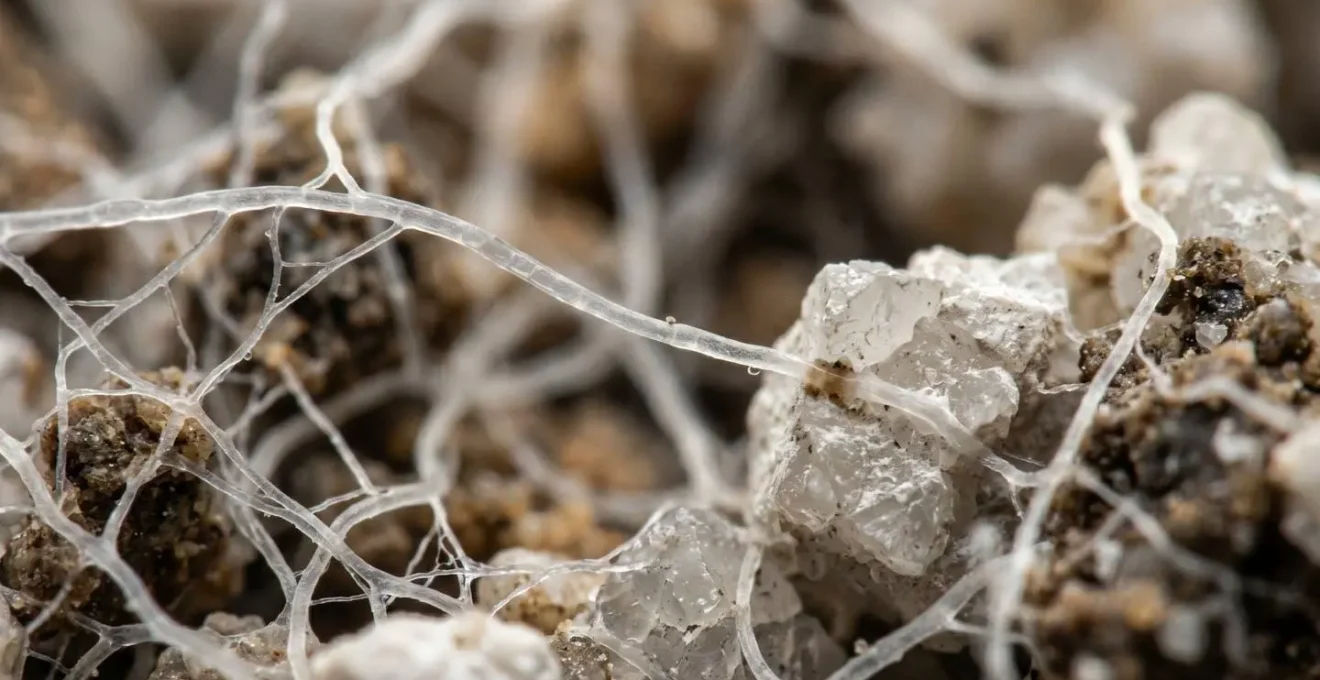
As the image above illustrates, the intricate network of fungal hyphae is the biological machinery capable of accessing locked nutrients at a microscopic level. By focusing on practices that enhance AMF populations—such as reduced tillage and diverse cover cropping—farmers can begin to leverage this powerful, self-sustaining system to mine their soil’s locked P reserves, rather than fighting the soil’s chemistry with expensive, and often counterproductive, inputs.
How to Unlock Legacy Phosphorus in Soils with High Calcium?
Unlocking the vast reserves of legacy phosphorus tied up as calcium phosphate requires a strategic shift from chemical intervention to biological activation. The goal is to foster an environment where natural processes can solubilise these insoluble compounds. This involves deploying a combination of specific plant species and management practices that actively alter the chemistry of the rhizosphere—the micro-environment directly surrounding the plant roots.
The primary mechanism is rhizosphere acidification. Certain plants, often called « biological drills, » exude organic acids (like citric, malic, and oxalic acid) from their roots. These acids create a localised drop in pH, which is strong enough to dissolve calcium phosphate bonds and release soluble phosphate ions that the crop can then absorb. Furthermore, these organic acids can chelate the calcium ions, effectively surrounding and neutralising them, which prevents them from re-locking the phosphate.
In addition to direct chemical action by plants, fostering populations of phosphate-solubilising microorganisms (PSMs), including the previously mentioned AMF and various bacteria, is critical. These organisms produce their own acids and enzymes to break down mineral phosphorus. Management practices that promote a healthy soil food web, such as reducing tillage and incorporating diverse organic matter, are essential for supporting these microscopic allies. The following checklist outlines a practical, multi-pronged approach based on UK research and best practices for mobilizing legacy P.
Action plan: A strategy for mobilizing legacy phosphorus
- Implement multi-year cover crops: UK field trials confirm that single-season cover crops often show no measurable impact on AMF. Plan for multiple, successive iterations to build and sustain fungal populations.
- Deploy buckwheat strategically: Incorporate buckwheat into your cover crop mix specifically for its ability to exude acidic compounds from its roots, which are highly effective at solubilizing calcium-bound phosphorus.
- Utilise lupins for chelation: Include lupins, which develop specialised ‘cluster roots’ that release a high concentration of chelating compounds, directly targeting and mobilising legacy P reserves.
- Incorporate bio-drilling species: Use deep-rooting species like fodder radish to physically explore new soil profiles, breaking compaction and creating channels for subsequent crops to access previously untapped P zones.
- Reduce tillage intensity: As confirmed by AHDB research, the benefits of cover cropping on AMF are amplified significantly when combined with reduced soil disturbance. Protect the fungal networks you are building.
How to Lower Soil pH Biologically to Release Calcium and Magnesium?
While lowering the pH of an entire field of calcareous soil is both economically and practically impossible, creating localised zones of acidity around crop roots is an achievable and highly effective strategy. This biological acidification is driven by the plants and microbes themselves. The primary method is to use cover crops that employ what is known as « Strategy I » iron acquisition, a mechanism also effective for mobilizing other nutrients.
Plants using this strategy, which includes most non-grass species like legumes and buckwheat, actively pump protons (H+) out of their roots into the rhizosphere. This efflux of H+ ions directly lowers the surrounding pH. This acidic micro-zone dissolves calcium carbonate, releasing both calcium (Ca) and magnesium (Mg) from the carbonate matrix into the soil solution. While this might seem counterintuitive—releasing more Ca—it is a necessary first step. The simultaneous release of organic acids by these same roots then chelates these newly freed Ca and Mg ions, preventing them from interfering with the uptake of other nutrients like potassium (K) and phosphorus (P).
Cover crop species are the primary tools for this task. Legumes such as alfalfa, vetches, and clovers are proficient acidifiers. Buckwheat is renowned for its ability to exude organic acids that solubilize phosphorus. Perhaps most powerfully, lupins develop specialised « proteoid » or cluster roots under P-deficient conditions, which release a massive amount of organic acids to mine the soil. Protecting the soil’s biological engine is equally important. Management practices that destroy soil structure and microbial life, particularly aggressive tillage, are counterproductive. Indeed, studies demonstrate that conventional tillage can decrease AM fungal diversity by up to 40%, crippling the very organisms needed to manage nutrient cycling. Therefore, a successful biological acidification strategy combines the right plants with the right soil management.
Albrecht vs Reams Tests: Which Method Reveals True Bio-Availability?
To effectively manage nutrient lock-up, you first need to accurately diagnose the problem. A standard UK soil test (using the P, K, Mg index system) is useful for identifying severe deficiencies but falls short on high-pH soils. It tells you what is present in an extractable form but fails to reveal the antagonistic relationships between nutrients that are blocking their uptake. This is where more advanced analytical methods, such as the Base Cation Saturation Ratio (BCSR) or « Albrecht » test, become invaluable diagnostic tools.
The Albrecht method is based on the principle that for optimal nutrient uptake, the soil’s cation exchange capacity (CEC) should be saturated with a specific ratio of basic cations: typically 60-70% Calcium, 10-20% Magnesium, 2-5% Potassium, and a small amount of Sodium. On a UK chalk soil, Calcium saturation might be 80% or even 90%, while Magnesium and Potassium are critically low. This gross imbalance, invisible on a standard test, is a primary driver of deficiency. The excess calcium ions physically crowd out magnesium and potassium from uptake sites on the root surface, inducing a deficiency in the plant even when the soil contains adequate levels of K and Mg. The following table, based on information from an analysis by New Generation Agriculture, compares the approaches.
| Test Parameter | Standard UK Test (Index System) | Albrecht BCSR Test |
|---|---|---|
| Primary Focus | Sufficiency levels of P, K, Mg, pH | Base cation saturation ratios (Ca:Mg:K balance) |
| Philosophy | Ensure nutrients within studied range, avoid deficiency/excess | Optimal cation balance (Ca 60-70%, Mg 10-20%, K 2-5%) for soil health |
| Parameters Measured | pH, P, K, Mg (4 parameters) | Organic matter, P (multiple extracts), K, Mg, Ca, H, CEC, base saturation %, Na, NO3-N, S, Zn, Mn, Fe, Cu, B (15+ parameters) |
| Interpretation | Straightforward index-based recommendations | Complex, requires specialist expertise to interpret ratios |
| Cost (UK) | £15-30 per sample (approximate) | £85-102 per sample (e.g., New Generation Agriculture) |
| Best For | General nutrient status, quick assessment | Diagnosing cation imbalances blocking nutrient uptake (e.g., Ca:Mg antagonism affecting K) |
While the Reams test is another biological approach focusing on energy levels in the soil, the Albrecht test is more chemically direct for diagnosing these specific lock-up issues. It must be used with scientific rigour, however. It is a diagnostic tool, not a dogma. As the UK’s AHDB wisely cautions, the direct link between these « ideal » ratios and yield is not always consistent.
The concept of ideal ratios of nutrients such as calcium and magnesium in soil has been around for over 100 years, but the evidence directly relating specific cation ratios to crop productivity is inconsistent.
– AHDB (Agriculture and Horticulture Development Board), The Albrecht system for soil nutrient testing – AHDB Knowledge Library
For a farmer on chalk soils, the value of an Albrecht test is not in chasing a perfect ratio but in understanding the *magnitude* of the calcium dominance. It provides a clear, chemical explanation for why your crops are potassium deficient and helps you focus solutions on mitigating this specific antagonism, rather than blindly applying more of a nutrient that is already present but unavailable.
The Micronutrient Interaction That Blocks Iron Uptake in Spring
One of the most visible symptoms of nutrient lock-up on chalk soils is lime-induced chlorosis, the characteristic yellowing of leaves, particularly in young growth during the spring. This is a direct result of iron (Fe) deficiency. As with phosphorus, the soil is not typically deficient in total iron; rather, the high pH has rendered it insoluble and unavailable to the plant. The Royal Horticultural Society confirms that on chalky soils, poor growth and yellowing leaves (chlorosis) result from the plant’s inability to absorb iron and manganese.
The chemical mechanism is straightforward: in the alkaline, oxygen-rich environment of a chalk soil, soluble ferrous iron (Fe2+) is rapidly oxidised to insoluble ferric iron (Fe3+), which precipitates out of the soil solution as ferric hydroxide. Plants can only absorb the soluble Fe2+ form, so they are effectively starved of iron even when it is abundant.
This problem is often exacerbated by another nutrient interaction involving phosphorus. High concentrations of phosphate in the soil solution—whether from native reserves or fertilizer application—can induce or worsen iron deficiency. Inside the plant, excess phosphate can bind with iron, forming insoluble iron phosphate compounds within the plant’s vascular tissues and rendering the iron metabolically inactive. This creates a complex antagonism: you need phosphorus, but too much available P at once can block the uptake or utilisation of iron. As UK Government guidance on soil health confirms, the interactions are complex and pH-dependent. At high pH levels, the chemical fixation of phosphorus with calcium dominates, which in turn influences the availability of all other nutrients, including iron. The key is to manage the system as a whole.
Strategies to combat iron chlorosis must therefore focus on increasing iron’s bio-availability at the root. This includes the same principles for P-mobilisation: using acidifying cover crops to lower rhizosphere pH and fostering a healthy mycorrhizal network. Additionally, the application of chelated iron can be an effective, albeit more expensive, short-term solution. A chelate is an organic molecule that surrounds and protects the iron ion, keeping it soluble and available for plant uptake even in high-pH conditions.
Key Takeaways
- The core problem on chalk soils is nutrient ‘lock-up’ due to high pH chemistry, not a lack of total nutrients.
- The solution is biological activation: using specific cover crops and mycorrhizal fungi to create acidic micro-zones and ‘mine’ existing reserves.
- Effective management requires advanced diagnostics (like Albrecht analysis) to understand cation imbalances and a strategic shift from feeding the crop to feeding the soil’s biology.
Synchronizing Mineralization Peaks with Crop Demand Stages
Adopting a biological approach to fertility, particularly through the use of cover crops, introduces a new dimension of management: timing. The nutrients sequestered in the biomass of a cover crop are not immediately available upon its termination. They must first be broken down by soil microorganisms in a process called mineralization. The speed of this process, and thus the timing of nutrient release, is critical for synchronizing nutrient supply with the peak demand of the subsequent cash crop.
Mineralization is a biological process driven by bacteria and fungi, and its rate is influenced by several factors. The most important is the carbon-to-nitrogen (C:N) ratio of the cover crop residue. A « green, » lush cover crop like a young legume will have a low C:N ratio (e.g., 20:1). Microbes can break this down very quickly, leading to a rapid release or « peak » of nutrients, primarily nitrogen. Conversely, a mature, woody, or straw-like cover crop (like mature rye) will have a high C:N ratio (e.g., 80:1). Microbes consuming this material will actually need to pull nitrogen from the soil to do so, temporarily immobilizing it before eventually releasing it much later.

The goal is to manage your cover crop termination—the timing and method (e.g., crimping, rolling, light incorporation)—to match this mineralization peak with your cash crop’s period of maximum nutrient uptake. For a spring-sown crop, terminating a legume-rich cover crop a few weeks before planting can provide a valuable pulse of nitrogen and other nutrients right when the young plant needs it most. Indeed, research in temperate soils shows that microbial activity can lead to a rapid mineralization (less than 8 weeks) of cover crop nutrients if soil conditions are favourable. Mis-timing this can mean the nutrient peak occurs before the crop’s roots are developed enough to capture it, leading to losses through leaching.
On chalk soils, this synchronization is even more critical. The biological processes of mineralization also release the organic acids that help to solubilise locked-up phosphorus and micronutrients. Therefore, synchronizing the peak of microbial activity from cover crop decomposition with the early growth stages of the cash crop provides a double benefit: it supplies mineralized N from the cover crop itself and it stimulates the release of legacy P and micronutrients from the soil bank, precisely when the crop’s demand is highest.
How to Farm Successfully on a Chalk Substratum With Limited Topsoil Depth?
Successful farming on a chalk substratum is the ultimate test of soil husbandry. It demands a long-term, integrated strategy that moves beyond single-season thinking and focuses on building the entire soil-plant system’s resilience and efficiency. It is less about fighting the inherent nature of the chalk and more about learning to work with its chemistry, leveraging biology to overcome its limitations. The synthesis of the strategies discussed—unlocking legacy P, managing micronutrients, and synchronizing mineralization—forms the foundation of this success.
A key principle is the protection and enhancement of the biological workforce. Every management decision, from tillage intensity to crop rotation, should be evaluated on its impact on the mycorrhizal fungal network and the broader soil food web. Building organic matter is paramount, as it improves water holding capacity (a critical issue on shallow, free-draining chalk), enhances cation exchange capacity, and provides the fuel for the microbial engine that drives nutrient cycling. This is a slow, cumulative process requiring consistent effort over many years.
Interestingly, managing pH on these soils requires a nuanced, long-term view. While adding lime seems absurd, acidification can still occur in the topsoil layer over time due to nitrogen fertiliser use and nutrient export. A comprehensive review of UK agricultural practices found that economics often lead to under-liming, even on soils that would benefit from maintenance applications to prevent topsoil acidification. A long-term UK study highlighted this, showing that while an initial lime application on upland grassland doubled livestock numbers, a 15-year gap in re-application led to acidification and a decline in productivity. This underscores the need for continuous monitoring and dynamic management, rather than a « fix and forget » mindset.
Ultimately, farming chalk successfully is about shifting from a chemical input model to a biological capital model. It means viewing the locked-up P and Ca not as a problem, but as a bank account. The investment is not in more fertilizer, but in the cover crops, reduced tillage, and diverse rotations that cultivate the biological keys to that vault. It requires more knowledge, more observation, and more sophisticated diagnostic tools, but the reward is a more resilient, self-sufficient, and profitable farming system.
Start implementing these soil-first strategies today to turn your farm’s greatest chemical challenge into its most profitable biological asset.