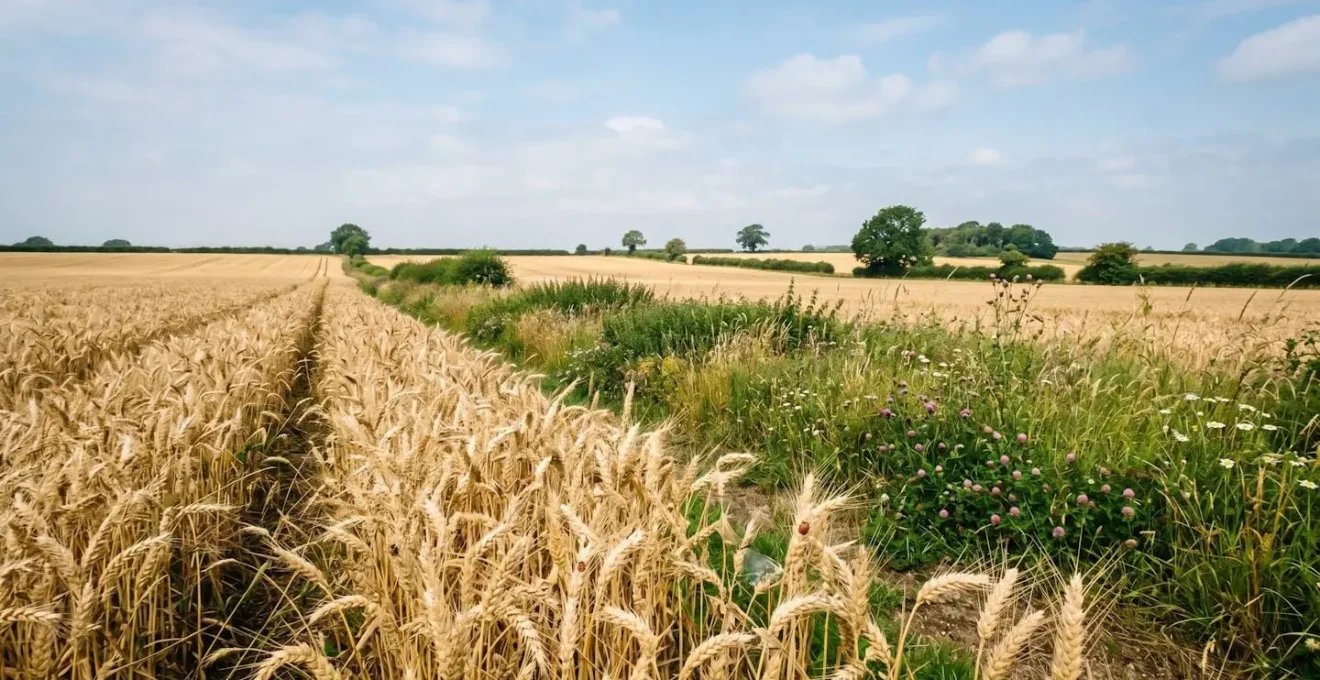
Relying on insecticides for aphid control is an increasingly fragile strategy; the ecological solution is to engineer a permanent, on-farm predator workforce.
- Effective biocontrol relies on maintaining a baseline level of prey to keep predator populations like ladybirds and ground beetles present and active.
- Dedicated habitats such as beetle banks and flowering strips are not optional additions but essential infrastructure for your farm’s immune system.
Recommendation: Shift focus from pest eradication to building ‘trophic resilience’ by providing continuous food sources and overwintering habitats for your most valuable allies: natural enemies.
For cereal growers, the familiar cycle of scouting for aphids and reacting with insecticide sprays is becoming less effective and more costly. Pyrethroid resistance is widespread, and the loss of key active ingredients tightens the toolbox. This reactive approach treats the symptom—the aphid outbreak—while ignoring the root cause: a simplified agricultural landscape that lacks a resilient, self-regulating food web. The constant pressure to maintain ‘clean’ fields often inadvertently eliminates the very predators that would otherwise provide robust, free, and continuous pest control services.
The conventional wisdom has often focused on isolated tactics, such as releasing ladybirds or planting a few wildflowers. However, these actions fail when they are not part of a cohesive system. A lasting solution does not lie in finding a new chemical spray, but in a paradigm shift. It requires moving away from agricultural practices that create a predator-free buffet for pests and toward a form of ecological engineering. This means systematically rebuilding the trophic networks that form a farm’s natural immune system.
But what if the key wasn’t to achieve zero aphids, but to maintain a managed, low-level population as a permanent food source for a standing army of predators? This article provides a systematic framework for grain growers to construct this resilient ecosystem. We will deconstruct the essential components, from supporting foliar predators to building habitats for ground-dwelling allies, and connect them into a functional, farm-scale network that reduces reliance on chemical inputs.
This guide will walk through the critical ecological principles and practical steps required to build a farm that controls pests naturally. Below is the roadmap to transforming your fields into a resilient, predator-rich environment.
Summary: A Grower’s Guide to Engineering a Pest-Resilient Farm
- Why You Need Aphids to Keep Ladybirds on Your Farm?
- How to Provide Habitat for Ground Beetles in Large Arable Fields?
- Broad-Spectrum Sprays vs Targeted Biology: Which Protects Yields Better?
- The Slug Pellet Mistake That Kills the Predators You Need Most
- Connecting Corridors: How to Link Trophic Networks Across the Landscape?
- Rotation Design: How to Break Pest Lifecycles Without Chemistry?
- The ‘Clean Field’ Mistake That Removes Habitat for Beneficial Predators
- How to Implement Integrated Pest Management to Meet UK Red Tractor Standards?
Why You Need Aphids to Keep Ladybirds on Your Farm?
The instinct to eliminate every aphid from a crop is understandable, but it’s ecologically counterproductive. Specialist predators like ladybirds (Coccinellidae) will not remain in a field without a reliable food source. When pest populations crash to zero, the predators either starve or emigrate, leaving the crop vulnerable to the next wave of colonizing aphids. The key to maintaining a standing army of predators is to provide a continuous, low-level food supply. This ensures they are present and ready to respond the moment pest numbers begin to rise, a concept central to building trophic resilience.
This doesn’t mean allowing pest aphids to run rampant. Instead, it involves ecological engineering through « banker plant » systems. This strategy uses a non-crop plant to host a different species of aphid that does not threaten the main cereal crop. These alternative aphids serve as a dedicated food source, or a « bank, » for ladybirds and other predators, keeping them on the farm even when the target pest is scarce. The illustration below captures this essential predator-prey interaction, the cornerstone of a healthy agroecosystem.
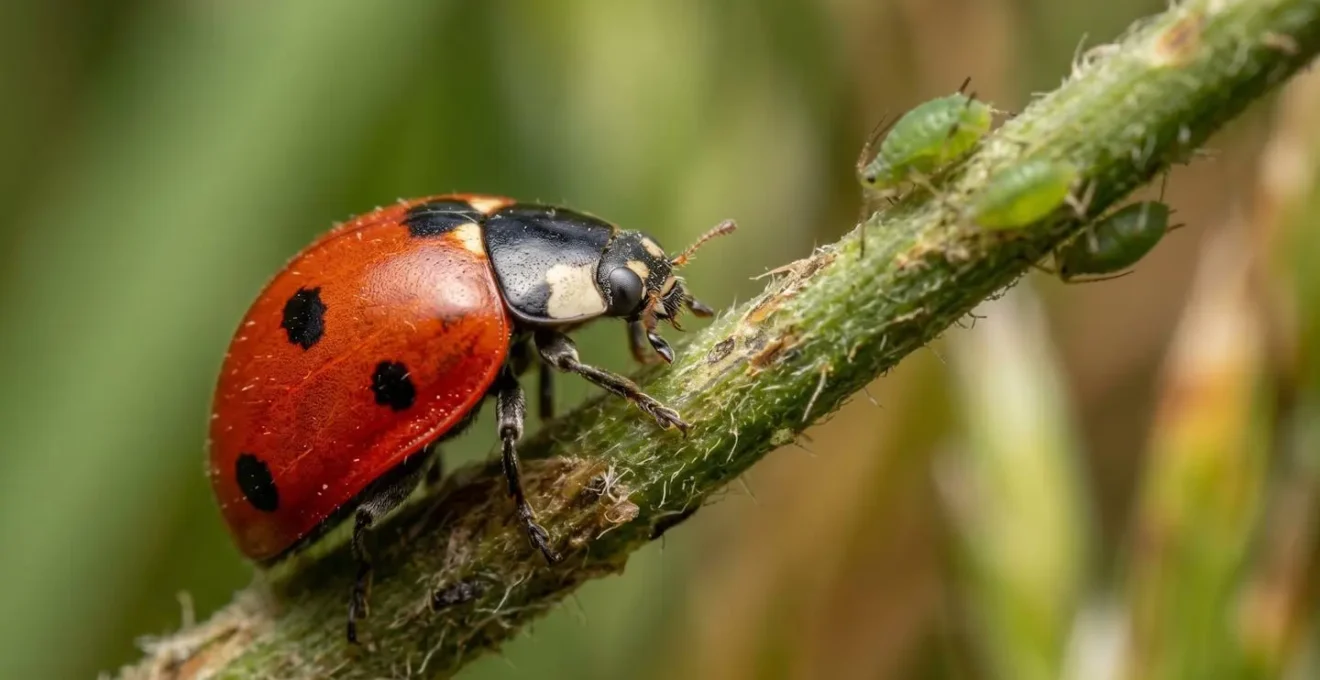
As the image shows, the presence of prey is what retains the predator. This relationship is not just observational; it is quantifiable and can be managed to achieve effective pest control. Building this predator scaffolding is a proactive investment in your farm’s natural defences.
Case Study: The Banker Plant System for Predator Retention
A practical application of this principle was demonstrated in a study on banker plant systems. Researchers used faba beans as the banker plant, which hosted an alternative aphid species (Megoura japonica) that does not feed on cereals. This system successfully sustained populations of the seven-spotted ladybird, Coccinella septempunctata. The study established a critical threshold: when the ratio of target pest aphids to the alternative prey on the banker plants exceeded 1:4, the ladybirds provided effective control of the pest population. By providing this continuous food source, the system prevented the predators from leaving the area, ensuring their presence throughout the growing season. This is confirmed by research showing how banker plant systems sustain predator populations by preventing the emigration that occurs when prey densities fall below a viable foraging threshold.
Ultimately, a small, managed aphid population is not a sign of failure but a mark of a functioning, resilient ecosystem. It’s the fuel that powers your on-farm biological control service.
How to Provide Habitat for Ground Beetles in Large Arable Fields?
While ladybirds and hoverflies patrol the crop canopy, a second, equally important army of predators operates at ground level. Carabid beetles, or ground beetles, are voracious generalist predators of slugs, aphid colonies that have fallen to the ground, and other pest insects. However, in large, uniform arable fields, these beneficials lack the undisturbed, insulated habitat required for overwintering and reproduction. The solution is to intentionally construct this missing infrastructure through the creation of beetle banks.
A beetle bank is a raised, grass-covered ridge, typically running through the middle of a large field. It is not just a strip of uncultivated land; it is a purpose-built habitat. Sown with dense, tussock-forming grasses like cocksfoot (Dactylis glomerata), it creates a warm, dry, and protected microclimate at the soil level. This structure is essential for ground beetles and other beneficial arthropods, such as spiders, to survive the winter months, allowing them to emerge in spring directly within the crop, ready to control early-season pests.
The effectiveness of these structures is well-documented. They act as predator reservoirs, concentrating beneficial populations where they are needed most. Field studies demonstrate that beetle banks are far more effective than simple field margins at building predator density. Research confirms that ground beetle densities can reach 90 individuals per square meter in beetle banks during the summer, compared to just 60/m² in standard field margins. This concentration of predators provides a crucial buffer against pest outbreaks, particularly in the center of large fields far from hedgerows.
By investing in this permanent infrastructure, a grower is not just leaving a strip of land fallow; they are building a predator factory in the heart of their production system, ensuring a rapid response force is always on hand.
Broad-Spectrum Sprays vs Targeted Biology: Which Protects Yields Better?
The long-standing reliance on broad-spectrum insecticides, particularly pyrethroids, operates on a principle of total eradication. While seemingly effective in the short term, this approach creates a biological vacuum. These sprays are indiscriminate, killing beneficial predators just as effectively as they kill pests. This action completely undermines the farm’s natural immune system, often leading to secondary pest outbreaks or a rapid resurgence of the primary pest, as their natural enemies have been eliminated. This « pesticide treadmill » requires ever-increasing applications to achieve the same level of control, all while resistance builds in the target pest population.
In contrast, a targeted biological approach focuses on enhancing the populations of natural enemies to keep pests below an economic threshold. This system is not about eliminating every pest but about maintaining a balance where predators suppress pest populations naturally. It leverages the specificity of predator-prey relationships, where parasitoid wasps target only certain aphid species, and generalists like ground beetles consume a wide range of pests without harming the crop. This creates a more stable, resilient system that is less prone to the boom-and-bust cycles associated with chemical control.
The argument that chemical sprays are essential to protect yields is being increasingly challenged by scientific evidence. When implemented correctly, biological control is not only better for the environment but can be more effective at protecting crops. In fact, a comprehensive meta-analysis of 99 studies found biological control led to a 63% reduction in pest abundance and, crucially, a yield increase of over 60% compared to systems relying on synthetic pesticides. The same analysis found natural enemy abundance was 43% greater, demonstrating the power of a functioning ecosystem.
Moving to a biologically based system is not about sacrificing yield; it’s about adopting a more sophisticated and ultimately more profitable strategy that works with nature, not against it.
The Slug Pellet Mistake That Kills the Predators You Need Most
In the complex food web of a cereal field, every management decision has cascading effects. One of the most common and damaging mistakes is the blanket application of metaldehyde-based slug pellets. While targeting slugs, these pellets cause significant collateral damage to one of the most important groups of generalist predators on the farm: ground beetles. Many species of carabid beetles are voracious slug predators, particularly of slug eggs and juveniles, providing a crucial first line of defense. By broadcasting pellets, growers inadvertently poison their primary allies in the fight against slugs.
The loss of these predators creates a dependency on chemical controls, as the natural regulatory function of the ecosystem is broken. Ground beetles are not just slug predators; their role is far more versatile. As the image below suggests, their habitat is the soil surface, where they are a key component of the soil food web, but their impact extends upwards into the crop canopy. This makes their conservation a top priority for any integrated pest management system.
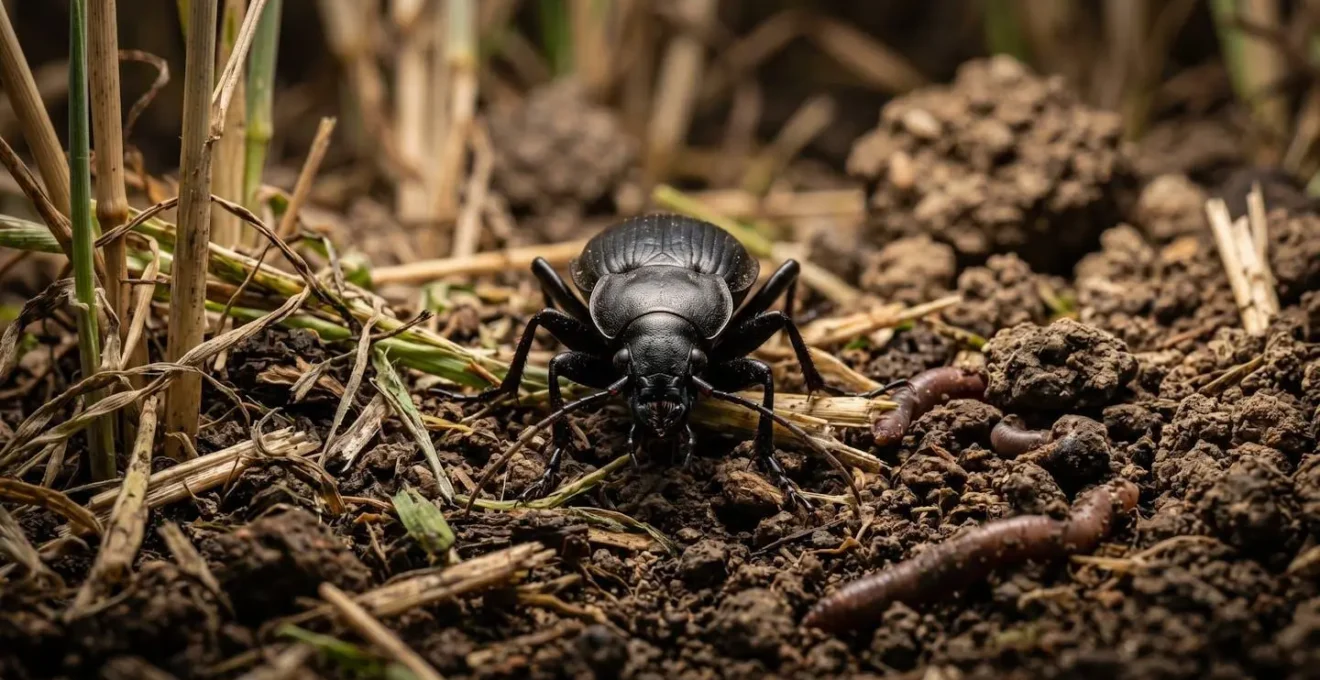
This connection between soil health and foliar pest control is often overlooked. As expert research highlights, the value of these predators extends beyond a single pest. A guide on ground beetle conservation notes their versatile role:
Many members of this group are potential biological control agents of slugs and other pests. Additionally, some studies have shown that they can climb the lower levels of plants to attack foliar pests such as aphids directly.
– Pterostichus ground beetle research, eOrganic Ground Beetle Conservation Guide
This dual role makes ground beetles a cornerstone of a resilient farm ecosystem. Protecting them from off-target chemical effects is not just an environmental concern; it is a critical agronomic decision. A single application of slug pellets can decimate a population of beneficials that took years to build, leaving the field vulnerable to both slugs and aphids.
Therefore, any slug control strategy must be highly targeted, using baiting points rather than broadcast applications, and should only be considered after confirming that slug pressure exceeds the control capacity of the existing predator population.
Connecting Corridors: How to Link Trophic Networks Across the Landscape?
Creating isolated islands of habitat, like a single beetle bank or wildflower strip, is a good start, but their true potential is only unlocked when they are connected. Predators need to move freely across the farm landscape to respond to shifting pest populations and to find resources and overwintering sites. This concept is known as functional connectivity. It’s not enough to simply have habitat; that habitat must be linked to form a cohesive network that supports predator movement and enhances their efficiency.
Corridors such as hedgerows, grass margins, and beetle banks act as highways for beneficial insects, allowing them to travel between fields and from permanent habitats into the heart of the crop. A beetle bank that connects to a species-rich hedgerow is exponentially more valuable than one that stands alone. This connectivity ensures that predators can re-colonize areas quickly after disturbances and effectively « patrol » the entire farm, not just the field edges. The impact of this landscape-level thinking on predator populations is significant and measurable.
For instance, research on landscape connectivity shows that carabid beetles are twice as abundant in crop fields adjacent to beetle banks and other uncultivated habitats compared to fields isolated from such features. This demonstrates that the influence of a habitat corridor extends far into the cropped area, delivering pest control services where they are most needed. The goal is to transform the farm from a patchwork of isolated fields into a single, integrated ecological unit.
Case Study: Landscape Complexity and Food Web Function
The importance of connectivity goes beyond just predator numbers; it affects the very functionality of the food web. A landscape-scale study analyzed food webs involving cereal aphids and their parasitoid wasps across 18 different agricultural landscapes. While the number of species present was similar everywhere, their interactions changed dramatically with landscape structure. The study found that primary parasitism rates were significantly higher in structurally complex landscapes (those with more semi-natural habitats and corridors). In these connected landscapes, parasitism reached levels sufficient for successful biological control. This proves that landscape complexity and functional connectivity directly enhance the effectiveness of the pest control services provided by the ecosystem.
By planning habitat creation with connectivity in mind, growers can amplify the benefits of each individual feature, creating a whole that is far greater than the sum of its parts.
Rotation Design: How to Break Pest Lifecycles Without Chemistry?
Crop rotation is a cornerstone of agronomy, but its role in pest management is often viewed simply through the lens of soil-borne pathogens. However, a well-designed rotation is also a powerful tool for managing insect pests and enhancing beneficial predator communities. By varying crop types over time, growers can disrupt the life cycles of specialist pests that rely on a single host plant. More importantly, a diverse rotation that includes different crop architectures and flowering times provides a continuous and varied habitat that supports a wider range of natural enemies, a concept known as temporal complementarity.
For example, a rotation that includes a flowering break crop like oilseed rape or faba beans provides vital nectar and pollen resources for hoverflies and parasitoid wasps, whose larvae are voracious aphid predators. Following this with a cereal crop allows these predator populations to move directly into the new crop. Furthermore, incorporating practices like reduced tillage or no-till within the rotation helps protect overwintering ground beetles and other soil-dwelling beneficials, which would otherwise be destroyed by plowing. This combination of temporal and structural diversity creates a more stable environment for predators year-round.
The synergy between rotation, tillage, and biological control is a key area of conservation agriculture research, demonstrating that these practices build a more robust predator community.
Case Study: Conservation Agriculture and Predator Communities
Research on conservation agriculture in winter wheat fields examined how practices like reduced tillage and crop rotation influenced predator communities. The study found that different management practices supported different types of predators. For instance, reduced tillage significantly benefited ground beetle communities. At the same time, the presence of flowering plants in the rotation supported parasitoid wasps. These two groups of predators were active at different times of the season, creating a complementary effect. This « temporal complementarity » meant that aphids were under attack from different enemies throughout their life cycle, leading to more effective and consistent pest suppression than a single predator group could achieve alone. This highlights how rotation design can build a multi-pronged biological defense system.
By thinking of rotation not just in terms of cash crops but also as a tool for ecological engineering, growers can create a farm landscape that is inherently hostile to pests and welcoming to their enemies.
The ‘Clean Field’ Mistake That Removes Habitat for Beneficial Predators
The aesthetic of a perfectly « clean » field—free of weeds, crop residue, and any perceived imperfection—is deeply ingrained in agricultural culture. However, this pursuit of sterility is one of the biggest impediments to establishing a functional on-farm food web. A sterile environment is a fragile one. By removing every non-crop plant and tilling in all residue, we eliminate the food sources (pollen, nectar, alternative prey) and overwintering sites that beneficial insects need to survive. This « clean field » ideology creates a perfect environment for pest outbreaks, as it removes all the natural checks and balances.
This problem extends beyond physical habitat. The excessive use of nitrogen fertilizer, aimed at maximizing yield, also contributes to a « cleaner, » less resilient system. High nitrogen levels in plant tissues can make crops more palatable and nutritious for aphids, leading to explosive population growth. This bottom-up pressure can overwhelm even a healthy predator population. It creates a system that favors pests adapted to high-resource environments, while potentially disadvantaging the predators trying to control them.
The assumption that organic or low-input systems automatically have more complex and beneficial food webs is also an oversimplification. The specific interactions between species matter more than simple diversity metrics.
Case Study: Farming Systems and Food Web Structure
A surprising finding came from a study comparing organic versus conventional winter wheat fields. Researchers expected the organic fields to have more complex food webs. Instead, they found that the highly fertilized conventional fields had higher food web complexity and interaction evenness. The elevated plant nitrogen in conventional fields supported a different community of leaf-colonizing aphids, which in turn supported a different set of interacting predators. The organic fields, in contrast, were dominated by a single ear-colonizing aphid species. This research challenged the simple assumption that « organic is always better, » demonstrating that bottom-up forces like fertilization can have powerful and sometimes counter-intuitive effects on trophic interactions. The key takeaway is that it is the functional relationships, not just species counts, that define a resilient system.
A truly resilient farm embraces a degree of managed « messiness »—leaving stubble, allowing non-competitive flowering plants in field margins, and optimizing fertilizer use to build a system that starves pests and feeds predators.
Key Takeaways
- Effective aphid control is not about eradication, but about engineering a stable ecosystem where predators are always present.
- Dedicated, permanent habitats like beetle banks and connected field margins are non-negotiable infrastructure for a resilient farm.
- Decisions like fertilizer rates and slug pellet use have cascading effects on the food web that can either support or destroy your predator populations.
How to Implement Integrated Pest Management to Meet UK Red Tractor Standards?
Transitioning from a reactive, chemistry-based approach to a proactive, ecological one requires a structured framework. This is the essence of Integrated Pest Management (IPM), a core requirement for farm assurance schemes like the UK’s Red Tractor. IPM is not a rigid set of rules but a decision-making process that prioritizes biological and cultural controls, using chemical intervention only as a last resort when economic thresholds are breached. It is about demonstrating proactive ecological enhancement rather than reactive dependence on sprays.
The foundation of any credible IPM plan is rigorous monitoring. This involves more than just scouting for pests; it requires quantifying the presence and activity of natural enemies to understand the predator-to-prey ratio. Are there enough ladybirds, parasitoid wasps, and ground beetles to handle the current aphid population? Recent surveys across major cereal-producing regions discovered a wide range of natural control, with 0-28% parasitism of cereal leaf beetle larvae in commercial fields, highlighting that relying on this service requires field-specific measurement. You cannot manage what you do not measure.
Implementing IPM involves using a variety of tools—sweep nets for foliar insects, pitfall traps for ground beetles, and yellow sticky traps for flying pests—to build a complete picture of your farm’s food web. This data allows you to make informed decisions, moving beyond a simple « spray/don’t spray » binary. It allows you to ask more sophisticated questions: Is the predator population increasing? Is the pest population trend leveling off due to predation? Answering these questions is fundamental to meeting assurance standards and building a truly resilient system.
Your Action Plan for IPM Monitoring and Ratio Assessment
- Establish Baselines: Begin scouting for adult pest activity in spring when air temperatures consistently exceed 10°C (50°F) to establish initial population data before they multiply.
- Scout Early and Often: Scout frequently from the onset of favorable temperatures until crop maturity to detect pest eggs and small larvae before populations exceed economic thresholds.
- Quantify Your Allies: Use multiple sampling methods (e.g., pitfall traps for ground beetles, sweep nets for foliar predators, water traps for parasitoid wasps) to quantify natural enemy presence and activity.
- Ask Critical Questions: Before any intervention, assess if the pest population truly exceeds the economic threshold for the current crop stage and whether natural enemy densities are sufficient to provide control.
- Document Everything: Record all monitoring data, calculated pest-to-predator ratios, intervention decisions (including the decision not to spray), and observed outcomes to demonstrate a proactive IPM strategy for audits.
By adopting this systematic, evidence-based approach, growers can not only meet certification requirements but also build a more profitable and sustainable farming operation that is less vulnerable to the rising costs and failing efficacy of chemical inputs.