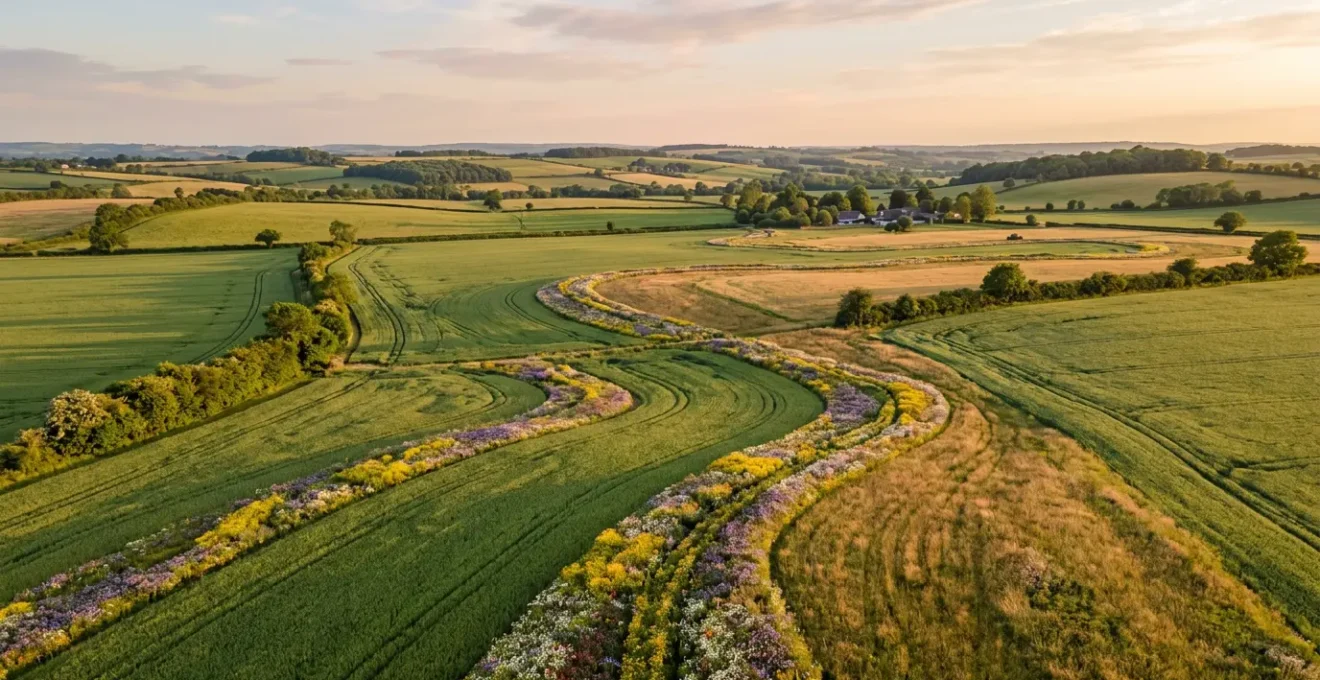
To successfully meet Biodiversity Net Gain (BNG) targets, large-scale farms must transition from simply planting flowers to engineering a resilient, landscape-scale ecological system for pollinators.
- Effective pollinator support requires using native wildflowers of local provenance to match the co-evolved needs of specialist insects.
- Strategic management, including suppressing competitive grasses and implementing rotational mowing, is more critical than initial seeding alone.
Recommendation: Adopt a systems-thinking approach, viewing field margins, in-field strips, and shelter belts not as isolated plots but as interconnected components of a functional ecological network that supports the entire pollinator lifecycle.
For landowners and farm managers across the UK, the pressure to meet Biodiversity Net Gain (BNG) and Higher Tier Stewardship objectives is mounting. The default response is often to purchase and sow generic « wildflower mixes » across fallow land. While well-intentioned, this approach frequently yields disappointing results, creating visually appealing but ecologically shallow habitats that fail to support robust, diverse pollinator populations. This is because it overlooks the fundamental principles of landscape ecology and the complex life cycles of the very insects we aim to protect.
The common advice to « plant more flowers » or « mow less » only scratches the surface. A truly effective strategy requires a deeper understanding of ecological dynamics. But what if the key to unlocking significant biodiversity gains wasn’t just about what you plant, but about systematically designing a landscape that provides continuous resources and refuge? This involves considering the genetic origin of your seeds, the competitive pressure from agricultural grasses, the spatial arrangement of habitats, and management practices that protect vulnerable larvae and overwintering adults.
This guide moves beyond the platitudes to provide a strategic framework for large-scale farmers. We will explore how to design and manage functional angiosperm pathways from the perspective of a landscape ecologist. By applying a systems-thinking approach, you can create a resilient ecological network that not only satisfies regulatory requirements but generates genuine, lasting biodiversity improvements across your entire holding.
This article provides a comprehensive overview of the key interventions a landowner can implement to achieve meaningful biodiversity targets, with a particular focus on wild pollinators. We will examine everything from seed selection and habitat establishment to long-term management and monitoring, giving you a strategic blueprint for success.
Summary: A Landscape-Scale Guide: Designing Angiosperm Pathways for Wild Pollinators on 500+ Acres
- Why Native Wildflowers Outperform Generic Mixes for UK Pollinators?
- How to Establish Wildflower Strips in Competitive Grassland?
- Field Margins vs In-Field Strips: Which Delivers Better Pollination Services?
- The Mowing Mistake That Destroys Pollinator Larvae in Autumn
- Ensuring Continuous Nectar: How to Bridge the ‘June Gap’ with Angiosperms?
- Improved Leys vs Herbal Leys: Which Scores Higher for Biodiversity?
- Why Shelter Belts Reduce Lamb Mortality Rates in Spring?
- How to Conduct a Species Richness Check to Qualify for Higher Tier Stewardship?
Why Native Wildflowers Outperform Generic Mixes for UK Pollinators?
The foundation of any successful pollinator pathway is the selection of appropriate plant species. While many commercial wildflower mixes promise a riot of colour, they often contain non-native species or cultivated strains that are ecologically ineffective. Native UK pollinators have co-evolved over millennia with native wildflowers, developing highly specialised relationships. The morphology of a flower—its shape, size, and nectar accessibility—is often precisely matched to the mouthparts of a specific bee, moth, or fly. When we introduce generic or foreign strains, these intricate connections break down.
The urgency of this issue is underscored by the catastrophic decline in natural habitats; research from Kew Gardens documents that 97% of the UK’s wildflower meadows have been lost since the 1930s. This makes the ecological integrity of our created habitats more critical than ever. It’s not just about providing any flower; it’s about providing the right flowers with the correct genetic provenance. Using seeds sourced from local or regional UK populations ensures that the resulting plants are adapted to local conditions and recognised by local pollinator ecotypes.
Case Study: The Critical Role of Local Provenance
A study by the Suffolk Wildlife Trust provided a stark illustration of this principle. Researchers found that certain specialist pollinators could not utilize cultivated or foreign strains of wildflowers, even if they were the same species. For instance, specific native bumblebee species were physically unable to feed on the cultivated strains of red clover commonly found in agricultural mixes due to subtle changes in flower structure. Similarly, the larvae of the common blue butterfly would not feed on foreign varieties of bird’s-foot-trefoil. This demonstrates that for a habitat to be truly functional, it must be built with genetically appropriate native plants.
Therefore, the first step in designing a resilient pollinator pathway is to source high-quality seed mixes composed of species native to your region. This decision alone dramatically increases the ecological value of your investment and lays the groundwork for a truly biodiverse system.
How to Establish Wildflower Strips in Competitive Grassland?
Simply scattering wildflower seed onto existing grassland, especially improved pasture, is a common recipe for failure. Vigorous agricultural grasses like perennial ryegrass, cocksfoot, and Yorkshire fog have been bred for rapid growth and will quickly outcompete delicate wildflower seedlings for light, water, and nutrients. To establish a species-rich sward, you must first manage this grass competition. This requires a strategic intervention to weaken the dominant grasses and create physical space for wildflowers to germinate and thrive.
A powerful, natural tool for this is the introduction of Yellow Rattle (Rhinanthus minor). This native annual is a hemi-parasite, meaning it derives some of its nutrients by tapping into the root systems of nearby grasses. This parasitism naturally weakens the grasses, opening up the sward and creating the low-nutrient, open conditions that most wildflowers prefer. The impact of such interventions is significant; a 2022 landscape-scale study demonstrated that species richness nearly doubled in areas where wildflower establishment was successful. Below ground, a healthy wildflower meadow supports a complex web of mycorrhizal fungi, which helps less competitive plants access nutrients and improves soil structure.
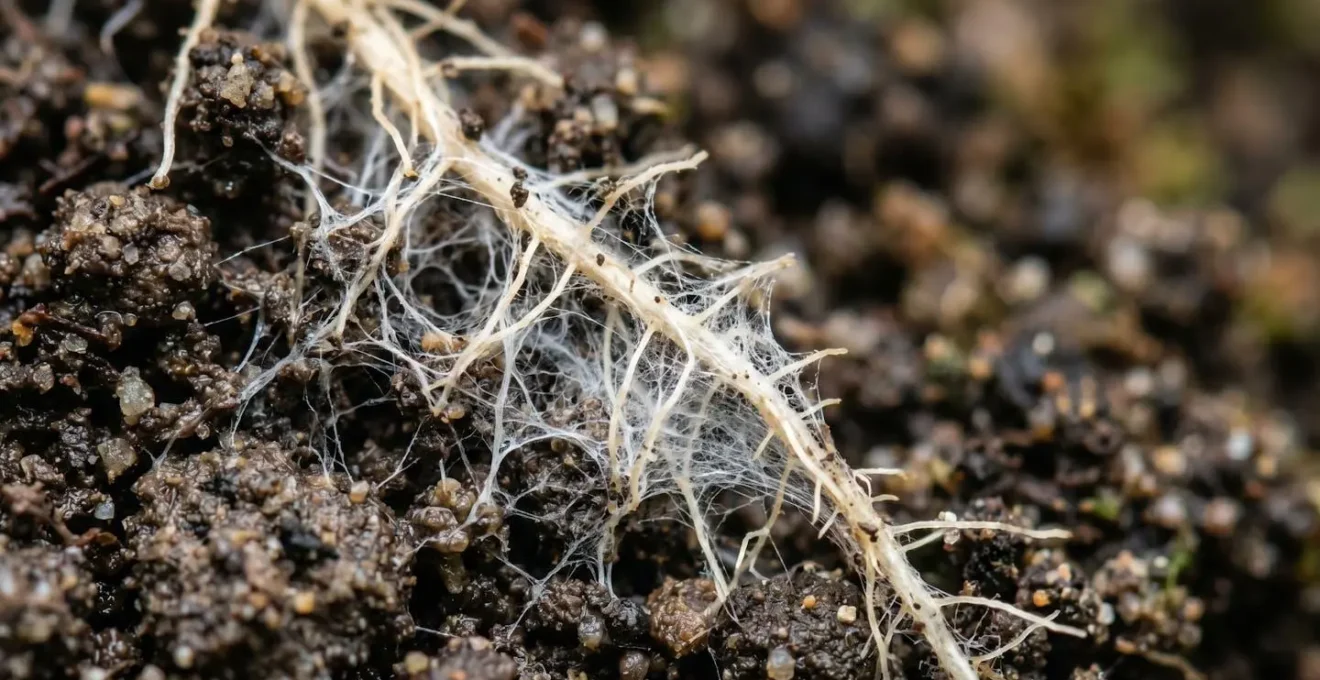
As the image above illustrates, the health of the visible meadow is intrinsically linked to the invisible ecosystem in the soil. Successful establishment is a process, not a single event. It involves preparing the seedbed, reducing grass vigour, and patiently allowing a new ecological balance to emerge. The following steps outline a proven method using Yellow Rattle:
- Establish the initial wildflower grassland sward and allow it to close up over 2-3 growing seasons.
- Identify areas where aggressive grasses (e.g., Yorkshire fog) are becoming dominant and crowding out smaller species.
- Sow Yellow Rattle (Rhinanthus minor) seed in autumn when the sward is at its shortest height to ensure good seed-to-soil contact.
- Allow Yellow Rattle to parasitize grass roots, naturally weakening their growth and creating space for less competitive forb species.
- Monitor the balance annually and repeat seeding in zones where grass competition remains high.
Field Margins vs In-Field Strips: Which Delivers Better Pollination Services?
Once you have a method for establishing wildflowers, the next strategic question is one of spatial ecology: where should these habitats be placed to deliver the maximum benefit? The default approach is to utilise field margins, creating linear strips of habitat around the perimeter of productive fields. While beneficial, this strategy can be limited by the foraging range of many wild pollinators. Solitary bees and hoverflies, which are highly effective pollinators, may only travel a few hundred metres from their nest. A wide field with only marginal strips may result in a « pollination desert » in its centre.
This is where in-field strips become a powerful tool. By creating one or more wildflower strips running through the centre of a large arable or horticultural field, you effectively bring the pollinators to the crop. This creates a network of resources that is accessible to a wider range of species, ensuring a more even distribution of pollination services across the entire cropped area. The optimal configuration depends on your specific landscape, but a 2025 simulation study found that wild bee populations thrive when 20-50% of the landscape is comprised of natural habitat, suggesting that a network of interconnected strips and margins is key.
Case Study: Enhancing Crop Pollination in Strawberries
A 2021 study across 19 sites provided clear evidence for this spatial strategy. Researchers observed that while wildflower strips along field margins enhanced wild bee visitation to the strawberry crop, this effect was limited to the field edges directly adjacent to the strips. The overall pollination level across the entire field did not significantly increase. Based on these findings, the researchers recommended establishing wildflower strips within the centre of crop fields. This strategic in-field placement helps overcome the limited foraging radius of smaller native bees, maximizing the spatial coverage of pollination enhancement and potentially boosting crop yield and quality.
For large-scale farms, a hybrid approach is often best: maintain wide, species-rich field margins as core habitat and supplement them with in-field strips in larger fields to ensure complete pollinator coverage. This transforms simple habitat plots into a functional, landscape-scale network.
The Mowing Mistake That Destroys Pollinator Larvae in Autumn
An effective pollinator pathway provides resources for the entire lifecycle, not just nectar and pollen for foraging adults. A common management error is to conduct a « tidy-up » mow of all wildflower areas in the autumn. While mowing is necessary to prevent scrub encroachment and remove excess nutrients, cutting everything at once can be catastrophic for next year’s pollinator populations. Many species of bees, butterflies, and other insects overwinter as eggs, larvae, or pupae within the hollow stems of plants like hogweed and teasel, or in the tussocky base of grasses.
A single, uniform autumn mow effectively destroys this entire generation of overwintering insects. This is particularly devastating for solitary bees, which do not have a large colony to absorb the loss. Furthermore, entomological surveys reveal that approximately 70% of solitary bee species are ground-nesting, creating shallow burrows in bare, undisturbed soil. Aggressive mowing and soil disturbance can destroy these fragile nesting sites. Protecting these vulnerable life stages is essential for ecological resilience and ensuring a healthy population emerges the following spring.
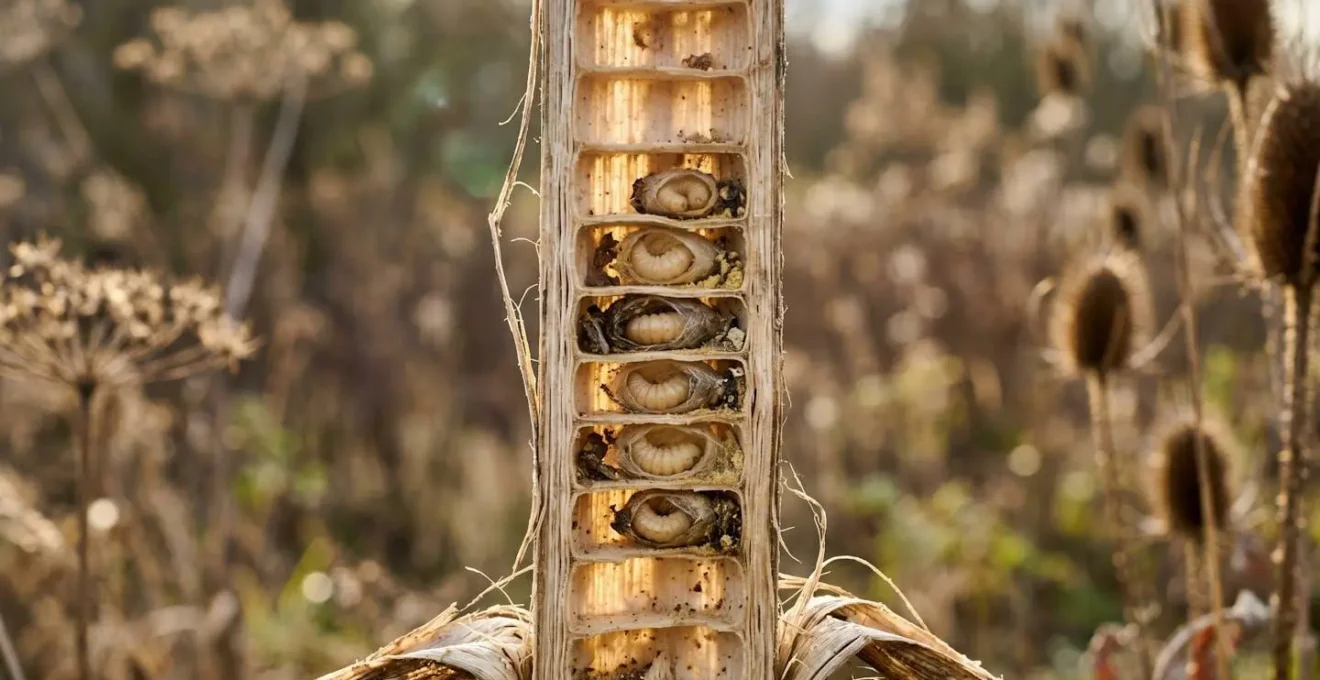
The solution is not to stop mowing, but to mow strategically. By implementing a system of rotational mowing, you ensure that a significant portion of the habitat remains untouched each year, providing a continuous refuge. This involves dividing your pollinator habitats into three or four zones and mowing only one zone each year, typically in late autumn after the first frosts or in late winter. This approach maintains the open structure of the meadow while always leaving two-thirds or more of the area as a safe haven for overwintering insects.
Ensuring Continuous Nectar: How to Bridge the ‘June Gap’ with Angiosperms?
A common feature of many newly established wildflower meadows is a spectacular bloom in late spring, followed by a period of lower floral abundance in mid-summer. This lull, often called the « June Gap, » can be a critical bottleneck for pollinator populations, particularly for bumblebee colonies that are reaching their peak size and have high foraging demands. Ensuring a continuous succession of flowering plants, a concept known as phenological synchrony, is a hallmark of a well-designed habitat. The goal is to provide a reliable nectar and pollen supply from early spring through to late autumn.
The need for this continuity is acute, as the UK Biodiversity Indicators 2024 report shows 38% of pollinating insect species have shown a long-term decline in their distribution. Bridging the June Gap involves selecting species that flower in mid-summer, such as knapweeds, scabious, and wild marjoram. But extending the season into late autumn is equally important. This is when many queen bumblebees are building up reserves for hibernation, and other insects are having their final generation.
Often overlooked, some of the most valuable late-season resources are common plants that might be considered « weeds. » As the UK Pollinator Monitoring Scheme highlights, these species can be ecological powerhouses.
Ivy and Hogweed to be clear favourites in terms of the overall total number of insects
– UK Pollinator Monitoring Scheme, PoMS Annual Report 2024
Allowing ivy to flower on trees and walls provides a vital, energy-rich nectar source in September and October. Similarly, managing areas to allow some hogweed or other late-flowering umbellifers to persist can be hugely beneficial. A successful pathway is a full-season buffet, not a single feast.
Improved Leys vs Herbal Leys: Which Scores Higher for Biodiversity?
Forage production is a core function of many large farms, but it doesn’t have to be at odds with biodiversity. Standard « improved » leys, typically dominated by one or two high-sugar grass species like perennial ryegrass, are ecological deserts. They offer minimal floral resources for pollinators, poor structural diversity for other insects and birds, and can lead to compacted soil over time. In contrast, herbal leys (or multi-species swards) represent a powerful system-level intervention that integrates production with ecological benefits.
Herbal leys are complex mixes containing a variety of grasses, nitrogen-fixing legumes (like clovers and sainfoin), and deep-rooting herbs (like chicory, plantain, and yarrow). This diversity delivers multiple wins. For pollinators, the continuous flowering of different legume and herb species provides a constant food source throughout the grazing season. Field research in agricultural corridors has documented this effect, showing a 78% increase in butterfly abundance in fields with wildflower-sown strips compared to those without. For livestock, the herbs provide essential minerals and have anthelmintic (anti-parasite) properties, improving animal health.
Furthermore, the varied root structures of a herbal ley have profound benefits for soil health. The deep taproots of chicory and sainfoin break up soil compaction, improve water infiltration, and increase drought resilience. This combination of benefits makes the switch from improved leys to herbal leys one of the most impactful changes a landowner can make. It transforms a simple production field into a multi-functional asset that builds soil, supports wildlife, and maintains high-quality forage.
Why Shelter Belts Reduce Lamb Mortality Rates in Spring?
A truly integrated, landscape-scale approach recognizes that different habitat features can serve multiple functions. Shelter belts—linear plantings of trees and shrubs—are a perfect example of this system-level intervention. Their primary agricultural purpose, especially in upland or exposed areas, is to protect livestock. For a flock of ewes lambing in spring, a well-placed shelter belt can be the difference between life and death. By reducing wind speed, they drastically lower the risk of hypothermia (wind chill) for newborn lambs, a major cause of mortality.
But their benefits extend far beyond livestock protection. Ecologically, shelter belts are vital corridors that connect fragmented habitats across the agricultural landscape. They provide nesting sites for birds, refuge for small mammals, and crucial foraging resources for pollinators, especially early in the season. Spring-flowering trees and shrubs like willow, blackthorn, and hawthorn are among the first sources of nectar and pollen to emerge, providing a lifeline for queen bumblebees coming out of hibernation. This allows them to found healthy colonies that will later move out to pollinate crops and wildflowers.
By planting a mix of native tree and shrub species with varied flowering times and structures, a shelter belt becomes a three-dimensional habitat. It offers shelter from the elements, food for pollinators, and a safe travel lane for wildlife moving between larger woodland blocks or species-rich grasslands. This demonstrates how a single, well-designed intervention can deliver simultaneous benefits for agricultural production and biodiversity, creating a more resilient and interconnected farm ecosystem.
Key Takeaways
- Prioritise native, locally-sourced wildflower seeds to support the co-evolved relationships with UK pollinators.
- Implement a rotational mowing schedule, leaving at least two-thirds of pollinator habitat unmowed each year to protect overwintering larvae.
- Think spatially by using in-field strips in addition to margins to create a functional network that overcomes the limited foraging range of many wild bees.
How to Conduct a Species Richness Check to Qualify for Higher Tier Stewardship?
Creating habitat is the first step; proving its effectiveness is the second. For Higher Tier Stewardship schemes and BNG reporting, simply showing that you have sown seeds is not enough. You must provide evidence that your interventions have resulted in a measurable increase in biodiversity. This requires a structured approach to monitoring, specifically focusing on species richness and abundance. While a full entomological survey is complex, farmers can use standardized citizen-science protocols to gather robust data.
The UK Pollinator Monitoring Scheme (PoMS) provides the tools and methodology for this. Their FIT Count (Flower-Insect Timed Count) is a simple, 10-minute survey that anyone can conduct. It involves observing a 50cm x 50cm patch of target flowers and counting the number of insects that land on them, identifying them to broad groups (e.g., bumblebees, hoverflies, other flies, butterflies/moths). Repeating these counts at the same locations through the season provides valuable data on pollinator activity. This data helps you identify which habitats are most effective, spot resource gaps like the June Gap, and build a powerful evidence base for your stewardship application.
The official UK biodiversity indicator for pollinators includes 393 species of bees and hoverflies monitored by the Joint Nature Conservation Committee, highlighting the diversity you are aiming to support. By tracking changes in abundance and the variety of insect groups over time, you can demonstrate a clear return on your environmental investment. This turns your anecdotal observations into quantifiable results.
Your Action Plan: Auditing On-Farm Pollinator Habitat
- Points of Contact: Map all existing and potential pollinator habitats on your farm. List every channel where pollinators can find resources: field margins, herbal leys, in-field strips, hedgerows, and shelter belts.
- Resource Collection: Inventory the key flowering species within each habitat. Note their flowering times to identify any potential « gaps » in floral resources, especially in mid-summer and early autumn.
- Lifecycle Coherence: Confront your management practices with pollinator needs. Do your mowing schedules leave at least 2/3 of habitat as an overwintering refuge? Are there areas of undisturbed soil for ground-nesting bees?
- Effectiveness & Activity: Conduct at least three FIT Counts between April and September in your key habitat zones. Use the PoMS app to record and compare insect abundance. Are your « hotspots » thriving or are they quiet?
- Integration Plan: Based on your audit, create a priority list. Does a key field need an in-field strip? Should a grass ley be converted to a herbal one next season? This becomes your evidence-based plan for BNG reporting.
To truly build a resilient agricultural landscape, the next logical step is to integrate these individual pollinator-focused actions into a comprehensive Whole Farm Plan that balances productivity with profound ecological restoration.